

Imagine coming in to have an old filling replaced. You expect a relatively simple appointment, but after examining the tooth, I explain that the filling is too large, part of the tooth has fractured, or the remaining structure needs additional protection.
I recommend a dental onlay.
Your first question might be what an onlay actually is. Your second is probably how much it costs.
And if you have heard of dental crowns, you might reasonably wonder why I would recommend an onlay instead of simply covering the entire tooth.
These are important questions because an onlay occupies a useful space between a conventional filling and a full crown.
My philosophy is to replace what is damaged while preserving what is still healthy.
Sometimes that means a filling. Sometimes it means a crown. And sometimes a custom ceramic onlay is exactly what a tooth needs.
To understand whether the cost makes sense, I think it helps to understand what you are actually paying for.
How much does a dental onlay cost?
According to CareCredit's national dental procedure cost data, the average price for a porcelain inlay or onlay is approximately $976 per tooth.
That figure combines inlays and onlays, and it is a national benchmark rather than a specific fee at our Tustin practice.
When I evaluate a tooth for an onlay, I look at much more than the size of the existing filling.
I need to understand how much healthy tooth remains, whether any cusps are weakened or fractured, how your teeth come together, and which restorative material makes sense for the situation.
All of those details influence the design of the onlay and the cost of completing the restoration.
Why isn't there one standard price?
Consider two molars with large fillings.
One tooth has a weakened corner but plenty of healthy structure remaining. The other has extensive decay, multiple compromised cusps, and very little unaffected chewing surface.
Both teeth might be candidates for onlays, but the restorations would not be identical.
I would also want to understand whether either tooth had developed a crack or needed additional treatment before the final restoration.
This is why I prefer to examine the tooth and explain the recommended treatment before giving someone a final estimate.
A meaningful price should reflect the work that your particular tooth needs.
What exactly are you paying for with a dental onlay?
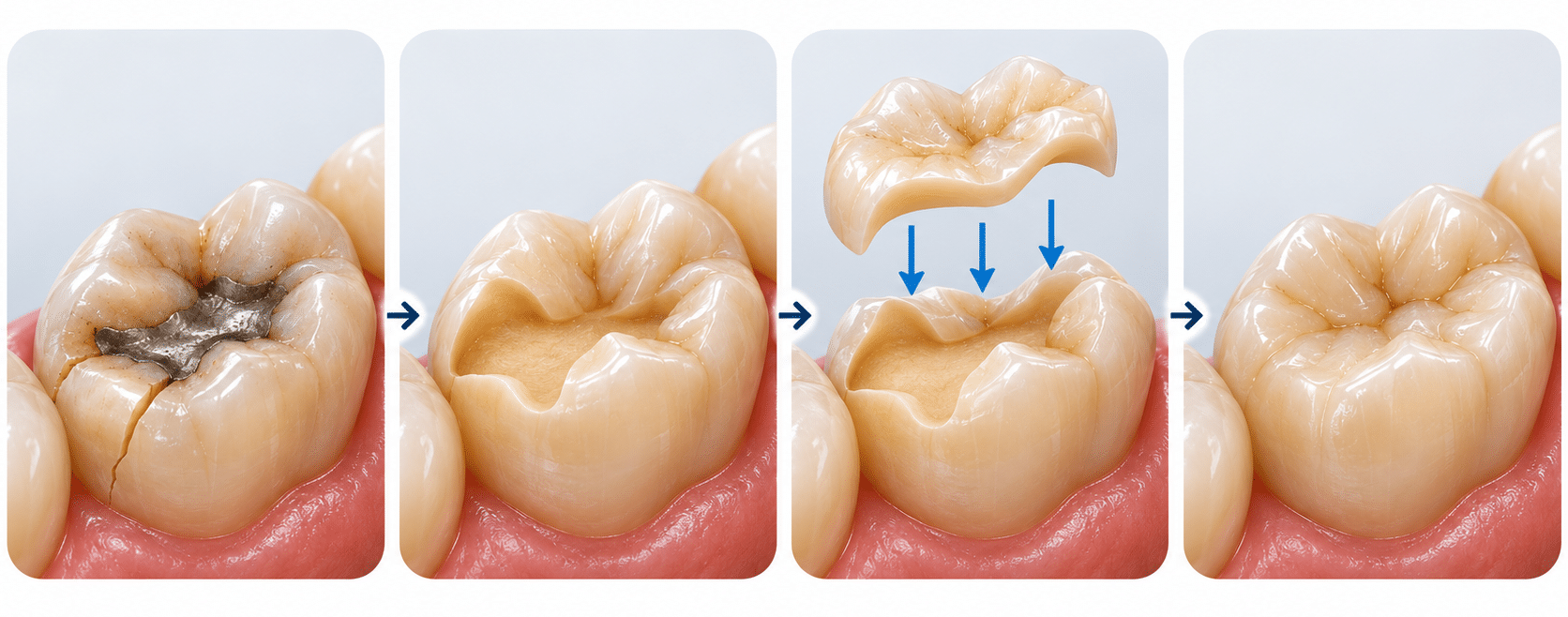
I often describe a dental onlay as a custom-made puzzle piece.
Imagine that one corner of a molar has broken, or a large old filling has left part of the chewing surface weakened.
The damaged material needs to be removed, but the rest of the tooth may still be perfectly healthy.
Rather than preparing the entire tooth for a crown, I can sometimes restore just the damaged area using a carefully designed onlay.
That onlay fits against the remaining tooth structure and restores the missing chewing surface and cusps.
How is an onlay different from a filling?
With a conventional filling, I place and shape restorative material directly in your mouth.
An indirect onlay is different. It is custom designed and fabricated from a material such as ceramic, then bonded to the prepared tooth.
That allows me to restore a damaged portion of the tooth with a precisely made piece rather than building everything directly inside the mouth.
How is an onlay different from a crown?
A traditional crown covers the entire prepared portion of the tooth above the gumline.
An onlay restores only the areas that need it, including one or more of the tooth's chewing cusps.
The difference is important because preparing a tooth for a full crown generally requires removing healthy tooth structure around its circumference.
If the tooth does not need that much coverage, I want to consider whether we can preserve more of it.
What about an inlay?
An inlay fits within the chewing surface of a tooth without covering its cusp tips.
An onlay extends over one or more cusps that need to be rebuilt or protected.
I decide between these restorations based on the location of the damage and the strength of the remaining tooth.
What determines the cost of a dental onlay?
When patients compare dental onlay prices, I encourage them to look beyond the material alone.
Several clinical and technical details influence the work involved.
How much of the tooth is damaged
I evaluate which parts of the tooth are healthy and which cusps or surfaces need restoration. A larger damaged area can require a more complex design.
The restorative material
Ceramic, indirect composite, and gold have different characteristics and fabrication requirements. The material should suit the tooth and the way it functions.
The tooth's location
Back teeth experience substantial chewing forces. I consider where the tooth sits, how it contacts opposing teeth, and the amount of support available.
Custom fabrication
An onlay must be accurately designed and made to fit your prepared tooth. Digital scanning, laboratory work, and fabrication are part of the process.
What is hiding beneath an old filling
Sometimes I cannot fully evaluate the remaining tooth until an old restoration is removed. Additional decay or fractures can change the treatment plan.
Your bite and chewing habits
If you grind or clench your teeth, I need to consider the additional forces acting on the restoration and whether protective measures are appropriate.
I want the finished restoration to look natural, but appearance is only part of the equation.
It also needs to fit accurately, allow you to chew comfortably, and protect the remaining tooth.
Are porcelain, composite, and gold onlays different in price?
Yes. Different restorative materials have different costs, fabrication requirements, and clinical properties.
I don't believe the most expensive material is automatically the right one for every tooth.
What matters is choosing a restoration that suits the amount of damage, your bite, and the desired appearance.
Ceramic onlays
Ceramic is an appealing option because it can be made to look very similar to natural tooth enamel.
Materials such as lithium disilicate offer a combination of strength and aesthetic properties that makes them useful for certain bonded restorations.
A ceramic onlay is custom designed to reproduce the appropriate chewing anatomy and fit the prepared tooth.
When the tooth is a good candidate, the result can look remarkably natural.
Indirect composite onlays
Some onlays are fabricated from resin-based composite materials rather than ceramic.
These materials have different wear, strength, and repair characteristics.
I consider those differences alongside the size of the restoration and the forces the tooth experiences.
Gold onlays
Gold alloys have a long history in restorative dentistry.
They can provide durable restorations, although their appearance is obviously different from a tooth-colored ceramic.
Gold material prices and laboratory fabrication also affect the fee.
For me, the discussion comes back to the same question: which restoration makes the most sense for this particular tooth?
Why does an onlay cost more than a filling?
A conventional filling is generally completed in one appointment.
I remove decay or compromised material, prepare the tooth, and place the filling directly.
A custom onlay involves additional steps. The tooth must be prepared, its shape accurately recorded, and the restoration designed and fabricated before it is bonded into place.
That additional work is one reason an onlay generally costs more than a routine filling.
How much does a filling cost at our Tustin practice?
At our Tustin practice, a tooth-colored filling generally ranges from $150 to $450, depending on the size of the cavity and the surfaces involved.
A filling is often the more affordable restoration when the damage is limited and enough healthy tooth remains.
But a large filling is not always the best long-term solution.
When a filling is no longer enough
Imagine a molar with an old filling occupying most of the chewing surface.
There may be only thin walls of natural tooth remaining around that filling.
If I simply replace it with another large filling, those weakened cusps may still be vulnerable to fracture.
In that situation, I may recommend an onlay that covers the compromised cusps while preserving the healthier parts of the tooth.
I would rather explain the reason for that recommendation than simply tell you that you need a more expensive restoration.
You can learn more about conventional restorations on our dental fillings page.
Is a dental onlay cheaper than a crown?
Not necessarily.
Patients sometimes assume that an onlay must cost less because it covers less of the tooth.
But a precision-made ceramic onlay can require as much attention to design, fabrication, bonding, and bite adjustment as a crown.
As a result, the fees can be comparable.
At our Tustin practice, custom porcelain or ceramic crowns typically range from $1,000 to $2,500, with some complex cases reaching approximately $3,000.
I would not choose an onlay simply because it might cost less.
I would choose it because it is the right amount of restoration for the tooth.
Dental onlay
Partial coverage
- Restores damaged chewing surfaces and cusps
- Preserves more healthy tooth structure when appropriate
- Requires sufficient remaining tooth support
- Custom fabrication and bonding contribute to the fee
Dental crown
Full coverage
- Covers the entire prepared visible portion of the tooth
- Provides broader coverage for extensively weakened teeth
- Requires preparation around the tooth
- Custom materials and fabrication influence cost
Why I don't automatically recommend a crown
If I can protect a tooth without preparing its entire circumference, that is worth considering.
We cannot grow back the enamel and dentin removed during tooth preparation.
So when healthy structure remains, I want a good reason before removing more of it.
Of course, there are situations where a crown is necessary. A tooth with extensive structural damage may need more complete coverage than an onlay can provide.
The important thing is matching the restoration to the condition of the tooth.
I've explained that decision in more detail in our article on crown vs. onlay.
You can also read about our approach to dental crowns.
What happens during dental onlay treatment?
I begin by examining the tooth and determining whether a partial coverage restoration can provide the protection it needs.
A laboratory-made onlay commonly involves a preparation appointment followed by a separate visit for final placement.
The exact process depends on the restorative material and fabrication method being used.
Examine the tooth
I evaluate old fillings, decay, cracks, remaining healthy tooth structure, and your bite before deciding how much coverage is necessary.
Prepare the damaged area
I remove compromised material and shape the tooth for the planned restoration, preserving healthy structure wherever clinically appropriate.
Design the onlay
A scan or impression captures the prepared tooth. The custom restoration is designed to restore its natural contours, contacts, and chewing surface.
Bond and finish
I check the completed restoration for fit, bond it into place, and carefully evaluate how your teeth come together.
Why the bonding process matters
One of the things I pay close attention to in restorative dentistry is how the restoration is bonded to the natural tooth.
A ceramic onlay needs more than a good-looking shape.
The preparation, adhesive technique, moisture control, fit, and bite all influence the final result.
When appropriate, I also use a technique called immediate dentin sealing.
This involves sealing freshly exposed dentin during preparation rather than waiting until the final restoration is placed.
These details are not something you will necessarily notice when looking at your finished tooth.
But they are part of what goes into a carefully planned indirect restoration.
Does dental insurance cover an onlay?
Some dental insurance plans provide coverage for indirect restorations, including dental onlays.
The amount depends on your individual policy and whether the proposed treatment meets the plan's criteria.
I encourage patients to understand their expected out-of-pocket cost before beginning treatment.
Why insurance may not pay the amount you expect
Dental insurance does not always reimburse a procedure based on the full treatment fee.
Some plans use an alternative benefit provision, meaning the insurer may calculate payment using the allowance for a different, less expensive restoration.
Your deductible, annual maximum, waiting periods, and frequency limitations may also affect your benefits.
So even if your plan lists a particular percentage for restorative treatment, that does not necessarily mean it will pay that percentage of the entire onlay fee.
What if you don't have dental insurance?
If you do not have insurance, I still want you to understand the recommended treatment and what it will cost.
We can discuss the complete estimate, any additional procedures that might be necessary, and the payment options available.
Our practice offers membership and payment options, including financing for qualifying patients.
The purpose is to make the financial side of treatment clear, without compromising the clinical decision about what your tooth needs.
How long does a dental onlay last?
A properly designed and maintained dental onlay can provide many years of reliable function.
But I never want patients to think that the lifespan of a restoration depends on the material alone.
The condition of the underlying tooth, the quality of the bond, the forces from your bite, and your oral hygiene all matter.
Ceramic onlays have shown favorable long-term outcomes in clinical research, but no restoration lasts forever.
What can cause an onlay to fail?
An onlay can chip, fracture, lose retention, or develop problems around its margins.
The natural tooth surrounding the restoration can also develop new decay.
If you grind or clench your teeth, I consider how those habits might affect the restoration.
Regular dental examinations allow me to monitor the restoration and the remaining tooth structure over time.
My goal is not simply to make an onlay that looks good when it is first placed.
I want the tooth to remain healthy and functional for years afterward.
Is preserving more natural tooth worth the cost?
When I discuss an onlay with a patient, this is usually the most important part of the conversation.
The real advantage of an onlay is not necessarily that it costs less than a crown.
It is that I may be able to preserve healthy tooth structure that would otherwise be removed during full crown preparation.
Natural enamel and dentin are valuable. Once we remove them, they do not simply grow back.
That is why I want to be thoughtful about how much tooth structure we sacrifice when repairing damage.
If a filling is sufficient, I don't see a reason to recommend a more extensive restoration.
If a ceramic onlay can protect weakened cusps while keeping the rest of the tooth intact, that deserves consideration.
And if the tooth is too compromised for an onlay, I will explain why a crown makes more sense.
I don't want to remove healthy tooth structure simply because I can. I want to preserve what belongs there and restore what no longer works.
What should you ask before agreeing to an onlay?
I always encourage patients to understand why I am recommending a particular treatment.
Ask how much of the tooth is damaged, whether the remaining cusps need protection, and what healthy structure can be preserved.
Ask whether a filling is still an option, or why a crown might be necessary.
And ask what the treatment will involve, what it will cost, and how to maintain the restoration afterward.
I believe patients make better decisions when they understand what we are trying to accomplish.
At our Tustin practice, I look at restorative dentistry as part of your overall dental health.
My priority is to protect your natural teeth, restore comfortable function, and create results that look like they belong in your smile.
If you have a large old filling, a fractured tooth, or a restoration that needs replacement, schedule a consultation and we can evaluate your options together.
Key takeaways
The cost is part of the decision. Preserving your tooth is the bigger picture.
- 01 The reported national average for porcelain inlays and onlays combined is approximately $976, although individual treatment fees vary.
- 02 An onlay restores damaged chewing surfaces and weakened cusps without necessarily covering the entire tooth.
- 03 Material, restoration size, tooth condition, and fabrication complexity influence the fee.
- 04 An onlay is not automatically less expensive than a crown, and insurance benefits depend on your individual plan.
- 05 My goal is to preserve healthy tooth structure while providing the protection needed for lasting function.
Frequently asked questions
Dental onlays: costs, coverage, and long-term value.
What is the average cost of a porcelain dental onlay?
CareCredit reports a national average of approximately $976 for porcelain inlays and onlays combined. That is not a separate onlay-only average or a guaranteed price at our Tustin practice. I determine the actual treatment fee after evaluating the tooth and the restoration needed. See the CareCredit dental procedure cost data.
Is an onlay better than a full dental crown?
I prefer to preserve healthy tooth structure when the tooth can be adequately protected with partial coverage. But a crown may be necessary when the remaining structure is more extensively compromised. A systematic review and meta-analysis comparing onlays, partial crowns, and full crowns found no statistically significant survival difference at the one- and three-year follow-up intervals analyzed, although the available evidence has limitations.
How long do ceramic dental onlays last?
Ceramic onlays can provide many years of reliable function. I look at the condition of the tooth, your bite, and your oral hygiene because all of those factors influence longevity. A systematic review examining ceramic onlay longevity reported favorable survival outcomes while identifying nonvital teeth and parafunctional habits as factors associated with increased failure risk.
Are ceramic onlays stronger than composite onlays?
Ceramic and composite have different mechanical properties and long-term performance characteristics. I consider the size of the restoration, tooth location, and chewing forces before selecting a material. A systematic review comparing resin and ceramic indirect restorations reported differences in estimated long-term survival among resin, feldspathic porcelain, and glass-ceramic restorations.
Does dental insurance cover porcelain onlays?
Some insurance plans provide benefits for onlays, but coverage depends on your policy and clinical eligibility. Alternative benefit provisions, deductibles, annual maximums, and frequency limitations may affect reimbursement. I recommend reviewing your expected patient portion before treatment. The American Dental Association's explanation of dental plan benefits and limitations provides additional information about these restrictions.
Can an onlay be placed on a tooth that had a root canal?
Yes, in appropriately selected cases. I evaluate how much healthy tooth structure remains and whether an onlay can provide adequate protection. If the tooth needs more complete coverage, I may recommend a crown. A systematic review comparing full crowns and cuspal-coverage onlays on root-canal-treated teeth examined survival and success outcomes for both approaches.
Can a dental onlay be repaired instead of replaced?
Sometimes. If the damage is localized and the remaining restoration and tooth are sound, repair may be possible. Extensive fractures, recurrent decay, or loss of retention can require replacement. A systematic review of complications in inlays, onlays, and crowns identifies fracture, loss of retention, and ceramic chipping among the technical complications associated with these restorations.
Does choosing an onlay always save money long-term?
No. I recommend an onlay when preserving healthy tooth structure is clinically appropriate, not because it guarantees a lower lifetime cost. Long-term value depends on the condition of the tooth, restoration design, material, and maintenance. An eight-year practice-based study of ceramic inlays, onlays, and crowns found that tooth-, technique-, and material-related factors influenced restorative outcomes.


