A chipped tooth can look like a very simple problem. A corner is missing, an edge suddenly feels rough, or one front tooth no longer looks quite like the tooth beside it.
Sometimes the repair really is simple.
A small chip may need little more than polishing or a conservative tooth-colored repair. But as more of the tooth is lost, the conversation changes. I start thinking about how much healthy enamel and dentin remain, whether the tooth has been weakened, how your bite contacts that area, and whether the fracture extends deeper than what we can see in the mirror.
I don't want to choose a treatment based only on the piece that's missing. I want to understand the tooth that remains.
That's what helps us decide whether the most appropriate repair is bonding, a porcelain veneer, a dental crown, or treatment for a deeper injury inside the tooth.
Can a chipped tooth be repaired?
In many cases, yes.
Teeth can be remarkably repairable, even when the missing piece looks significant. What matters is not simply the size of the chip. We also have to consider where the tooth fractured and how much healthy, predictable tooth structure remains.
A small chip limited to enamel may be primarily a cosmetic concern. A deeper fracture can expose dentin, weaken the remaining tooth, or reach the pulp where the nerves and blood vessels are located.
That means two chipped front teeth that look somewhat similar at first glance may need completely different treatment.
Before repairing the tooth, I want to evaluate the fracture itself, the remaining enamel and dentin, existing fillings or restorations, the bite, and the health of the tooth underneath.
How can a chipped tooth be repaired?
The more healthy tooth structure we can preserve, the better. So I don't automatically move from a small chip to a large restoration.
Instead, the treatment should become more protective only when the tooth gives us a reason to make it more protective.
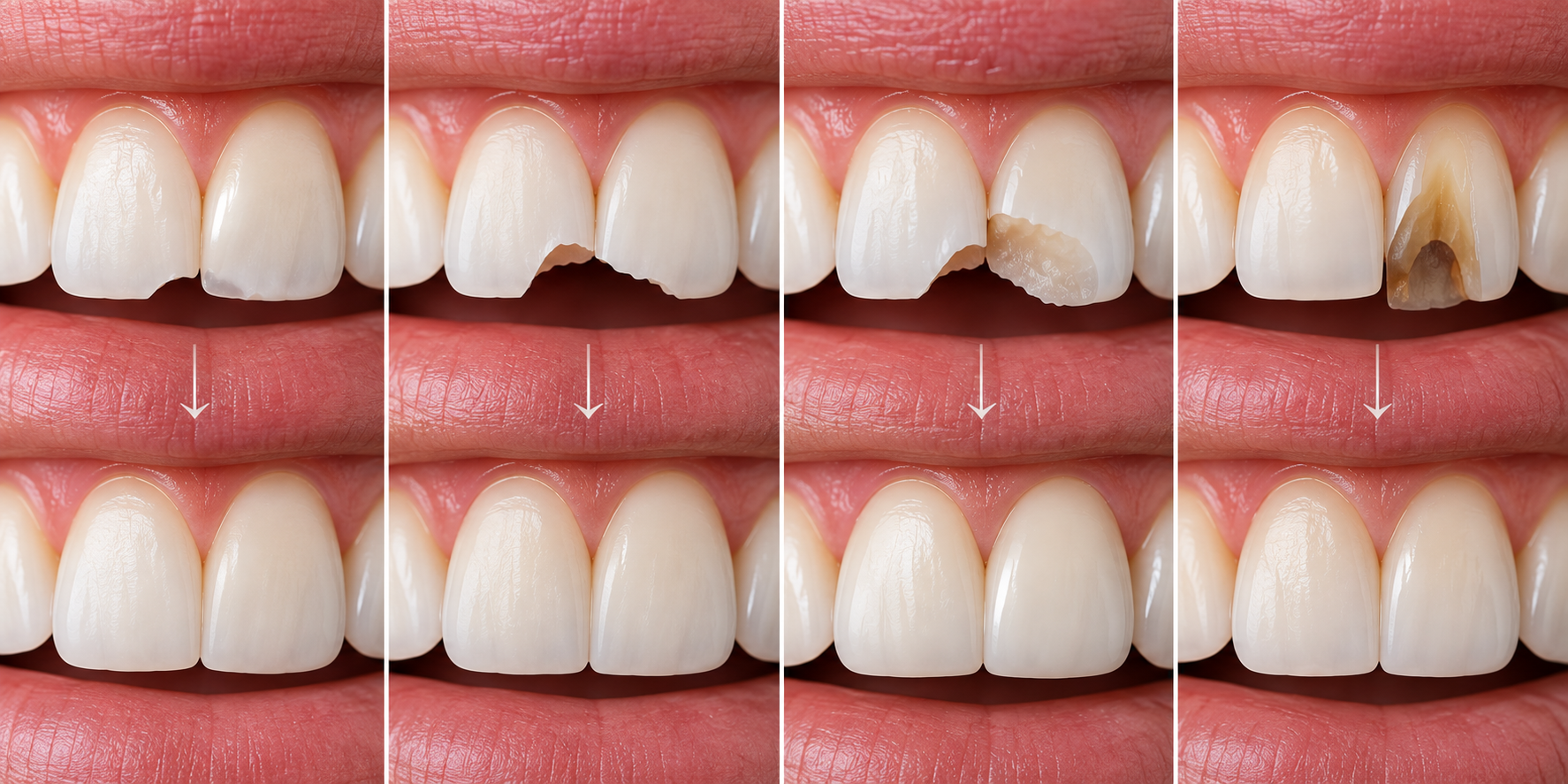
Smooth or polish
A very small enamel chip may only leave a rough or sharp edge. If the tooth is healthy and its shape allows it, conservative reshaping and polishing may be enough.
Composite bonding
Tooth-colored composite can rebuild a missing edge or corner while preserving most of the natural tooth. This can work very well for many small to moderate chips.
Porcelain veneer
A veneer may make sense when a front tooth needs a more extensive cosmetic restoration or when we want to address more than the chipped edge alone.
Dental crown
When substantial tooth structure has been lost or the remaining tooth needs greater protection, a crown may be more predictable than repairing only the missing portion.
Treat the pulp first
If the fracture reaches or significantly injures the pulp, the health of the inside of the tooth has to be addressed before planning the final restoration.
Replace the tooth
Some fractures extend too deeply for the tooth to be restored predictably. In those cases, we can discuss replacement only after determining that saving the natural tooth is not a dependable option.
The goal isn't to put the largest restoration on a chipped tooth. It's to use the most conservative treatment that can predictably protect it.
When can dental bonding repair a chipped tooth?
Bonding is often one of the first treatments people think about for a chipped front tooth, and for the right tooth, it can be an excellent solution.
Tooth-colored composite is added directly to the damaged area and shaped to recreate the missing portion of the tooth. Because we are adding material rather than covering the entire tooth, bonding can often be quite conservative.
It is especially useful when the chip is small to moderate, the remaining tooth is healthy, and the repaired area is not being subjected to forces that make repeated fracture likely.
But the fact that a tooth can be bonded does not always mean bonding is the best long-term choice.
If a large corner is missing, the tooth is structurally compromised, or the same bonded area has broken several times, I want to understand why before simply adding composite again.
You can learn more about how we use dental bonding to conservatively reshape and repair teeth.
A repair that keeps breaking isn't just asking to be repaired again. It's asking us to figure out why.
When does a chipped tooth need more than bonding?
As the amount of missing tooth structure increases, we have to think differently about what the restoration needs to accomplish.
Bonding replaces a missing area. A veneer or crown can provide a different level of coverage and control when the remaining tooth needs more than a localized repair.
If the concern is primarily on the visible surface of a front tooth, our porcelain veneers page explains how veneers are planned and what they can change.
When a tooth needs more complete structural coverage, dental crowns may offer a different restorative approach.
What if the chip is deep or the tooth hurts?
A tooth is more than the hard white surface we see.
Enamel forms the outer layer. Beneath it is dentin, and at the center of the tooth is the pulp, where the nerves and blood vessels are located.
If a fracture extends deeply enough, the pulp can become exposed or injured. You may notice significant sensitivity, pain when biting, spontaneous aching, or a pink or red area within the broken portion of the tooth.
At that point, restoring the missing piece is only part of the problem. We first have to determine whether the pulp can remain healthy or whether the tooth needs additional treatment before it is restored.
This is one reason I don't like diagnosing a chipped tooth from a photo alone. What looks like a cosmetic fracture on the surface can sometimes involve much more of the tooth.
Can a tooth be too badly chipped to repair?
Yes, but the amount of visible tooth that is missing does not tell us the whole story.
A tooth that looks dramatically broken may still have enough healthy structure in the right places to be restored. A much smaller-looking fracture can be more serious if a crack travels deeply beneath the gumline or into the root.
That's why the question isn't simply whether I can put something over the broken area.
I want to know whether the remaining tooth can predictably support a restoration and continue functioning comfortably.
If it can, saving the natural tooth is worth considering. If it cannot, then we can talk about replacement options with a clear understanding of why the tooth is no longer predictable to restore.
Why did the tooth chip in the first place?
Sometimes the answer is obvious. You bit directly onto something hard, fell, or took an unexpected hit to the mouth.
Other times, the chip is the first visible sign of a problem that has been developing for a while.
- Grinding or clenching. Repeated forces can place stress on the edges and cusps of teeth, especially when a tooth is already weakened.
- Large existing fillings. A tooth with less natural structure remaining may fracture around an older restoration.
- Decay. A cavity can weaken the tooth from within before part of the outer structure finally breaks.
- Enamel wear. Years of wear can gradually change the shape and thickness of the biting edges.
- Your bite. The way your teeth come together can place concentrated force on one area of a tooth or restoration.
- Trauma. Falls, sports injuries, accidents, and other direct impacts can fracture otherwise healthy teeth.
If the same tooth keeps chipping, the repeated fracture may be more important than the missing piece.
What should you do right after chipping a tooth?
First, don't panic. A chipped tooth can look alarming, particularly when it involves a front tooth, but many dental fractures are treatable.
Find the broken piece if you can
If you can locate the fragment, keep it and bring it with you to your appointment.
Rinse gently
Gently rinse your mouth with water to clear away debris without repeatedly disturbing the injured area.
Avoid biting on the tooth
Until we know how much structure is involved, avoid putting unnecessary pressure directly on the damaged tooth.
Pay attention to your symptoms
Significant pain, bleeding, tooth movement, facial trauma, or a fracture that appears to expose the inside of the tooth deserves prompt evaluation.
If you aren't sure how quickly you need to be seen, our emergency dentistry information explains which dental problems deserve more immediate attention.
Repair the tooth you have, not just the chip you see
When I evaluate a chipped tooth, I don't want to begin with, "Which restoration should we put here?"
I want to begin with the tooth.
How much healthy enamel remains? Is there decay underneath the fractured area? Is there an older filling weakening the tooth? Is the pulp healthy? Does your bite put unusual pressure on this spot? Has the tooth broken before?
Once we understand those things, the treatment decision usually becomes much clearer.
Sometimes the right answer is a very small repair. Sometimes the tooth is telling us it needs more protection.
The goal is not to turn every chipped tooth into a larger dental project. It is to understand what happened and choose a repair that makes sense for the tooth today and for the years ahead.
Key takeaways
Repair the chip. Understand the tooth.
- 01 Most chipped teeth can be repaired, but the appropriate treatment depends on the depth and location of the fracture.
- 02 Very small enamel chips may only need smoothing or polishing.
- 03 Composite bonding can conservatively restore many small to moderate chips.
- 04 Larger fractures may need a veneer or crown when the remaining tooth requires more support or coverage.
- 05 Pain or a deep fracture can indicate injury to the pulp inside the tooth and should be evaluated promptly.
- 06 If a tooth repeatedly chips, understanding why it keeps breaking is an important part of planning the next repair.
Frequently asked questions
A few questions patients ask most.
Can dental bonding fix a chipped front tooth?
Yes. Direct composite is widely used to restore damaged anterior teeth and can be a conservative option when enough healthy tooth structure remains. A systematic review of long-term anterior composite restorations included Class III and Class IV restorations placed for reasons including tooth fracture. Across the studies, anterior composite restorations generally demonstrated good long-term clinical performance, although outcomes varied among the different types of restorations.
How long can bonding on a chipped front tooth last?
There isn't one lifespan that applies to every bonded tooth. Long-term clinical research does show that direct anterior composite can perform well for many years. A multicenter study of direct anterior composite buildups reported overall survival rates of 98.8% at two years, 91.7% at ten years, and 77.6% at fifteen years. Functional survival was higher because some restorations could be repaired rather than completely replaced. An individual repair's longevity still depends on the tooth, restoration, bite, and clinical situation.
Why can bonding on a chipped tooth break again?
Fracture is one of the important long-term complications of anterior composite restorations. A systematic review evaluating 1,821 anterior composite restorations found fracture of the tooth or restoration to be the most common reason for failure. That's why a repair that repeatedly breaks deserves more than another layer of composite. We want to evaluate the tooth, the size and location of the restoration, and the forces being placed on it.
Can a chipped-tooth repair be repaired again instead of replaced?
Sometimes. One advantage of direct composite is that a localized problem may be repairable without automatically replacing the entire restoration. In a long-term multicenter study of anterior composite buildups , 576 restorations remained successful, 81 survived with repair, and only eight were classified as failures. The authors specifically noted the flexibility, reparability, and minimally invasive nature of direct composite treatment.
Are composite repairs on front teeth considered predictable?
They can be, but results vary with the restoration and clinical situation. A systematic review and critical appraisal of direct anterior composite restorations evaluated 24 clinical studies and found substantial variation in performance among studies. The review also identified factors such as treatment environment and the number of operators as potential influences on clinical performance. That is why the decision to use composite should be based on the individual tooth rather than assuming every chip should receive the same repair.
Is a veneer or crown always better than bonding for a larger chip?
No. A larger restoration is not automatically a better restoration. Direct anterior composite has the advantage of allowing conservative treatment and, in some situations, future repair. A long-term multicenter study of direct anterior composite buildups found strong functional survival and highlighted minimal invasiveness and reparability as advantages of this approach. Whether bonding, a veneer, or a crown is more appropriate still depends on how much healthy tooth remains and what the final restoration needs to accomplish.
Does every chipped front tooth need to be crowned?
No. Clinical research includes many anterior teeth treated successfully with direct composite rather than full-coverage restorations. A systematic review of long-term anterior composite restorations included restorations placed for fractures as well as other indications and found generally favorable long-term clinical performance. The amount of remaining healthy tooth structure and the demands placed on the tooth should guide how extensive the restoration needs to be.
What is the most common problem with long-term anterior bonding?
Fracture is an important long-term complication. A systematic review of anterior composite restoration longevity found fracture of the tooth or restoration to be the most common reason for failure. When composite was placed for primarily cosmetic reasons, changes involving color, anatomical form, and surface staining were also reported more frequently. That distinction matters because a restoration can need attention for structural reasons, cosmetic reasons, or both.
Can bonding still make sense if it may eventually need repair?
Yes. Longevity is only one part of a restorative decision. Preserving natural tooth structure and having the ability to repair a restoration can also be valuable. In a multicenter long-term study of direct anterior composite buildups , functional survival remained 98.9% at ten years and 98.5% at fifteen years when restorations that remained functional after repair were included. This is one reason a conservative, repairable restoration can sometimes remain a sensible choice even though no dental restoration should be considered permanent.