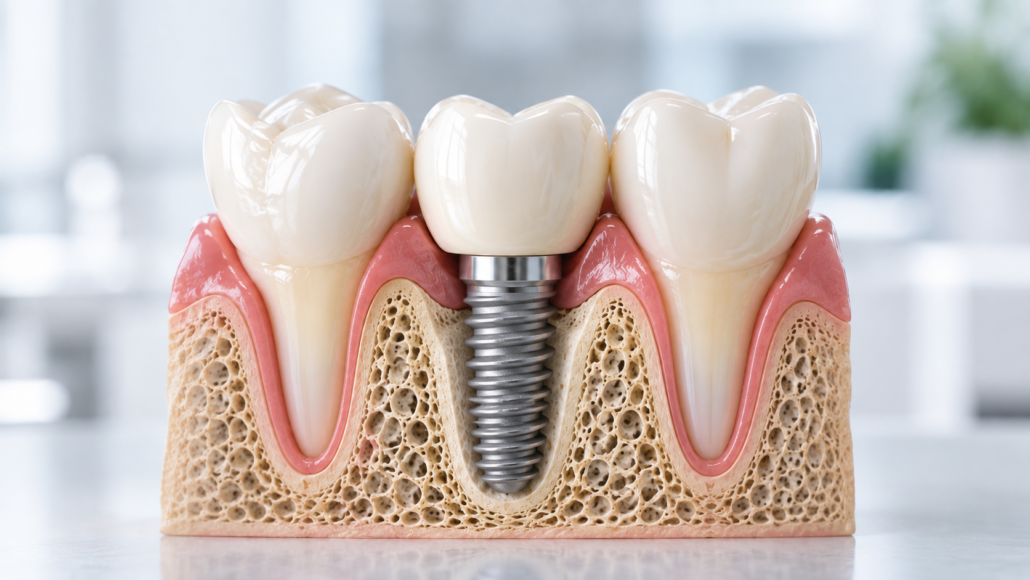
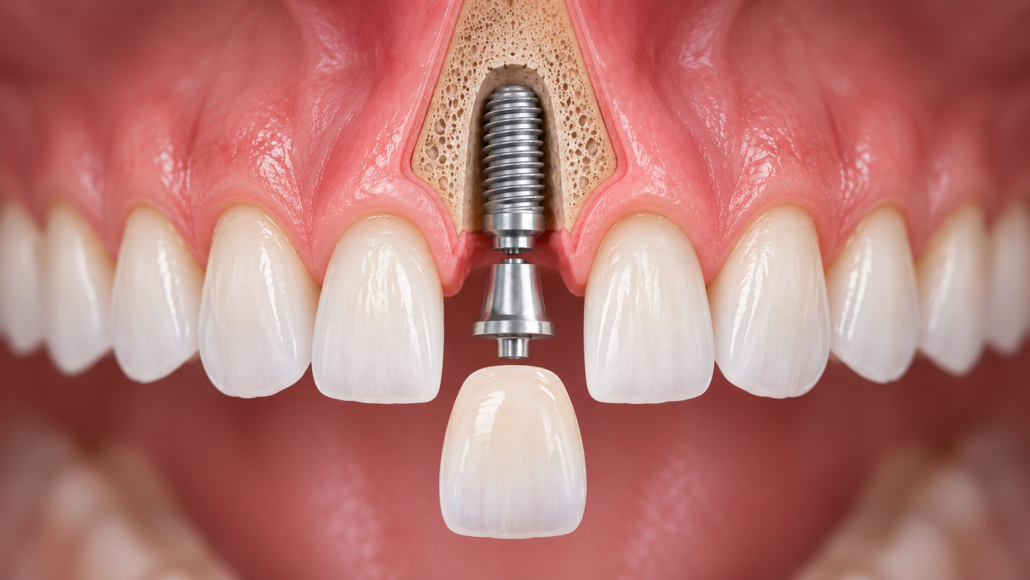
Saving a natural tooth and knowing when to stop repairing one are both parts of conservative dentistry. The difficult part is knowing where that line is.
If you have a badly damaged tooth, you may hear two very different possibilities. One is to repair the tooth and keep it. The other is to remove it and replace it with a dental implant. Understandably, many patients want to know which choice is better.
I do not think that decision should begin with a preference for a procedure. It begins with the tooth. How much healthy structure remains? What is happening underneath an existing filling or crown? Is the root healthy? Is there a crack? Does the tooth have adequate support? And if we restore it again, what do we realistically expect from that restoration?
Sometimes those answers point toward preserving the tooth. Sometimes they tell us that another repair may only postpone a larger problem. The goal is to understand the difference before making an irreversible decision.
Why do we try to save a natural tooth?
Your natural teeth are remarkably well designed. A healthy tooth has its own root, periodontal ligament, surrounding bone, and sensory feedback. If a damaged tooth can be restored to a healthy, functional condition with a reasonable long-term outlook, keeping it deserves serious consideration.
That does not mean keeping a tooth at any cost. There is a difference between preserving natural tooth structure and repeatedly repairing a tooth whose foundation has become increasingly compromised.
Conservative dentistry is not about doing the least treatment today. It is about preserving as much healthy structure as we reasonably can for the future.
A tooth that needs a new filling or dental crown may still have an excellent foundation. Another tooth may look similar above the gumline but have extensive decay, a deep fracture, or very little sound tooth remaining underneath an old restoration.
Those are very different situations, even if both patients arrive asking whether their tooth can be saved.
What makes a damaged tooth worth saving?
There is no single test that determines whether a tooth should stay or go. We look at several pieces of the tooth together because a restoration is only as dependable as the structure supporting it.
Healthy tooth structure
We need enough sound natural tooth remaining to support a predictable restoration. The location of that healthy structure matters too.
The condition of the root
A tooth can lose a significant amount of its visible structure and still have a usable root. A serious root fracture can create a very different prognosis.
Bone and gum support
The tissues surrounding the tooth need to provide enough support for it to remain healthy and functional.
The bite
A restored tooth still has to withstand chewing forces. Clenching, grinding, tooth position, and the way your teeth meet can influence the long-term plan.
We also look at the history of the tooth. A small new problem in an otherwise healthy tooth is different from a tooth that has already had a large filling, a crown, recurrent decay, root canal treatment, and another restoration.
The question is really about the foundation.
A crown can rebuild the visible portion of a damaged tooth, but it cannot make an unhealthy foundation healthy. In the same way, a dental implant is not automatically an upgrade from a natural tooth. It is a replacement when the natural tooth can no longer provide the foundation we need.
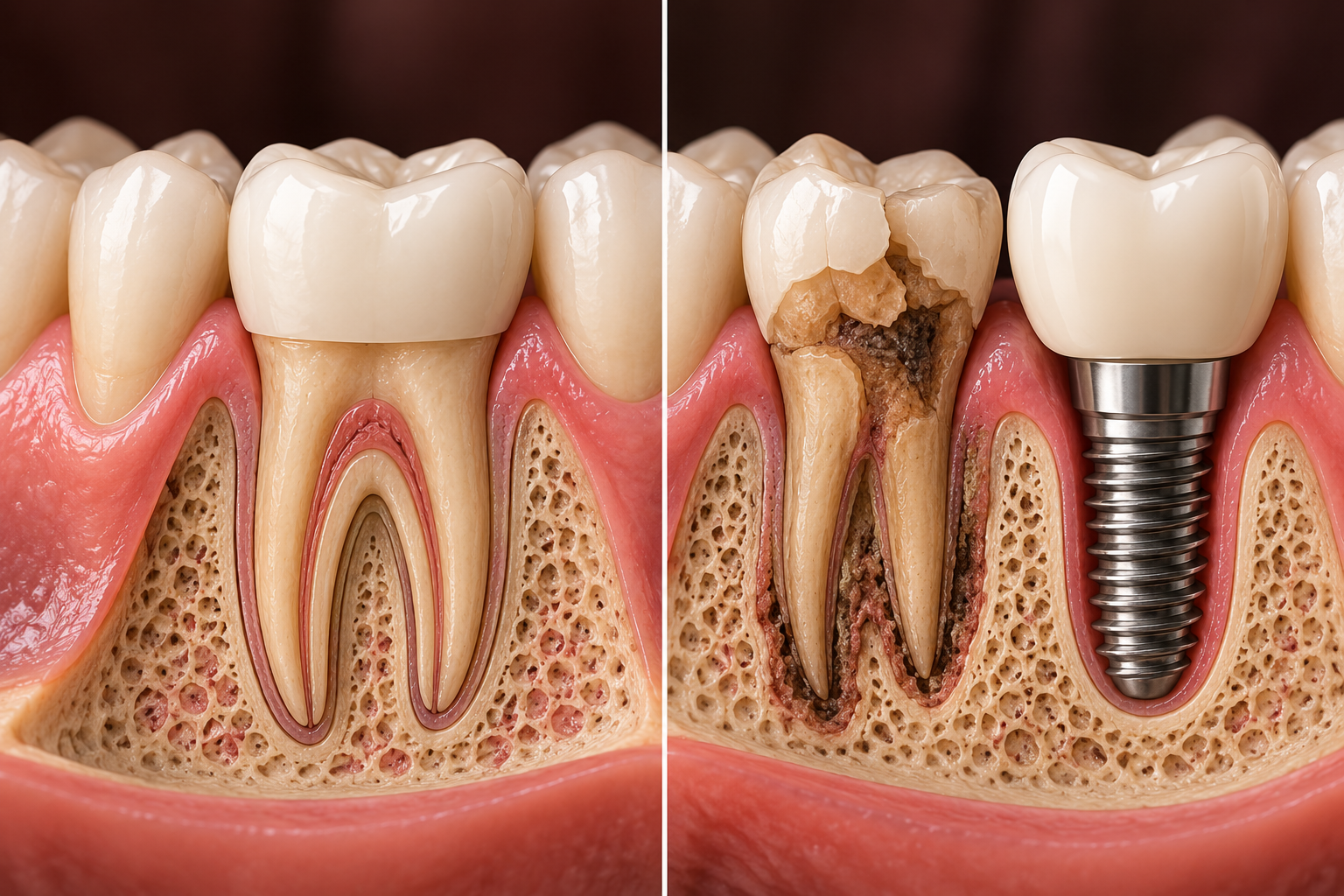
This is why an X-ray alone does not always answer the question. We need to understand what remains once decay or an old restoration is evaluated, whether cracks are present, what is happening around the root, and what the tooth would need in order to function again.
When might a dental implant make more sense?
There are situations where the desire to save a natural tooth has to be balanced against what that tooth can realistically support. If too little healthy structure remains, a fracture extends into an unfavorable area, or the supporting tissues have been significantly compromised, another restoration may have a poor prognosis.
At that point, removing the tooth and considering a dental implant may provide a more predictable path forward.
- Extensive decay Decay that extends deeply beneath an existing restoration or into areas that cannot be predictably restored can limit our ability to rebuild the tooth.
- Severe structural loss Sometimes so much natural tooth has been lost that there is no longer a dependable foundation for another restoration.
- An unfavorable fracture The location and direction of a crack matter. Some cracked teeth can be restored, while certain fractures can make the tooth non-restorable.
- Compromised support Significant loss of the bone or periodontal support surrounding a tooth can affect whether keeping it makes sense.
- Repeated failure A tooth that has been repaired multiple times deserves a broader conversation about whether another repair is likely to provide meaningful longevity.
None of these automatically means you need an implant. They are reasons to look more carefully at prognosis before investing in another restoration.
When does repairing a tooth again stop making sense?
This is often the harder question. Dentistry gives us many ways to repair teeth, and technically being able to place another restoration does not necessarily tell us whether we should.
Imagine a tooth with an older crown. Decay develops underneath the edge of that crown. If we remove the crown and decay and find substantial healthy tooth structure underneath, replacing the crown may be very reasonable.
But suppose removing the decay leaves very little healthy tooth above the gumline. Perhaps the tooth has already had a root canal, has a large buildup underneath the crown, or has developed a crack. We now have to ask a different question: how much are we asking this remaining tooth to support?
Restore
When the foundation is sound
Keeping the natural tooth can make sense when there is enough healthy structure, adequate support, and a restoration can provide a predictable functional result.
Replace
When the foundation is failing
Extraction and replacement may become the better conversation when damage leaves too little dependable tooth or the long-term prognosis has become poor.
Cost belongs in this discussion too. Saving a tooth is not necessarily less expensive if it requires several procedures and still carries a poor prognosis. An implant is also a significant treatment involving surgery, healing, and a final restoration. The meaningful comparison is not simply today's fee. It is what each option is expected to accomplish and how predictable that result appears to be.
What if saving the tooth requires a root canal?
Needing root canal treatment does not automatically mean a tooth should be removed. Root canal treatment addresses the tissue inside the tooth. We still have to evaluate the structure around it and determine whether the tooth can be predictably restored afterward.
That distinction is important. A tooth can have a treatable problem inside the root and plenty of healthy structure remaining. Another tooth may have a root canal that is technically successful but very little usable tooth structure left above it.
So I would not reduce the decision to “root canal versus implant.” The more useful question is what the entire tooth looks like after the necessary treatment and whether we believe it can continue functioning predictably.
How do we decide whether to save or replace the tooth?
I like to make this decision in an order that keeps us focused on the patient rather than the procedure. First we diagnose what is actually wrong. Then we determine what would be required to save the tooth. Only then can we fairly compare that option with removing and replacing it.
Understand the problem
Is the issue decay, a fracture, an infection, failing dental work, loss of support, or a combination of problems?
Determine what remains
We evaluate the healthy tooth structure, root, surrounding bone and gum, and how the tooth functions in your bite.
Understand what saving it requires
That might be a new restoration, a crown, root canal treatment, or a combination of procedures depending on the tooth.
Compare the prognosis
Now we can compare preserving the tooth with extraction and replacement, including the treatment involved, expected longevity, healing, cost, and uncertainty of each option.
Sometimes the answer becomes quite clear. Other times both choices are reasonable, and the decision comes down to the advantages, limitations, and priorities that matter most to you.
The best treatment is not automatically the newest treatment.
Dental implants have changed what we can do for patients with missing or non-restorable teeth. They are an extraordinary treatment when they are needed. But having an excellent replacement for a tooth does not make removing a restorable natural tooth the better choice.
The opposite is also true. Preserving natural teeth is important, but saving a tooth should not become an objective at any cost. If the foundation is poor and the prognosis is uncertain, repeatedly repairing it may simply delay the decision while requiring additional treatment along the way.
My goal is to understand the tooth we have in front of us, preserve what is healthy when we reasonably can, and be candid when replacement has become the more predictable option.
Key takeaways
Save what is healthy. Replace what cannot be predictably restored.
- 01 A natural tooth is generally worth preserving when it has a healthy enough foundation to be predictably restored.
- 02 The amount of healthy tooth remaining, root condition, bone and gum support, and bite all affect the prognosis.
- 03 A tooth that can technically be repaired is not necessarily a tooth that should undergo another repair.
- 04 Dental implants are valuable replacements when a natural tooth is missing or can no longer be predictably restored.
- 05 The decision should compare the long-term prognosis of both options, not simply which treatment costs less today.
Frequently asked questions
A few questions I hear most.
Is it always better to save your natural tooth?
Not always. Preserving a natural tooth is valuable when it can be predictably restored, but prognosis matters. Evidence comparing tooth retention with implant replacement supports evaluating the condition of the individual tooth rather than assuming one treatment is universally superior. Long-term outcomes for endodontically treated teeth and implants show that both approaches can provide high survival rates in appropriately selected cases.
Is an implant stronger than a natural tooth?
An implant is not simply a stronger version of a tooth. Natural teeth and implants attach to the surrounding tissues differently and each has its own biological considerations. Research comparing teeth and dental implants describes important differences in their surrounding tissues and response to disease.
Can a badly damaged tooth still be saved?
Sometimes. The decision depends on where the damage extends, how much healthy tooth remains, the condition of the root and supporting tissues, and whether a predictable restoration can be made. Restorability and remaining tooth structure are central considerations when determining the prognosis of a compromised tooth.
Is a root canal better than getting an implant?
Neither treatment is automatically better. Root canal treatment can preserve a restorable natural tooth, while an implant replaces a tooth that has been removed. The prognosis of the individual tooth should guide the comparison. Comparative evidence for restored endodontically treated teeth and implants shows high survival for both treatment approaches.
Should I keep repairing the same tooth?
It depends on what remains underneath the existing dental work. Replacing a restoration can be reasonable when the underlying tooth is sound. As healthy tooth structure becomes more limited, the prognosis can change. The amount and distribution of remaining tooth structure influence how a compromised tooth can be restored.
What happens if my tooth cannot be saved?
If a tooth is considered non-restorable, we can discuss how and when to remove it and the appropriate replacement options. Dental implants are one established way to replace a missing tooth, with long-term treatment planning influenced by the condition of the site and surrounding tissues.