A front tooth implant has two jobs. It needs to function like a tooth, but it also needs to look as though it belongs there. That changes how the entire case is planned.
When I am replacing a tooth farther back in the mouth, function is usually the biggest concern. We want a strong, stable tooth that lets you chew comfortably. A front tooth has to accomplish that too, but now everything is visible.
You see the shape of the tooth. You see where it meets the gum. You may see the gumline when you smile. Even small differences in position can affect whether the final restoration looks like a natural part of your smile.
Why is a front tooth dental implant different?
With a front tooth, I am not simply asking where an implant can be placed. I am thinking about where the finished tooth needs to be, how it should emerge from the gum, and what we need underneath it to support that result.
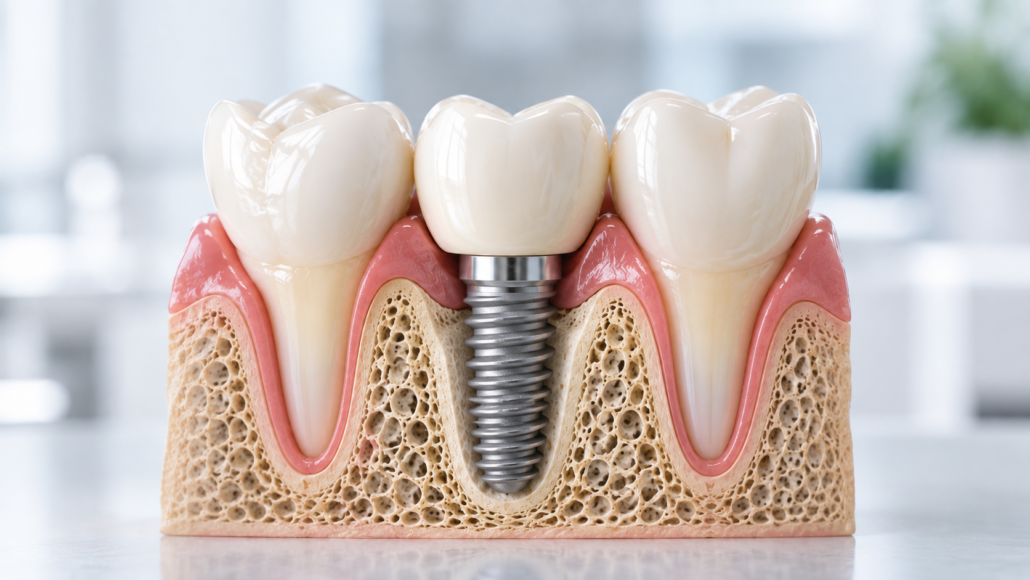
That makes the relationship between the implant, bone, gum tissue, and final crown especially important. All four have to work together.
Tooth position
Where does the finished tooth need to sit relative to the neighboring teeth and the rest of your smile?
Bone support
Is there enough bone in the right position to support the implant where the final restoration needs it?
Gum contour
Is there enough healthy gum tissue to create a natural transition around the replacement tooth?
Final crown
What shape, length, position, and contour will allow the restoration to blend naturally with your smile?
These are not separate decisions. Changing one can affect the others, which is why careful planning matters before the implant is placed.
We start with the final tooth in mind.
One of the most important parts of planning a front tooth implant happens before the implant is placed. We first need to understand where we ultimately want the tooth to be.
The position, angle, shape, and relationship to the neighboring teeth all matter. Once we know what we are trying to create above the gumline, we can plan what needs to happen underneath it.
We do not start with the implant and hope the tooth looks right afterward. We start with where the final tooth belongs and work backward.
This is particularly important with a front tooth because an implant is not a natural tooth root. The implant has to be positioned so the abutment and crown can emerge in the right place while still being supported by the surrounding bone and gum.
If you are considering replacing a missing tooth, our dental implants page explains the broader treatment process and how implants are used to restore missing teeth.
The bone and gum matter as much as the implant.
People often picture dental implant treatment as placing a titanium post into the jaw and attaching a tooth to it. Mechanically, that is part of what happens. With a front tooth, however, the tissues surrounding that implant become especially important.
The bone along the front of the mouth can be thin. Gum tissue also varies from person to person. Some people naturally have thicker tissue, while others have thin gum tissue where small changes can be much easier to see.
Bone
The foundation
The implant needs adequate bone in the position required for the final tooth. If the bone is too thin or deficient, grafting may be considered before or during implant treatment.
Gum tissue
The visible frame
The gum creates the transition between the crown and your smile. Tissue thickness and contour can influence how naturally the replacement tooth appears to emerge from the gum.
This does not mean every front tooth implant needs a bone graft or gum graft. We evaluate what is actually present and what the planned restoration requires. If additional support is needed, grafting becomes part of that individual plan.
The goal is not simply to add tissue. The goal is to create the support needed for a stable implant and a natural-looking transition between the restoration and your gumline.
What are the parts of a front tooth implant?
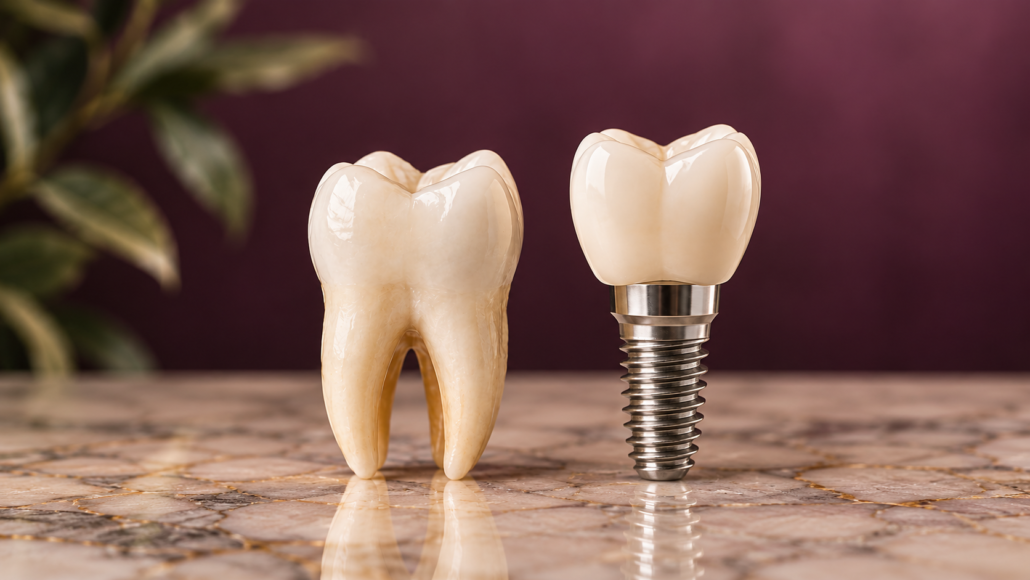
What we casually call a dental implant is actually a restoration made from several components. Understanding those pieces makes it easier to see why implant position affects the finished tooth.
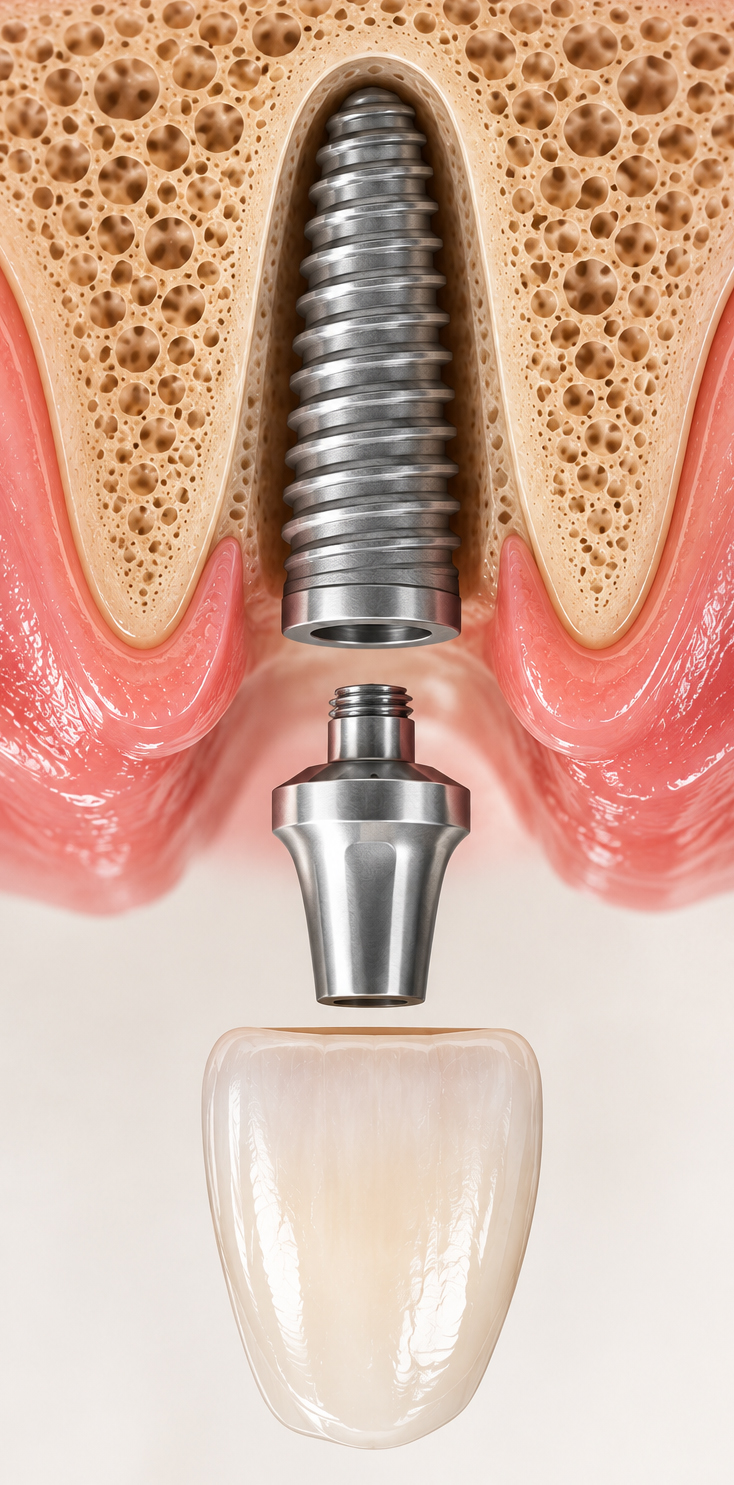
Three parts. One tooth.
Each component has a different job.
- The implant The titanium portion is placed in the jawbone and becomes the foundation for the replacement tooth.
- The abutment This connects the implant underneath the gum to the restoration above it.
- The crown This is the tooth you see. Its shape and contour are designed to work with the neighboring teeth and surrounding gum.
With a front tooth, the surrounding bone and gum help determine how naturally these three parts come together. Where the implant sits in the bone influences where the abutment and crown can emerge.
The crown attached to an implant also differs from a traditional dental crown placed over a natural tooth. With an implant restoration, the crown is supported by the implant and abutment rather than by your natural tooth underneath.
Will I have a missing front tooth while the implant heals?
This is usually one of the first practical questions people ask. Most people understandably do not want to spend several months with a visible space in the front of their smile.
There are several ways we can maintain the appearance of a tooth while the implant heals. The right option depends on the implant, the surrounding tissues, and how much pressure we need to keep away from the surgical area.
Removable temporary tooth
Sometimes called a flipper, this small removable appliance fills the visible space while the implant underneath heals.
Clear tray with a tooth
A clear removable tray can be made with a tooth positioned in the missing space so the gap is not visible.
Temporary implant crown
In selected cases, a temporary crown may be attached to the implant. This is not appropriate for every implant and generally needs to be protected from biting pressure while healing occurs.
Having a tooth in the space does not necessarily mean the implant underneath is ready for normal chewing.
The temporary restoration solves the cosmetic problem while the biology underneath continues to heal. Protecting the implant during that period can be more important than getting to the final crown quickly.
How long does a front tooth dental implant take?
There is an important difference between recovering from implant surgery and the implant being fully integrated with the bone. The first few days are generally when you notice the surgical recovery most. Tenderness can continue beyond that, but the implant itself is still healing long after you feel better.
The first few days
This is the early surgical recovery period. Tenderness and swelling are expected to gradually improve.
The following weeks
The area may feel much more normal, but the implant still needs to be protected as healing continues underneath the gum.
The next several months
The bone continues to integrate around the implant. This part of healing commonly takes several months and varies according to the individual case.
The final restoration
Once the implant and surrounding tissues are ready, attention turns to the final crown and the way the gum frames the tooth. More involved front-tooth cases can require additional time for the tissue to mature.
This is why I would rather plan a front implant carefully than rush toward the final crown. The goal is not to get a tooth into the space as quickly as possible. It is to create a tooth that is stable, functional, and looks at home in your smile.
A front tooth changes the priority.
Dental implants throughout the mouth share the same basic principles, but a front tooth brings the final appearance into every stage of the treatment plan. We have to consider the implant position, available bone, gum thickness, temporary tooth, final crown, and the way all of those elements relate to the neighboring teeth.
For some patients, the process is relatively straightforward. For others, creating enough bone or developing the gum contour takes additional steps. The important part is recognizing those differences before treatment begins.
A good front tooth implant should not call attention to itself. Ideally, when everything is finished, what you notice is simply a complete smile.
Key takeaways
The final tooth guides the entire plan.
- 01 Front tooth implants require additional attention to tooth position, gum contour, and the appearance of the final restoration.
- 02 Planning starts with where the finished tooth should be rather than simply where an implant can fit.
- 03 Bone or gum grafting may be considered when the existing tissues do not provide the support the planned restoration needs.
- 04 A flipper, clear tray, or selected temporary implant crown can usually maintain the appearance of the smile while the implant heals.
- 05 Feeling better after surgery happens much sooner than complete implant integration. The implant continues healing within the bone for months.
Frequently asked questions
A few questions I hear most.
Is a front tooth dental implant harder than a back tooth implant?
It can be more demanding because the final result is highly visible. Implant position and the surrounding soft tissue both influence the emergence profile and esthetic result of a front tooth restoration. These factors are important in implant treatment within the esthetic zone.
Can a front tooth implant look natural?
Yes. The crown is only part of the result. Implant position, tissue thickness, the abutment, and the way the restoration emerges through the gum all contribute to its appearance. Research on single-tooth implants in the esthetic zone highlights the importance of these surrounding tissues to the final result.
Will I have to go without a front tooth while my implant heals?
Usually there is a temporary solution for the visible space. Depending on the case, that may be a removable tooth, a clear tray with a tooth, or sometimes a temporary crown attached to the implant. Immediate provisional restorations can be used in appropriately selected anterior implant cases when the implant has sufficient initial stability.
Why does the gum around a front tooth implant matter?
The gum creates the visible transition between the implant crown and the rest of your smile. Its contour helps the replacement tooth appear to emerge naturally rather than simply sit above the tissue. Managing the soft tissue around anterior implants is an important part of developing that natural contour.
Can I get a front tooth implant and a temporary crown the same day?
Sometimes, but not every implant is a candidate. The implant needs enough initial stability, and the temporary restoration has to be carefully managed while healing occurs. Evidence on immediate anterior implant treatment supports this approach in appropriately selected cases.
Does every front tooth implant need bone or gum grafting?
No. Grafting depends on the amount and shape of the existing bone and soft tissue, the planned implant position, and the desired final result. Preserving and managing both hard and soft tissue is particularly important around single-tooth implants in the esthetic zone, but the treatment required is individual to each patient.