

Getting veneers should not mean automatically reducing every tooth by the same amount. The preparation should follow the plan, not the other way around.
When I plan veneers, I start by looking at the teeth you already have. Where are they positioned? What shape are they? Is the enamel healthy? Are there existing fillings or crowns? Is there enough room for the ceramic? Are we changing the color significantly? And where do the finished teeth need to be for the smile to look natural in your face?
Those decisions determine how much preparation is appropriate. Sometimes very little needs to change. Sometimes more preparation is necessary to create room for the ceramic or accomplish a meaningful change in color, shape, or position. In other situations, the more conservative choice may be to move the teeth first rather than remove healthy tooth structure to make veneers fit.
What does “shaving your teeth” for veneers actually mean?
“Shaving” is the word patients commonly use, but tooth preparation is a better description. A veneer is a thin ceramic restoration bonded to the visible surface of a tooth. Depending on the starting tooth and the result we are trying to create, a small amount of enamel may need to be shaped to make room for that ceramic.
In some cases, preparation can be extremely conservative. It may involve smoothing part of the surface or refining an edge. Other teeth may require more preparation because of their position, color, or existing dental work.
This is very different from assuming that every tooth receiving a veneer needs to be reduced to a small peg. The amount of preparation should be individualized to the tooth and the treatment plan.
How much do they shave your teeth for veneers?
There is no single measurement that applies to every patient, or even necessarily to every tooth in the same smile. Consider two people who both want ceramic veneers.
One may have relatively small, straight teeth with spaces between them. If the plan is to add width or length, there may already be room for the ceramic. Another person may have teeth that project forward but wants them to appear farther back. Simply adding ceramic to the front could make those teeth look even more prominent, so trying to accomplish the entire correction restoratively could require substantially more tooth preparation.
What conservative veneer preparation can look like
The amount of enamel removed is determined by the starting tooth and the space needed for the ceramic.
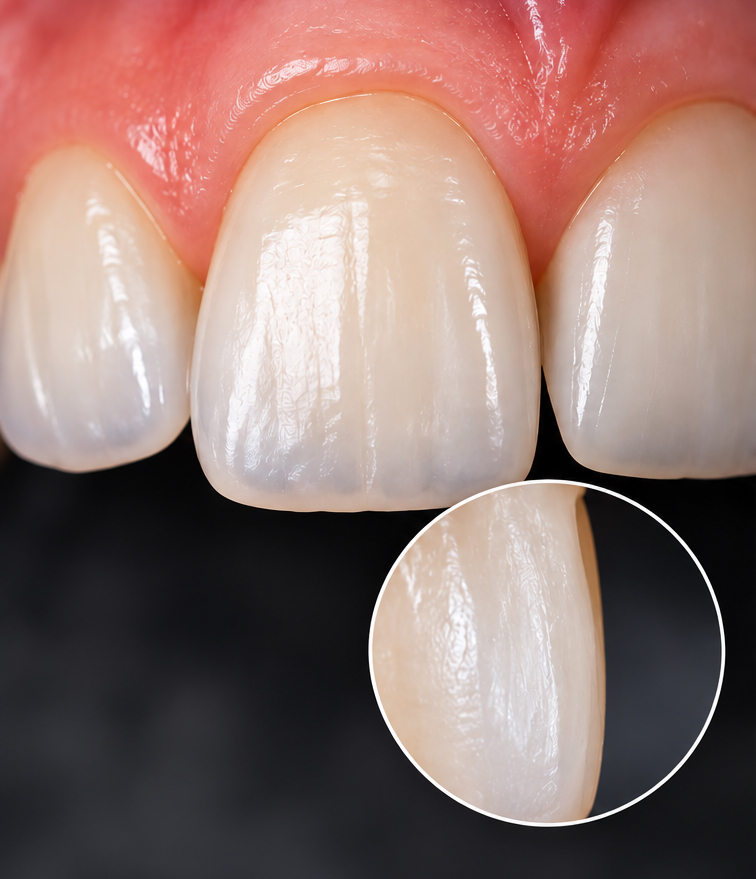
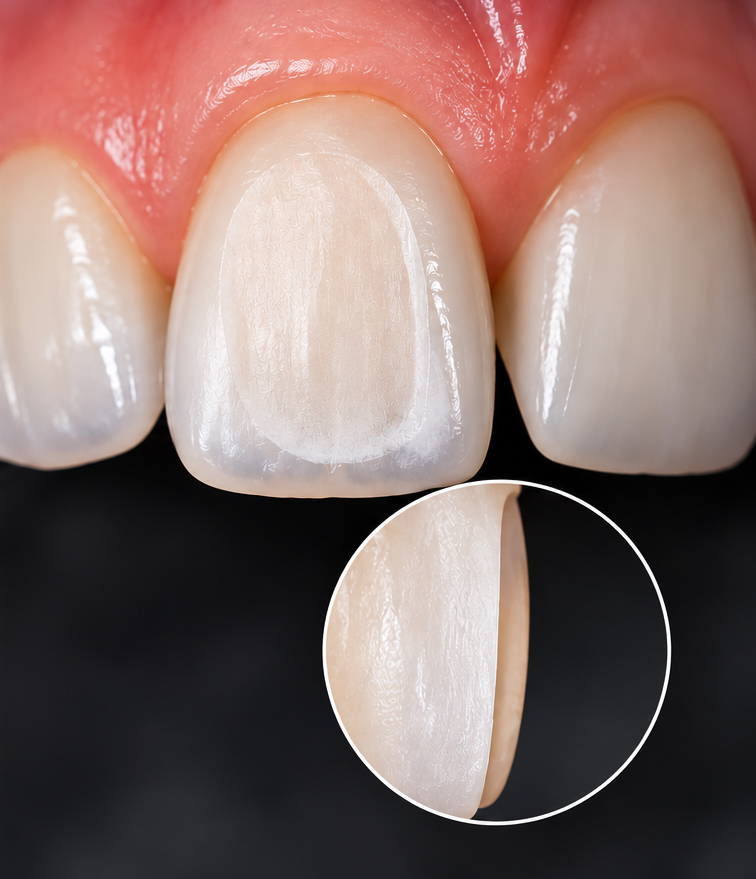
Color can affect the plan as well. A significantly dark tooth may require enough restorative space for the ceramic to manage the underlying color without creating a bulky finished tooth.
So I do not begin treatment by deciding that every tooth needs a predetermined amount removed. I want the amount of preparation to follow the anatomy and the final design.
We plan the finished smile before deciding how much to prepare.
One of the most important parts of conservative cosmetic dentistry happens before a tooth is prepared. I use photographs and digital records to evaluate the teeth, the smile, and the face, and to plan where the finished teeth should be.
Once we know where a tooth begins and where we want it to end, we can determine what actually has to change. A tooth that is already close to its ideal position may require very little preparation. Another tooth in the same smile may need more.
We are not starting with how much tooth structure we can remove. We are starting with where the finished tooth should be and working backward.
This is also why comprehensive planning matters. A veneer is not simply a thin piece of ceramic placed on a tooth. Its position and contour need to make sense with the neighboring teeth, the bite, and the rest of the smile.
Sometimes I would rather straighten the teeth first.
Tooth position can dramatically change how conservative veneer treatment can be. If a tooth sticks out significantly, disguising that position with a veneer alone may mean removing more healthy tooth structure simply because of where the tooth started.
Moving the tooth into a better position first can change that equation. This is one reason I sometimes incorporate Invisalign into a cosmetic treatment plan. If we can improve the position of a tooth and the bite before placing the ceramic restoration, we may be able to prepare the tooth much more conservatively.
In some cases, moving one protruding tooth back may be the difference between a conservative veneer and needing a more extensive restoration. Occasionally, after the teeth have been aligned, a patient may discover that less cosmetic dentistry is needed than originally expected.
Orthodontic treatment takes additional time. But when a few months of tooth movement can preserve healthy natural tooth structure for years to come, that can be a very worthwhile tradeoff.
When I would say no to veneers.
There are times when technically being able to do something does not mean I believe it should be done.
I once evaluated someone with extremely crowded front teeth who wanted veneers rather than orthodontic treatment. The important part of his case was that those teeth were healthy. They did not have extensive restorations or disease that already required us to rebuild them.
To make those significantly crowded teeth appear straight using veneers alone would have required removing far more healthy tooth structure than I was comfortable sacrificing. Orthodontic treatment could move the teeth into a much healthier position without cutting them down simply to make them look straight.
I just couldn't bring myself to cut down those great, healthy teeth.
So I said no to the veneer treatment he was asking for.
That is something a before-and-after photograph cannot always communicate. The question is not only whether we can make a smile look different. We also have to consider what we are asking healthy teeth to give up in order to get there.
Does that mean no-prep veneers are always better?
No. “No-prep” sounds automatically more conservative, but avoiding preparation at all costs is not the goal. The goal is to prepare only what is appropriate for that tooth and restoration.
Ceramic has thickness. Tooth position matters. Color matters. Shape matters. The bite matters. If ceramic is simply added to a tooth that does not have adequate space for it, the finished restoration can become too prominent or bulky.
Some people have starting anatomy that makes minimal-preparation or potentially no-preparation veneers possible. Other patients need some preparation to create the contour, color, and restorative space we are trying to achieve.
I would not choose the treatment simply because it carries the label “no-prep.” I would choose the most conservative approach that still allows us to create a healthy, functional, and natural result.
What happens to your natural tooth underneath a veneer?
Your natural tooth remains underneath the ceramic veneer. The restoration is bonded to the prepared surface rather than replacing the entire tooth. That is one of the important differences between a veneer and a crown.
The health of that underlying tooth matters enormously. Before cosmetic treatment, I want active dental disease and unhealthy gum conditions addressed. I also want to understand the bite and why any existing wear or damage occurred so that we are not simply covering a problem without addressing what caused it.
A beautiful ceramic restoration should never distract us from the health of the tooth supporting it.
Not every tooth in a smile needs the same restoration.
A smile does not necessarily consist of eight or ten identical teeth receiving eight or ten identical veneers. I treatment plan each tooth according to what is already there and what that tooth needs to do.
One tooth may primarily need a cosmetic change and be an excellent candidate for a ceramic veneer. Another may already contain a large restoration. Another may have significant wear that also needs to be restored. A tooth that already has a crown may need a new crown rather than a veneer.
From the front, those restorations can still work together as one natural-looking smile. The goal is not to make every tooth receive the same treatment. It is to treat each tooth appropriately while designing the smile as a whole.
The question I would ask before getting veneers.
If you are considering veneers and are worried about having your teeth shaved down, ask your dentist to show you the plan.
Instead of asking only, “Will you shave my teeth?” I would ask: “Why does each tooth need this amount of preparation?”
If a tooth requires more preparation because it is dark, rotated, prominent, previously restored, or needs room for the ceramic, you should understand that. If moving a tooth first could meaningfully reduce how much healthy structure needs to be removed, you should understand that option too.
A cosmetic consultation should give you enough information to make that decision before treatment begins.
Key takeaways
Veneer preparation should be planned tooth by tooth.
- 01 Veneers do not require every tooth to be shaved down the same way. Preparation depends on the existing tooth and the result being planned.
- 02 Some preparations can be very conservative. Selected teeth may require very little reduction, and some cases may be candidates for no-preparation techniques.
- 03 Tooth position matters. A protruding or significantly rotated tooth may require more reduction if veneers alone are used to disguise its position.
- 04 Moving teeth first can sometimes preserve more natural tooth structure. Orthodontic treatment can create a more favorable starting position for conservative restorative treatment.
- 05 No-prep is not automatically better. The right approach is the one that preserves healthy structure while still providing appropriate space, contour, function, and esthetics.
- 06 Ask to understand the plan. You should know why a tooth needs preparation and what reasonable alternatives are available before treatment begins.
Frequently asked questions
A few questions I hear most.
Do veneers ruin your natural teeth?
Veneer treatment does not inherently “ruin” a tooth, but any enamel intentionally removed during preparation is an irreversible change. Preserving enamel is important because ceramic veneers bonded primarily to enamel have shown better clinical outcomes than veneers with extensive dentin exposure. That is one reason conservative preparation matters.
How much do they shave your teeth for veneers?
There is no single preparation depth for every veneer. It depends on the tooth's starting position, shape, color, and the planned final contour. A preparation technique driven by the planned final veneer contour can reduce unnecessary tooth removal compared with preparing without that restorative reference.
Can you get veneers without shaving your teeth?
Some patients can. No-prep or minimal-prep ceramic veneers are possible in appropriately selected cases. Published clinical evidence supports no-preparation veneers as a conservative option for selected anterior teeth, but they are not appropriate for every tooth position, color, or desired change.
Do they shave your teeth into pegs for veneers?
That is not synonymous with conservative ceramic veneer preparation. Veneers are designed to cover primarily the visible surface of a tooth, and minimum-thickness ceramic veneers can preserve substantial natural tooth structure in appropriately selected cases. More extensive circumferential reduction is associated with other restorative designs, such as full crowns.
Can veneers fix crooked teeth?
Veneers can alter the visible shape of some mildly misaligned teeth, but they do not actually move teeth. Orthodontic and restorative treatment can be complementary, and with significant crowding or protrusion, moving the teeth first may permit a more conservative restorative plan.
Is shaving teeth for veneers painful?
Local anesthesia can be used when preparation requires it, so the procedure itself should be comfortable. Sensitivity afterward varies with the tooth and the amount of preparation. Long-term clinical data on enamel-preserving veneer techniques report favorable outcomes for postoperative sensitivity.
Does enamel grow back after veneer preparation?
No. Mature dental enamel is cell-free and does not naturally regenerate after it has been lost. This is why the decision to prepare enamel should be deliberate and why preserving healthy enamel whenever clinically appropriate is important.
Are no-prep veneers better than traditional veneers?
Not automatically. They can be an excellent conservative option when the starting tooth position, color, and desired final contour make adding ceramic appropriate. A systematic review found favorable survival and complication outcomes for no-prep veneers in selected patients, but case selection remains essential.




