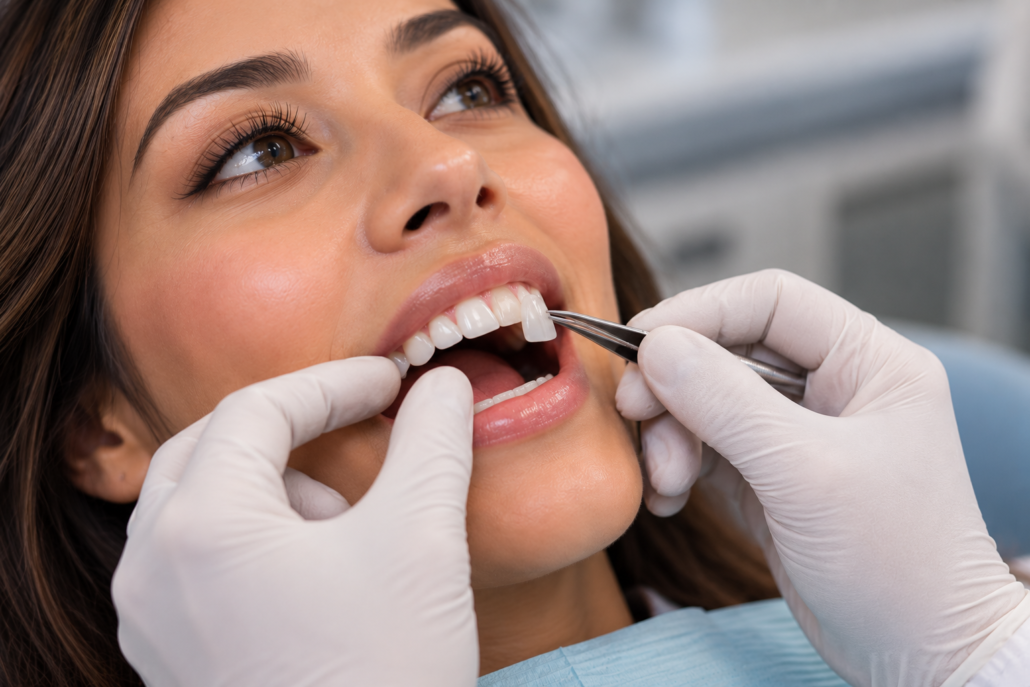
If your veneers are ten, fifteen, or even twenty years old, it is reasonable to wonder whether you're approaching some kind of replacement date.
You aren't.
Porcelain veneers are restorations, and restorations can eventually need repair or replacement. But I don't think the calendar should make that decision for us.
Old is not a diagnosis. I want to know what is healthy, what is working, and what has actually changed.
A veneer may deserve attention because the porcelain has fractured, the restoration has come loose, the margin has changed, the gums have receded, the underlying tooth has developed a problem, or the appearance simply no longer feels right to you.
Those are very different reasons for replacing a veneer, and they don't necessarily lead to the same treatment.
Can porcelain veneers be replaced?
Yes.
An existing porcelain veneer can be removed and a new restoration can be made for the tooth.
What matters is what we find when we evaluate the existing veneer, the natural tooth underneath it, the surrounding gums, your bite, and the other dentistry around it.
That's why I would separate the question "Can this veneer be replaced?" from "Does this veneer need to be replaced?"
Well-made porcelain veneers can remain functional and attractive for many years, so I don't treat age alone as a reason to replace them. What matters is the condition of the restoration, the health of the tooth underneath, and whether anything has actually changed.
If you're considering veneers for the first time, our porcelain veneers page explains how we plan treatment, what veneers can change, and what to expect from the process.
How do you know when an old veneer actually needs attention?
I would start by figuring out what has changed.

The porcelain is damaged
A significant chip or fracture may mean the veneer needs to be repaired or remade, depending on the extent and location of the damage.
The veneer has come loose
Debonding deserves an evaluation of both the restoration and the tooth. I want to understand why it happened before simply putting the veneer back.
The margin has changed
A dark edge, visible margin, rough area, or change near the gumline may be cosmetic, biological, or related to the restoration itself.
The tooth underneath needs treatment
Porcelain cannot develop a cavity, but the natural tooth can. Decay or another problem involving the supporting tooth may change whether the existing veneer can remain.
The gums have changed
Gum recession can expose a margin or natural tooth structure that wasn't visible when the veneer was originally made.
You no longer like the appearance
Older veneers may still function well but no longer match what you want aesthetically. Shape, proportion, opacity, texture, color, and how the veneers relate to your face can all be reconsidered.
We don't replace dentistry simply because it's old. We replace it when there is a reason worth treating.
Does every problem with an old veneer mean replacement?
No.
One of the most useful parts of the examination is deciding whether we're looking at something that needs to be monitored, something that can reasonably be repaired, or something that truly calls for a new restoration.
The important part is diagnosing the problem before deciding on the size of the solution. Regular dental exams also give us the opportunity to monitor older restorations before a small change becomes a larger problem.
What happens when a porcelain veneer is replaced?
Replacement isn't simply a matter of taking one shell off and putting another one in its place.
The old restoration has to be removed, the tooth has to be reassessed, and the next restoration has to be designed around the tooth that exists today.

Existing veneer
We evaluate the restoration, its margins, the surrounding gums, and the supporting tooth before deciding what should change.

Veneer removed
The old veneer is carefully removed so the remaining tooth structure can be evaluated before the next restoration is planned.

Replacement veneer
If the tooth remains appropriate for a veneer, the new restoration is designed for the tooth, gumline, and smile as they exist today.
Evaluate before removing anything
We look at the veneer, margins, gums, bite, neighboring restorations, and the condition of the tooth as completely as we can before deciding what should change.
Remove the existing veneer
The goal is controlled removal of the ceramic while preserving as much healthy underlying tooth structure as possible.
Reassess the natural tooth
Once the restoration is off, we can evaluate the remaining enamel and dentin, existing restorative material, margins, and any decay or structural issue that needs to be addressed.
Plan for the tooth you have now
If another veneer remains appropriate, the replacement is designed around the current tooth, bite, gumline, and surrounding smile rather than simply copying the old one.
What happens to the tooth underneath when a veneer is replaced?
This is the part of replacement dentistry I care about most.
Once the old veneer has been removed, I want to know how much healthy enamel remains, whether dentin is exposed, whether there is existing composite or other restorative material, and whether the tooth is healthy enough for another veneer.
Preserving healthy natural tooth structure matters. The condition of the tooth underneath helps determine whether another veneer remains the right restoration or whether the treatment plan needs to change.
Replacement isn't about making the old veneer disappear. It's about protecting the tooth that has to support the next one.
That does not mean every replacement requires substantially more tooth reduction. It means the existing tooth structure should guide what we do next.
If you're wondering what a prepared tooth actually looks like or what remains beneath a veneer, I explain that more fully in what happens to teeth under veneers .
Can an old veneer be removed without damaging the tooth?
The goal is to remove the existing restoration while preserving as much healthy natural tooth structure as possible.
How straightforward that is depends partly on how the original veneer was prepared and bonded. Once it is removed, we can see the tooth more completely and determine what kind of restoration it can support next.
That's one reason I don't like thinking of veneer replacement as a simple swap. The condition of the tooth after removal matters more than whether we can technically make another piece of porcelain.
Can you replace just one veneer?
Sometimes, yes.
A problem with one veneer does not automatically mean every veneer beside it needs to be replaced.
The challenge is often not whether we can make a new veneer. It's whether we can make that new veneer belong naturally beside porcelain that may have been in the mouth for many years.
We have to consider color, translucency, surface texture, tooth length, shape, and how the existing veneers reflect light.
If one restoration can be replaced predictably and the others are healthy, there may be no reason to turn a one-tooth problem into a much larger treatment.
One veneer with a problem does not automatically mean every veneer beside it needs to be replaced.
What if your veneers are healthy but you don't like how they look?
That's a different conversation from replacing a failed veneer.
Some patients come in with older veneers that are still intact but feel too opaque, too uniform, too square, too bright, or simply unlike them.
Those concerns are legitimate, but replacement is still an elective decision.
Before removing healthy restorations, I want to understand exactly what you dislike and whether replacing the porcelain is actually the best way to change it.
- Color. Are the veneers themselves the concern, or have the natural teeth around them changed?
- Shape. Are the teeth too long, short, square, rounded, or uniform for your face and smile?
- Opacity. Do the veneers look flat or artificial because they don't reproduce the optical qualities you expect from natural teeth?
- Proportion. Is the problem one tooth, several teeth, or the relationship between the teeth, lips, gums, and smile?
- Existing tooth structure. Is the cosmetic improvement worth another restorative procedure on teeth that are currently healthy?
If several healthy veneers are being reconsidered because you want to change the overall shape, color, proportion, or character of your smile, the conversation becomes larger than veneer replacement alone. That's where I would approach the case as smile makeover planning and look at the smile as a whole.
What if there is decay under an old veneer?
The porcelain itself cannot develop a cavity, but the natural tooth underneath and around it still can.
If decay is found around or underneath an existing veneer, the first priority is treating the tooth. From there, we look at how much healthy tooth structure remains and what restoration makes sense afterward.
Sometimes another veneer remains appropriate. If the tooth has lost more structure, a different restorative approach may make more sense.
This is also why the decision to use veneers in the first place involves more than appearance. Our porcelain veneers page explains how we evaluate the teeth and plan treatment before the restorations are made.
How often do porcelain veneers need to be replaced?
There isn't a replacement schedule I would give every patient.
Some veneers remain healthy and attractive for many years. Others may need attention sooner because of fracture, changes to the supporting tooth, the bite, the gumline, or another clinical issue.
That's why I would rather examine the veneer in front of me than use its age as a countdown clock.
If your veneers are comfortable, intact, healthy, and still look good, getting older doesn't automatically make them a problem.
Key takeaways
Replace the problem. Not simply the date on the calendar.
- 01 Porcelain veneers can be replaced, but they do not have a universal expiration date.
- 02 Fracture, debonding, changes at the margins, decay, gum changes, or cosmetic concerns can all lead to a replacement conversation.
- 03 The natural tooth underneath should be reassessed before a replacement veneer is planned.
- 04 Preserving healthy natural tooth structure is an important part of planning what comes next.
- 05 A problem with one veneer does not automatically mean all of the surrounding veneers need to be replaced.
- 06 Healthy older veneers can often be monitored rather than replaced solely because of their age.
Frequently asked questions
A few questions patients ask most.
Can porcelain veneers be replaced?
Yes. An existing veneer can be removed and a new restoration planned after the underlying tooth is evaluated. Veneers are long-lasting but not permanent. A recent systematic review and meta-analysis found high long-term survival across several commonly used ceramic veneer materials.
Do veneers have to be replaced every 10 years?
No. Ten years is not an expiration date. A systematic review of 6,500 porcelain laminate veneers estimated cumulative survival at 95.5% after ten years. Individual veneers should be evaluated by their condition rather than replaced automatically because of age.
Can you replace just one porcelain veneer?
Often, yes. A single damaged or failing veneer does not automatically require replacement of the surrounding restorations. The challenge is matching the new ceramic to the color, translucency, texture, and shape of the existing veneers.
Can old veneers be removed without damaging your teeth?
The goal is to preserve as much healthy tooth structure as possible during removal. Research into laser-assisted ceramic veneer debonding has found that erbium lasers can reduce bond strength and may facilitate removal. The appropriate technique depends on the individual restoration and tooth.
Does replacing veneers require removing more tooth?
Not necessarily. It depends on the original preparation, remaining enamel and dentin, existing restorative material, decay, and the design of the replacement. Research comparing different veneer bonding substrates found particularly strong survival and success when veneers were bonded primarily to enamel.
Can a tooth get a cavity underneath a veneer?
Yes. Porcelain cannot decay, but the supporting natural tooth can. In a systematic review of long-term porcelain veneer outcomes , secondary caries was a documented complication, although it was less common than fracture or debonding.
What is the most common reason porcelain veneers fail?
Fracture is one of the most consistently reported complications. A systematic review of 25 clinical studies found fracture to be the most common complication, followed by debonding.
How many times can porcelain veneers be replaced?
There isn't a research-supported maximum number. What matters is the condition of the tooth at each replacement, including remaining enamel, dentin exposure, previous restorations, margins, bite, and overall tooth health. Research on veneer survival with different bonding substrates supports evaluating the remaining tooth structure rather than relying on a fixed number of replacements.
Can I replace veneers just because I don't like how they look?
Yes. Appearance can be a reason to consider replacement, but removing healthy restorations is still a restorative decision. We first want to identify exactly what you would like to change and evaluate the supporting teeth before deciding whether replacement makes sense.