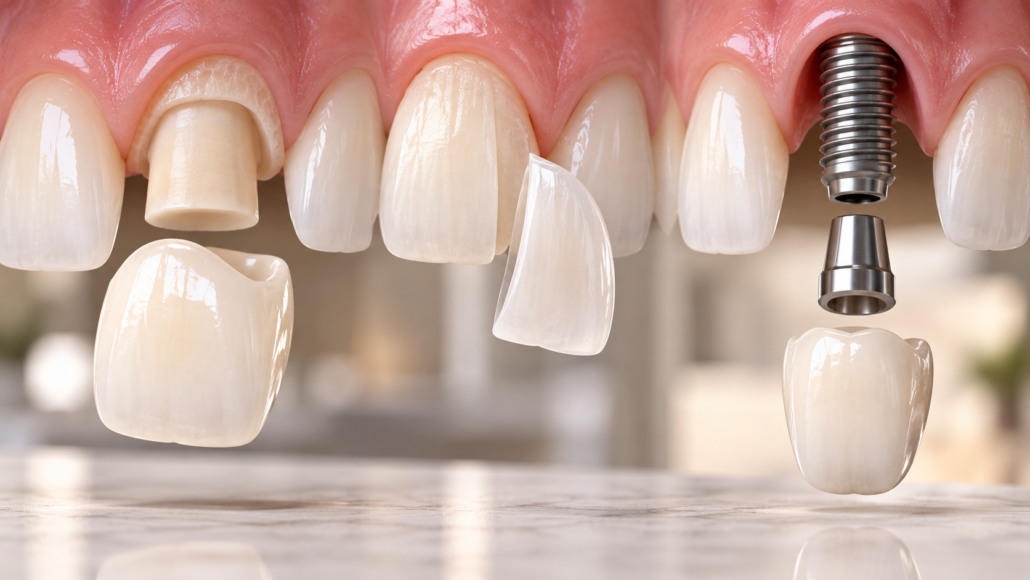
When someone comes in wanting veneers, the first thing I want to understand is what they actually dislike about their smile. Sometimes the answer is the color or shape of the teeth. Sometimes the teeth are crowded, rotated, tipped, or simply sitting in positions that make the smile look uneven.
Those are not necessarily the same problem, and they do not necessarily need the same treatment.
A veneer can change the visible surface of a tooth. Invisalign moves the tooth itself. If tooth position is contributing to what you want to change, it is worth asking whether moving the teeth first could give us a better starting point before we decide what, if anything, should be done with veneers.
I do not want to use a veneer to solve a positioning problem if moving the tooth first would give us a better foundation.
Should Invisalign or veneers come first?
If you genuinely need both treatments, Invisalign will often be considered first because orthodontics changes where the teeth are positioned. Once the teeth have moved, we can reevaluate their proportions, spacing, symmetry, and relationship to the rest of your smile.
That does not mean everyone considering veneers should have Invisalign. If the teeth are already in appropriate positions and your concerns are primarily about shape, color, size, wear, or existing dental work, orthodontics may add very little.
This is why I prefer to begin with the end result rather than with a predetermined procedure. We need to know what we are trying to accomplish before deciding which treatment belongs first.
Invisalign
Changes tooth position
Clear aligners can move teeth that are crowded, rotated, spaced, or otherwise positioned in a way that affects the appearance and function of the smile.
Veneers
Change the visible tooth
Veneers can change characteristics such as shape, proportion, color, and the appearance of worn or otherwise cosmetically compromised teeth.
If you are still deciding what clear aligners can realistically accomplish, our Invisalign treatment guide explains how treatment is planned and the types of orthodontic concerns that may be treated.
Why might we straighten your teeth before veneers?
Imagine one front tooth is rotated inward and another overlaps it slightly. If we try to make those teeth look straight using only restorations, the restorative plan has to compensate for where the natural teeth are sitting.
Move those teeth into better positions first and the restorative problem may look very different. A tooth we thought needed a veneer may no longer need one. Another may still benefit from a change in shape or proportion, but we are now designing that restoration around a better-positioned tooth.
This is one of the reasons I like to separate position from appearance when evaluating a smile.
- We can see the true proportions of the teeth. Crowding and rotation can make teeth appear narrower, wider, shorter, or less symmetrical than they actually are.
- We can reassess which teeth need restorative treatment. Once alignment improves, some cosmetic concerns may become less noticeable or disappear altogether.
- We can plan veneers around the final tooth positions. If veneers are still appropriate, their shape and proportions can be designed for the smile that exists after orthodontic movement rather than before it.
- We may be able to keep the restorative plan more conservative. When appropriate, improving position first can reduce the amount of correction we are asking the restorations themselves to accomplish.
Conservative does not automatically mean fewer veneers or no tooth preparation. Every case is different. It means we are not asking restorative dentistry to compensate for something that could be addressed more appropriately with orthodontic movement.
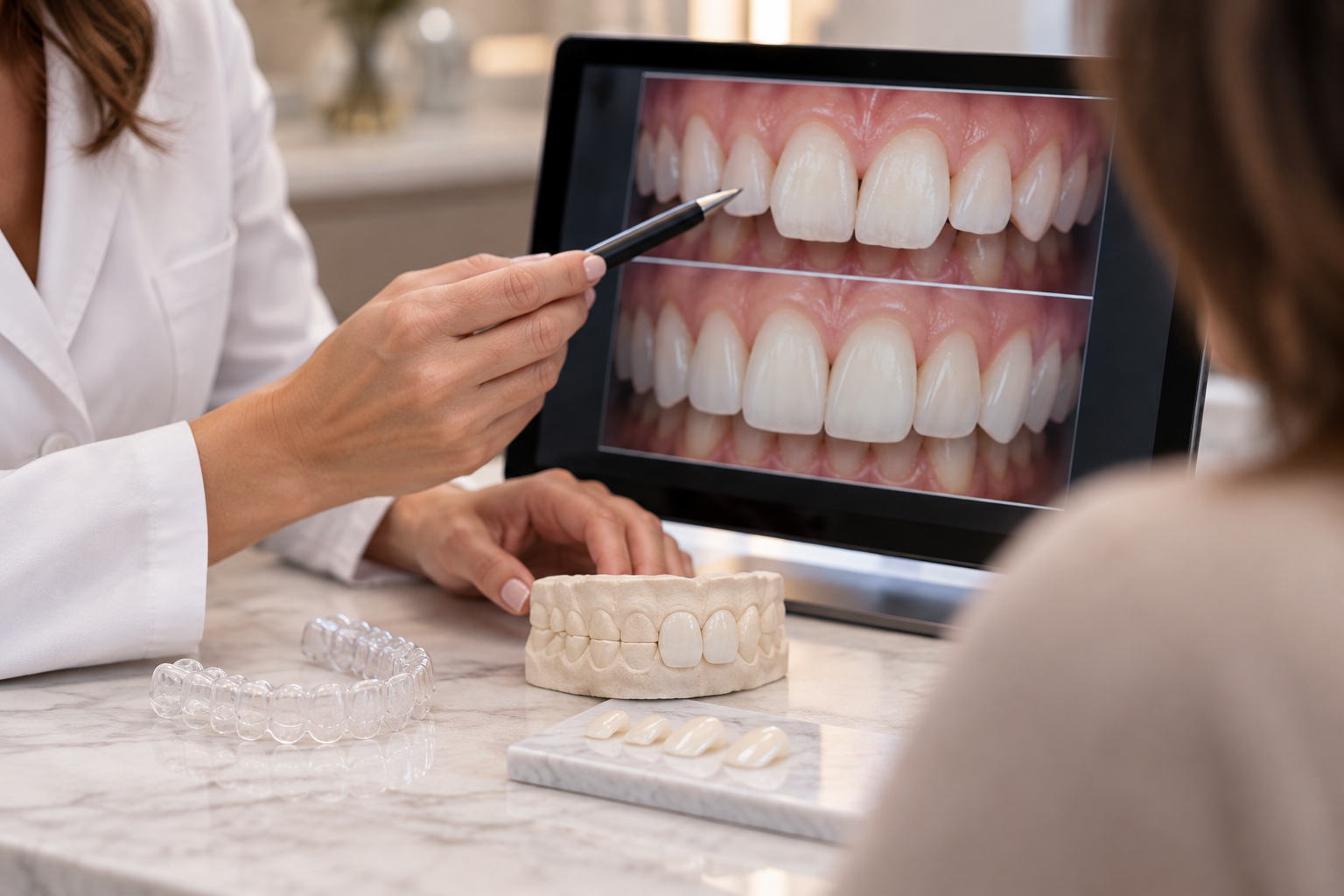
When might you not need Invisalign before veneers?
There are plenty of situations where orthodontic treatment is not necessary simply because someone is considering veneers.
Your teeth may already be positioned well and the concern may have very little to do with alignment. Perhaps a tooth is chipped. Maybe several teeth are worn, disproportionately small, permanently discolored, or have older restorations that no longer blend well with the smile.
In those situations, moving otherwise well-positioned teeth may not provide a meaningful benefit.
There are also cases where a small positional discrepancy can be managed within a carefully planned veneer treatment. The important distinction is whether we are making a modest restorative correction or asking veneers to disguise a larger orthodontic problem.
Invisalign should not be an extra step simply because we can do it. It should earn its place in the treatment plan.
If veneers are the primary treatment being considered, you can read more about how we approach porcelain veneers and the role they can play in changing tooth shape, color, and proportion.
When do Invisalign and veneers work well together?
The combination makes the most sense when the smile has two different kinds of concerns: some related to where the teeth are positioned and others related to the teeth themselves.
Crowding plus worn teeth
Orthodontics can address tooth position first. Afterward, veneers may be considered for teeth whose wear, shape, or proportions still need attention.
Spacing plus small teeth
Instead of simply making the veneers wider to close every space, orthodontics may help distribute the spacing more intentionally before the final restorative design.
Rotation plus uneven shape
Moving a rotated tooth can improve its orientation in the smile. A veneer may then address a remaining difference in shape or proportion if one still exists.
Alignment plus a broader smile makeover
When several aspects of a smile are being considered together, orthodontics can become one stage within a larger treatment plan rather than a separate cosmetic decision.
For patients considering several changes at once, our smile makeover page explains how different treatments can be planned as parts of one overall result.
How do we decide whether Invisalign belongs in the plan?
We start by looking at your smile as it exists today, but we do not stop at the front surfaces of the teeth. We need to understand tooth position, spacing, alignment, the bite, existing dental work, tooth structure, and what you actually want to change.
From there, the question becomes much more useful than "Do I need Invisalign or veneers?"
We can ask which concerns are caused by tooth position, which are caused by the teeth themselves, and which may require both orthodontic and restorative planning.
- First, identify the problem. Is the concern primarily alignment, tooth shape, color, wear, proportions, existing dentistry, or a combination?
- Then establish the orthodontic goal. If teeth need to move, we determine what positions would create a better functional and restorative starting point.
- Reevaluate after movement. Once orthodontic treatment is complete, the restorative plan can be reassessed rather than assuming every originally proposed veneer is still necessary.
- Finish only what still needs finishing. Veneers or other restorative treatment can then address the concerns that remain.
At our practice, orthodontic treatment is provided by Dr. Edward Viloria , our board-certified orthodontist. When a case involves both orthodontics and cosmetic or restorative dentistry, that allows the sequence to be considered as one coordinated treatment plan rather than as two unrelated procedures.
Key takeaways
Move what needs moving. Restore what still needs restoring.
- 01 Invisalign and veneers solve different problems. Invisalign moves teeth, while veneers change the visible characteristics of teeth.
- 02 If tooth position contributes to the cosmetic concern, orthodontic treatment may be considered before veneers.
- 03 Straightening first can change the restorative plan and may change which teeth actually need veneers.
- 04 Invisalign is not automatically necessary before veneers. Well-positioned teeth with concerns involving shape, color, wear, or existing restorations may be primarily a restorative problem.
- 05 The best sequence starts with the final goal and uses each treatment only where it adds something meaningful.
Frequently asked questions
Invisalign and veneers, answered.
Should I straighten my teeth before getting veneers?
Sometimes. If crowding, rotation, spacing, or another positional issue contributes to what you want to change, orthodontic treatment may create a better starting point for the final restorations. Published interdisciplinary orthodontic and restorative treatment guidance emphasizes establishing the treatment objectives and coordinating the orthodontic and restorative stages around the intended final result.
Can veneers make crooked teeth look straight?
Veneers can sometimes visually compensate for a small difference in tooth position, but they do not actually reposition the tooth or its root. An interdisciplinary treatment report using orthodontics and laminate veneers illustrates how tooth position and restorative space can be established orthodontically before the final veneer treatment. Larger positional concerns may therefore be better evaluated orthodontically rather than simply disguised restoratively.
Can Invisalign reduce how many veneers I need?
It can change the restorative plan, but there is no way to promise that it will reduce the number of veneers in every case. Moving teeth can change spacing, orientation, and the way individual teeth fit into the final smile. A published case involving orthodontic space redistribution followed by porcelain laminate veneers demonstrates how orthodontic treatment can establish more favorable tooth positions before the final restorative work is completed.
Can you get Invisalign if you already have veneers?
Potentially, yes. A veneer is bonded to a natural tooth, so the underlying tooth may still be moved orthodontically. Existing veneers do change treatment planning, especially when an orthodontic attachment needs to be bonded to porcelain. A systematic review of orthodontic bonding to porcelain found that bonding to porcelain depends on appropriate surface preparation and bonding protocols. The condition of the veneers and the movements being planned should be evaluated before treatment.
Can I get veneers immediately after Invisalign?
The timing should be coordinated rather than assumed. Teeth need to be retained after active orthodontic movement, and a veneer plan needs to work with that retention strategy. A systematic review of orthodontic retention evaluated methods used to maintain tooth position after active orthodontic treatment. If veneers are planned, the final restorations and retainers should be considered together.
Do veneers move during Invisalign treatment?
A veneer bonded to a natural tooth does not move independently of the tooth. If that tooth is orthodontically repositioned, the restoration goes with it. The veneer still matters to treatment planning because its condition, final appearance, and the possible need for an attachment all need to be considered. A systematic review of orthodontic bonding to porcelain also explains why bonding orthodontic attachments to porcelain requires different surface preparation than bonding directly to natural enamel.
Can Invisalign correct tooth position before veneers?
Clear aligners can produce orthodontic tooth movement, but not every type of movement has the same predictability. A systematic review of clear aligner treatment found that the predictability of treatment varies according to the type of tooth movement being attempted. Whether Invisalign can create the positions wanted before veneers therefore depends on the individual orthodontic problem.
How do I know whether I need Invisalign, veneers, or both?
Start by separating problems of tooth position from problems involving shape, color, wear, or proportion. Some smiles involve one type of concern and others involve both. Published interdisciplinary orthodontic and restorative treatment guidance emphasizes comprehensive diagnosis, treatment objectives, and sequencing the orthodontic and restorative stages around the intended final result. That is why the decision is better made from the final goal backward rather than choosing a procedure first.