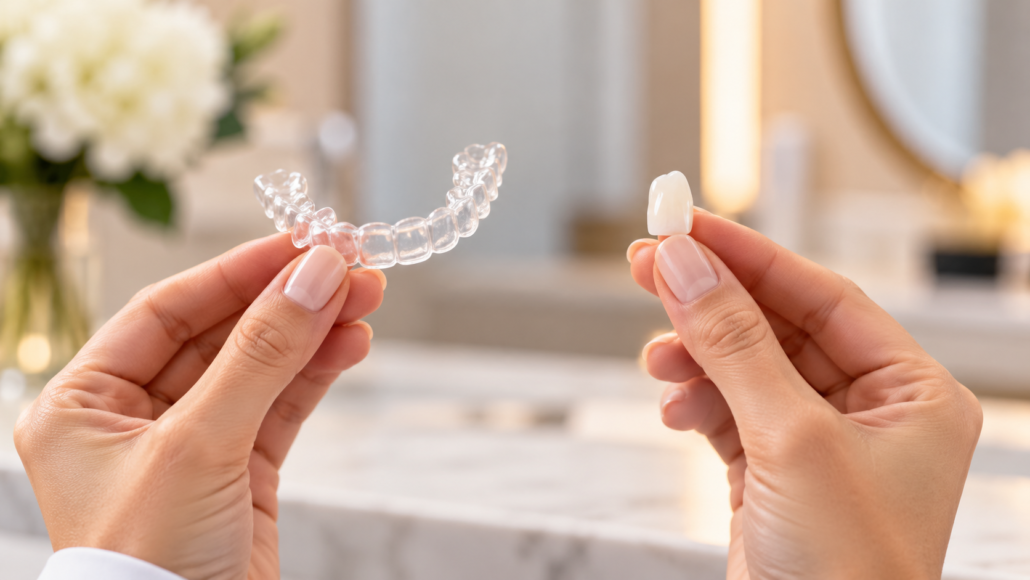
Adults considering Invisalign rarely arrive with a completely untouched set of teeth. There may be a crown on a molar, veneers on the front teeth, a dental implant replacing a missing tooth, or several different restorations completed over the years.
That does not necessarily prevent orthodontic treatment.
What it does mean is that we cannot plan Invisalign as though those restorations are not there. A crown, a veneer, and a dental implant behave differently during orthodontic treatment, and those differences matter when deciding which teeth can move and where we want them to go.
Existing dental work is not automatically a roadblock. It becomes part of the orthodontic plan.
Can you get Invisalign if you already have dental work?
Often, yes. The important distinction is between a restoration that is attached to a natural tooth and a restoration that is supported by a dental implant.
A natural tooth still has a root surrounded by the tissues that allow orthodontic movement. Putting a crown or veneer on that tooth does not replace the root. The tooth may therefore still be moved when it is healthy and the movement is appropriate.
An implant is different. The implant is integrated directly with the surrounding bone. It does not have the same periodontal ligament as a natural tooth and cannot be orthodontically moved in the same way.
Natural tooth
Crown or veneer
The restoration changes the visible or functional portion of the tooth, but the natural root remains. When appropriate, the tooth itself may still be moved orthodontically.
Dental implant
Fixed in the bone
An implant replaces the tooth root and becomes integrated with the surrounding bone. It cannot simply be moved through the bone with an aligner.
This is why a history of dental work does not give us a simple yes or no answer. We need to know exactly what is in the mouth before designing the tooth movements.
If you are still learning how clear aligners work, our Invisalign treatment guide explains how treatment is planned and what wearing aligners involves.
Can Invisalign move a tooth with a crown?
A crown covers a natural tooth. Underneath it, the tooth still has its root and supporting structures. If the tooth, bone, gums, and crown are healthy, having a crown does not automatically mean the tooth has to remain where it is.
What changes is the planning.
Before moving a crowned tooth, we want to understand why the crown was placed, how well it fits, the condition of the tooth underneath, and whether the crown is expected to remain after orthodontic treatment.
- The crown needs to be evaluated. A restoration that is already loose, damaged, leaking, or due for replacement should not simply be ignored because orthodontic treatment is beginning.
- The tooth underneath matters. We need to evaluate the health and prognosis of the natural tooth, not just the appearance of the crown.
- Attachments may require additional planning. Invisalign attachments are commonly bonded to teeth to help create particular movements. Bonding to restorative materials can behave differently than bonding to natural enamel.
- The final crown may need to be reconsidered. If an older crown is already due for replacement, there are cases where it makes more sense to establish the final tooth position before completing the definitive restoration.
In other words, a crown does not automatically make Invisalign impossible. It simply gives us more information to consider before treatment begins.
If you are already dealing with a restoration that repeatedly comes loose, our article Why Does My Crown Keep Falling Off? explains why the underlying tooth and the reason for repeated failure should be evaluated before simply replacing the crown again.
Can you get Invisalign if you already have veneers?
Veneers are bonded to the front surfaces of natural teeth, so the underlying teeth may still be capable of orthodontic movement.
But veneers deserve careful attention before treatment starts. We want to know how old they are, how well they are bonded, whether there are any chips or fractures, and what the final tooth positions could mean for the appearance of the existing restorations.
There is also a larger planning question. A veneer was designed for the position and relationships of the teeth at the time it was made. If we substantially change those relationships, we need to think about whether the existing veneer will still make sense in the finished smile.
Moving the tooth is only part of the question. We also need to know whether the restoration will still work where the tooth is going.
For someone who has not yet had veneers placed, treatment sequencing deserves even more consideration. Our guide to Invisalign before veneers explains why changing tooth position first can sometimes change the restorative plan that follows.
You can also learn more about the restorative side of that decision on our porcelain veneers page.
Can you get Invisalign if you have a dental implant?
Yes, having a dental implant does not automatically prevent you from having Invisalign. But the implant itself creates an important limitation: it cannot be moved orthodontically like a natural tooth.
Natural teeth are suspended in the jaw by a periodontal ligament. Orthodontic forces stimulate changes in the tissues and bone around the roots, allowing those teeth to gradually change position.
A dental implant is designed to behave differently. Once integrated, it is directly anchored to the surrounding bone. That stability is exactly what we want from an implant when it is replacing a missing tooth, but it also means we cannot ask an aligner to move it somewhere else.
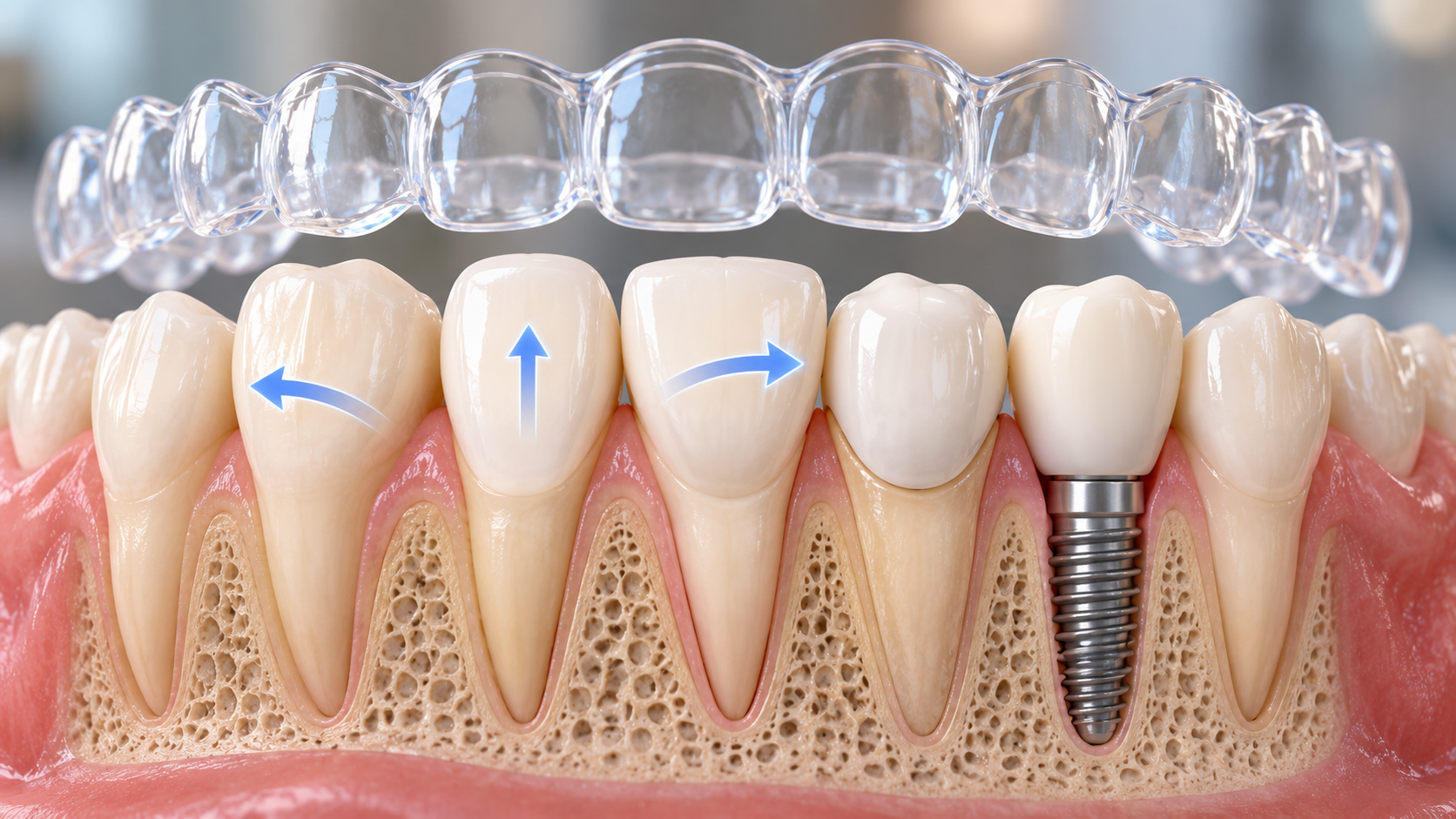
If the implant cannot move, what happens to the other teeth?
This is where orthodontic planning becomes especially important. The implant may stay exactly where it is while selected natural teeth around it are moved.
Whether that works well depends on where the implant is located, where the surrounding teeth need to go, the bite, and what we want the final relationship between the implant crown and natural teeth to look like.
The implant stays put
We treat the existing implant position as a fixed part of the case rather than planning movement of the implant itself.
Natural teeth can move around it
When clinically appropriate, neighboring natural teeth may be repositioned while the implant remains stationary.
The bite still has to work
We are not simply making the front teeth look straighter. The final positions need to make sense with the implant, opposing teeth, and overall bite.
The restoration may need reevaluation
If surrounding tooth positions change significantly, we may also need to consider how the existing implant crown fits into the final restorative result.
If you are considering an implant but have not had one placed yet, the sequence can be particularly important. In some cases, it may make sense to establish the desired tooth positions before placing an implant that will not be movable later.
Our dental implants page explains more about how implants are used to replace missing teeth and how treatment is planned.
Why the order of treatment can matter
Existing dentistry is only one version of this question. Sometimes a patient comes in needing orthodontics and restorative dentistry, but neither treatment has been completed yet.
That gives us an opportunity to decide on the sequence before we commit to restorations that will have to function within the final orthodontic result.
- Identify what is healthy enough to keep. Existing crowns, veneers, fillings, implants, and natural teeth should be evaluated before orthodontic movement begins.
- Determine which teeth actually need to move. Not every tooth has to move simply because someone is having Invisalign.
- Recognize what cannot move. An existing implant becomes a fixed reference point that needs to be incorporated into the orthodontic plan.
- Plan the final restorative relationships. We want to know how the teeth and existing restorations should fit together when treatment is finished.
- Replace dentistry when it makes sense. If an existing restoration needs replacement, its timing can be coordinated with orthodontic treatment rather than treating the two decisions as unrelated.
This is particularly useful for adults who have accumulated dental work over many years. Invisalign is not being planned for a blank slate. It needs to work with the dentistry that is already there and with any restorative treatment that may still be needed.
Orthodontic treatment at our practice is provided by Dr. Edward Viloria . When a patient also has restorative or cosmetic needs, the orthodontic and restorative sides of the treatment can be considered together rather than independently.
Key takeaways
Existing dental work changes the plan. It does not automatically eliminate Invisalign.
- 01 Natural teeth with crowns or veneers may still be moved orthodontically when the teeth and supporting tissues are healthy.
- 02 Existing restorations need to be evaluated before treatment because their condition, position, and materials can affect planning.
- 03 A dental implant is integrated with the bone and cannot be orthodontically moved like a natural tooth.
- 04 Natural teeth may sometimes be moved around an existing implant while the implant remains fixed.
- 05 When orthodontics and restorative dentistry are both needed, planning the sequence before treatment begins can prevent one treatment from unnecessarily complicating the other.
Frequently asked questions
Invisalign with existing dental work, answered.
Can Invisalign move a tooth that has a crown?
Potentially, yes. A crown covers the visible portion of a natural tooth, but the tooth still has its root and periodontal ligament. Orthodontic movement depends on remodeling of the tissues and alveolar bone around that root, a process described in research on the biology of orthodontic tooth movement . The tooth, crown, gums, bone, and planned movement still need to be evaluated before treatment.
Can Invisalign damage a crown?
Having a crown does not automatically mean orthodontic treatment will damage it. The restoration should still be evaluated before treatment, particularly if an attachment needs to be bonded to its surface. Research evaluating orthodontic bonding to restorative materials shows that bonding performance depends on the restorative material and how its surface is prepared.
Can you get Invisalign with porcelain veneers?
In some cases, yes. A veneer is bonded to a natural tooth, so the underlying tooth may still be capable of orthodontic movement. The condition of the veneer, planned movement, and whether an attachment is needed all matter. A systematic review of orthodontic bonding to porcelain found that porcelain surfaces require appropriate surface preparation and bonding protocols rather than being treated like natural enamel.
Can Invisalign move a dental implant?
No. An integrated dental implant is fixed in the surrounding bone and does not have the periodontal ligament that allows a natural tooth to move orthodontically. In research using osseointegrated implants as orthodontic anchorage , the implants remained stable while natural teeth were moved. Invisalign treatment therefore has to be planned around the established implant position.
Can teeth be moved around an existing dental implant?
They may be, depending on the case. The implant remains fixed while selected natural teeth are moved into planned positions. Osseointegrated implants have been used as stable anchorage during orthodontic tooth movement , demonstrating the difference between the fixed implant and movable natural teeth. Whether this is appropriate depends on the implant position, surrounding teeth, and final bite.
Should Invisalign be done before a dental implant?
Sometimes. If orthodontic treatment needs to change the implant space or reposition neighboring teeth, completing those movements first may make sense because the implant will remain fixed after integration. Published interdisciplinary orthodontic and implant treatment literature illustrates the importance of coordinating tooth position, implant placement, and the final restorative result.
What if my crown or veneer needs replacement anyway?
That can change the treatment sequence. If the natural tooth needs to move and the restoration also needs replacement, orthodontic and restorative treatment can be coordinated rather than automatically completing the definitive restoration first. This is particularly important when the final tooth position affects the restoration that follows. Published interdisciplinary treatment literature demonstrates how orthodontic and restorative planning can be coordinated when final tooth position affects the restorative result.
Do crowns or veneers make Invisalign take longer?
Not simply because they are present. Treatment time depends more on the movements required and the complexity of the orthodontic plan. A systematic review evaluating clear aligner treatment found that predictability varies among different types of orthodontic movement. Existing crowns or veneers become additional planning considerations, but their presence alone does not determine how long treatment will take.