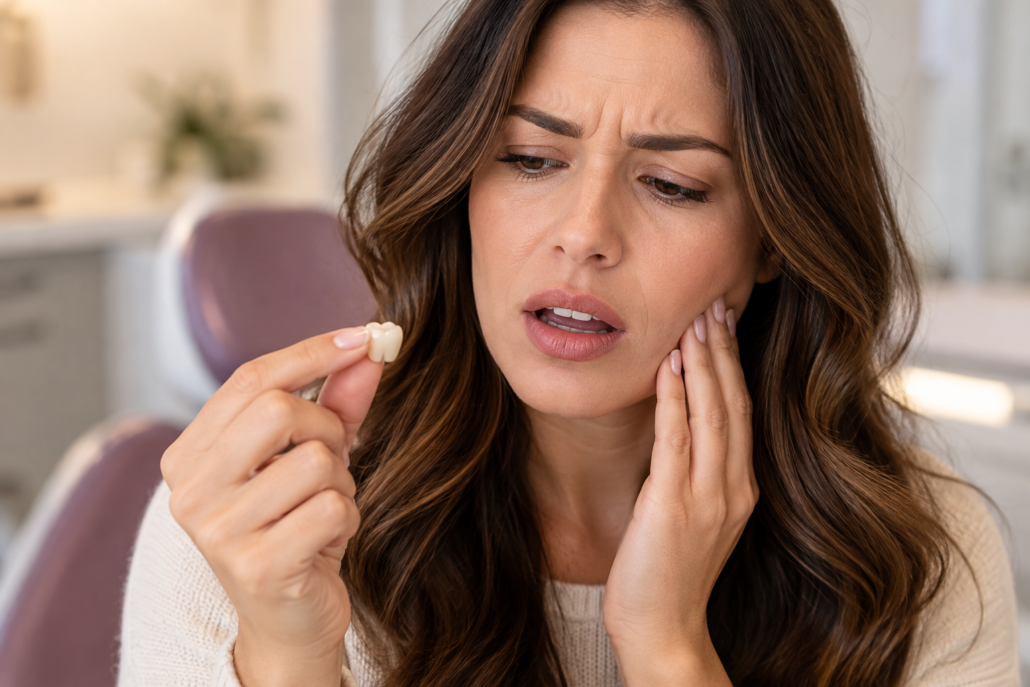
You've finished a root canal, the tooth feels better, and then you hear that you may need a crown. It's reasonable to wonder why. Didn't the root canal already fix the tooth?
It fixed a different part of the problem. Root canal treatment addresses the tissue inside the tooth. It does not rebuild the tooth structure that was lost to decay, an old filling, a fracture, or the access needed to perform the root canal.
What happens next depends on what that tooth needs in order to function again. For some teeth, that means a dental crown. For others, a more conservative restoration may be possible.
A root canal tells me what treatment happened inside the tooth. It doesn't tell me how much healthy tooth is still there.
Why are crowns so common after root canals?
Many teeth that need root canal treatment have already been through quite a lot. There may be a large filling, significant decay, a fracture, or missing tooth structure before the root canal even begins. Creating access to the inside of the tooth removes additional structure.
That matters most when the remaining cusps are thin or unsupported. Every time you chew, those cusps are subjected to force. If they flex or fracture, the tooth can develop a much larger problem than the one we started with.
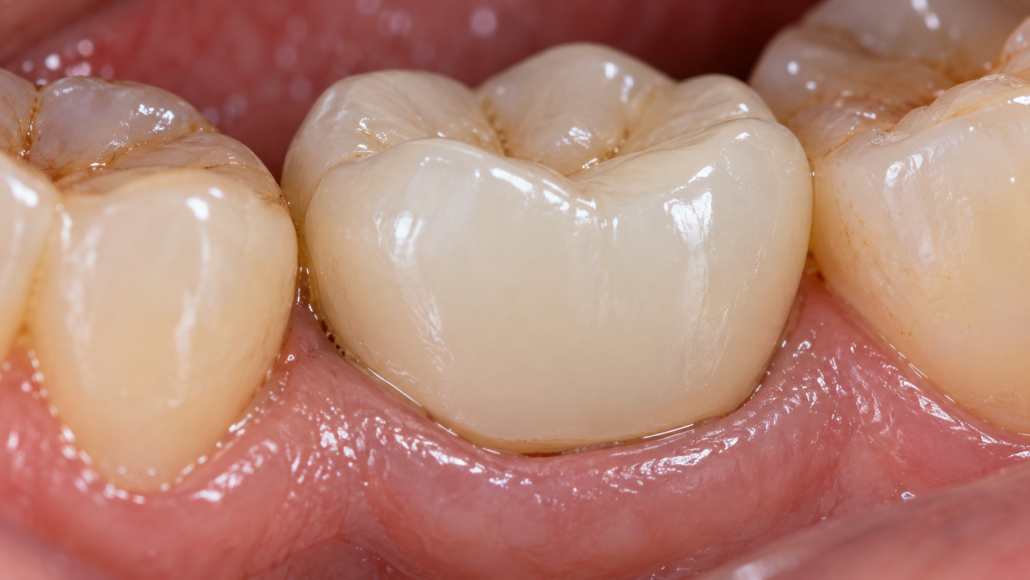
A crown surrounds the prepared portion of the tooth and provides coverage over the cusps. That's one reason crowns have traditionally been used so often after root canal treatment, particularly on molars and premolars.
So why doesn't every root canal tooth need a crown?
Because teeth don't all arrive at the root canal in the same condition. One tooth may have lost most of its chewing surface to a large filling and decay. Another may still have substantial healthy enamel and dentin remaining.
Those are very different restorative situations, even though both teeth received the same endodontic treatment.
I don't want to remove healthy tooth structure simply because a root canal appears in the dental history. At the same time, I don't want to preserve a thin or compromised cusp just to say we did the smaller restoration. The goal is to keep healthy structure while protecting the parts of the tooth that actually need protection.
Molars and premolars usually need more protection
Back teeth do most of the heavy chewing. Their shape includes raised cusps that take force repeatedly throughout the day. When a root canal treated molar or premolar has lost significant structure, those cusps can become vulnerable.
That's why the conversation with a back tooth is often less about whether it needs a restoration and more about how much coverage it needs. The answer might be a full crown, but it can also be a partial-coverage restoration that protects the vulnerable cusps while retaining other healthy areas of the tooth.
Front teeth are a different conversation
Front teeth experience force differently from molars and premolars, and they don't have the same broad chewing surface with multiple cusps. If a front tooth has relatively intact structure after root canal treatment, covering the entire tooth may not always be necessary.
But the location of the tooth isn't the only factor. A front tooth with extensive decay, a large existing restoration, a fracture, or substantial loss of structure may still need a more comprehensive restoration.
This is why I would be cautious with any rule that says every root canal needs a crown or that front teeth never need crowns. The individual tooth still gets the final vote.
Could an onlay protect the tooth instead?
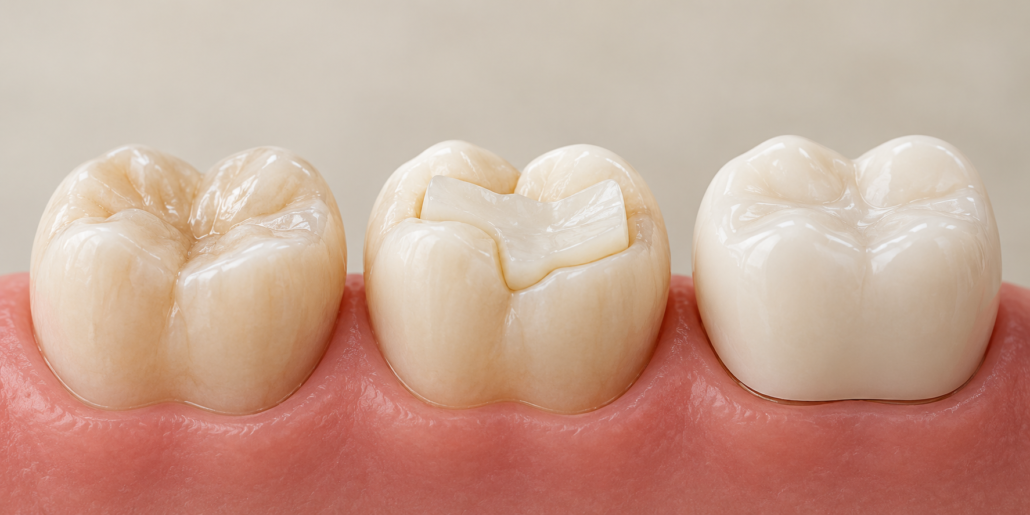
Sometimes. An onlay can cover the chewing surface and vulnerable cusps without surrounding the entire tooth. That can make it an interesting option when a root canal treated back tooth needs cuspal protection but still has healthy structure worth preserving.
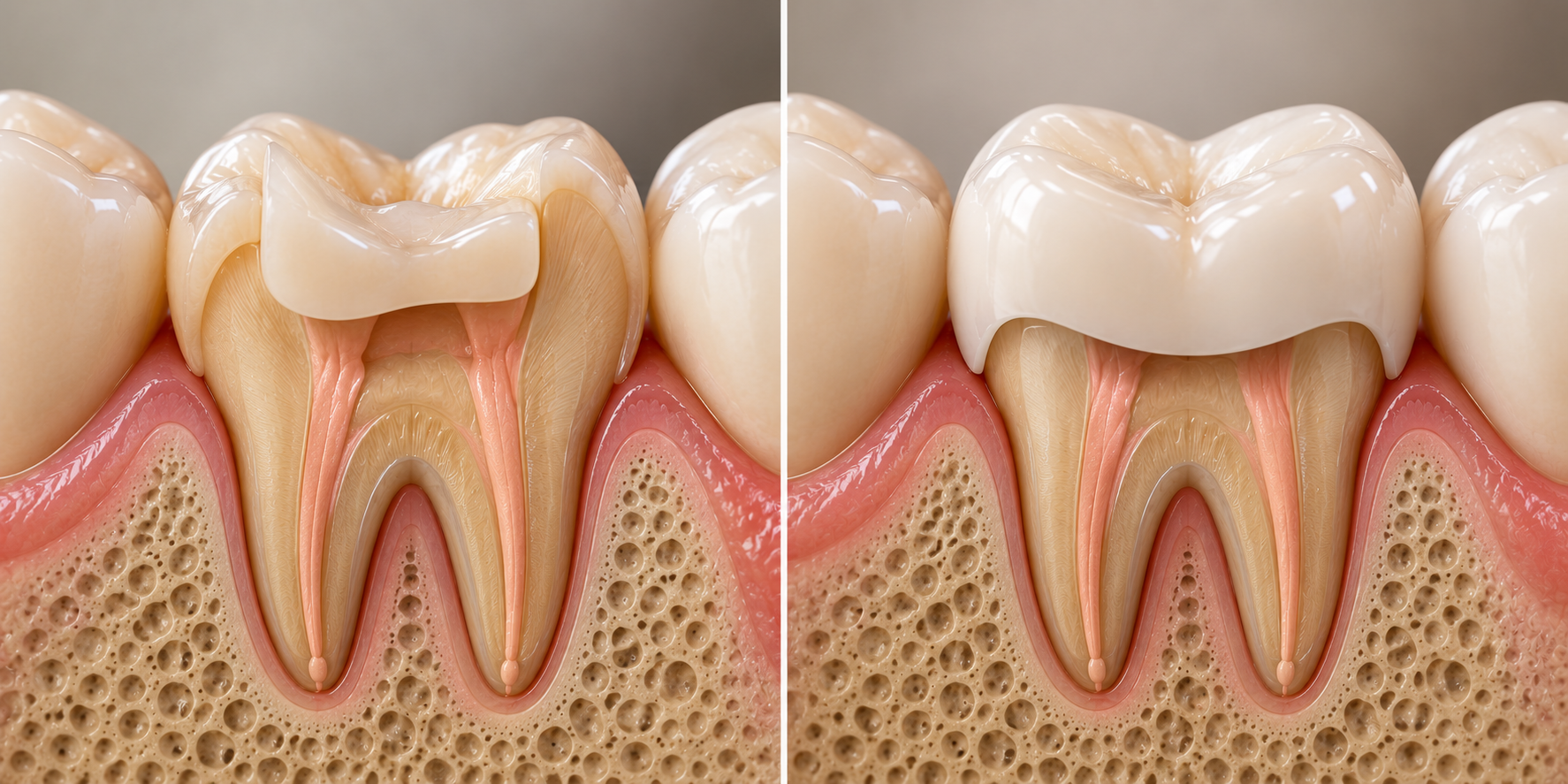
The decision is not simply onlay good, crown bad, or the other way around. Partial coverage only makes sense when the tooth structure we are preserving is strong enough to be useful.
If you want to see that distinction in more detail, our guide to crowns vs. onlays explains how the two restorations differ and why the amount of healthy tooth remaining matters.
What am I looking at before I recommend a crown?
I want to know what we're actually asking the remaining tooth to do. That means looking beyond the fact that it had a root canal and evaluating the structure that's still available.
How much tooth remains?
A tooth with thick, healthy walls gives us different restorative options than one with very little natural structure left above the gumline.
Where is the missing structure?
The location matters. Losing part of a chewing cusp is different from losing a small area in the center of the tooth.
Are there cracks?
Existing cracks or weakened cusps can change how much coverage the tooth needs and how we design the final restoration.
How does the tooth function?
We consider where the tooth sits in the mouth, how it meets the opposing teeth, and the forces it will need to tolerate every day.
The root canal may not be what weakened the tooth most
This is an important distinction. Patients sometimes hear that a root canal makes a tooth weak. In reality, the tooth may already have lost a considerable amount of structure before the root canal was performed.
A large cavity, an old filling, a fracture, or repeated dental work can leave relatively little natural tooth behind. The access needed for root canal treatment adds to that structural loss, but the condition that brought the tooth to treatment matters too.
That's why two root canal treated molars can end up with different restorative plans. The procedure may be the same. The teeth we are rebuilding are not.
Don't forget about the final restoration
Once a root canal is complete, the tooth still needs to be sealed and restored appropriately. A temporary restoration is exactly that: temporary. It isn't meant to become the long-term solution simply because the tooth no longer hurts.
The final restoration is part of preserving the tooth. What that restoration looks like depends on the tooth, but finishing the restorative phase matters.
Protect the tooth without treating it like a formula
Dentistry would be easier if every root canal came with the same next step. Teeth aren't that predictable. Some need full coverage. Some can be treated more conservatively. Some have already lost so much structure that the larger question is whether the tooth can be predictably restored at all.
I would rather make that decision from the tooth in front of me than from a rule about what is supposed to happen after a root canal.
The question isn't, "Did this tooth have a root canal?" The question is, "What does this tooth need now?"
When several teeth need to be evaluated together, our restorative dentistry page explains how we approach treatment planning with the larger picture in mind.
Key takeaways
A root canal doesn't automatically mean a crown. The remaining tooth determines what comes next.
- 01 Root canal treatment addresses the inside of the tooth. The tooth still needs an appropriate final restoration.
- 02 Molars and premolars often need coverage over weakened chewing cusps.
- 03 Cuspal coverage does not always have to mean a full crown. An onlay may be appropriate for selected teeth.
- 04 Front teeth and back teeth have different structural and functional demands.
- 05 The amount, location, and quality of the remaining natural tooth should guide the restorative plan.
Frequently asked questions
A few questions patients ask most.
Does every tooth need a crown after a root canal?
No. The appropriate restoration depends heavily on how much healthy tooth remains and where that structure is located. A systematic review of remaining tooth structure found that teeth with more extensive structural loss benefited more from cuspal coverage, while less damaged teeth could perform well with more conservative bonded restorations.
Why do molars often need crowns after root canals?
Molars absorb substantial chewing forces and frequently have already lost significant structure by the time root canal treatment is needed. Long-term evidence has shown better survival for root canal treated teeth restored with crowns than those restored with direct restorations alone, although the condition of the individual tooth remains important.
Can I get an onlay instead of a crown after a root canal?
For selected posterior teeth, yes. A systematic review comparing full crowns with full-cuspal-coverage onlays found favorable short- to midterm survival for onlays used to restore root canal treated posterior teeth.
Can a root canal tooth just be filled?
Sometimes, particularly when substantial healthy tooth structure remains. However, direct fillings are not appropriate for every root canal treated tooth. A systematic review comparing direct and indirect restorations found higher five- and ten-year survival for indirect restorations, mostly crowns, while noting that the quality of the supporting evidence was limited.
Does a front tooth need a crown after a root canal?
Not necessarily. The amount of remaining structure, existing restorations, fractures, and functional demands all matter. Research evaluating restoration of severely damaged root canal treated anterior teeth also shows that conservative restorative approaches can be viable alternatives to traditional core-and-crown treatment in selected situations.
What happens if I don't get the final restoration after my root canal?
The tooth may remain more vulnerable to structural or restorative failure if the definitive restoration it needs is delayed. Evidence on restoration of root canal treated teeth supports completing an appropriate permanent restoration rather than treating the endodontic procedure as the end of treatment.
Is a post always needed before a crown?
No. A post is not automatically required simply because a tooth had a root canal or will receive a crown. An assessment of systematic reviews found that preservation of coronal tooth structure is a fundamental factor in restorative outcomes and that evidence does not support a single post strategy for every root canal treated tooth.
How long can a root canal tooth last with a crown?
Many can function for years, but no restoration comes with a guaranteed lifespan. One systematic review reported approximately 81% ten-year survival for root canal treated teeth restored with crowns. Individual outcomes depend on the tooth, restoration, bite, oral health, and other clinical factors.