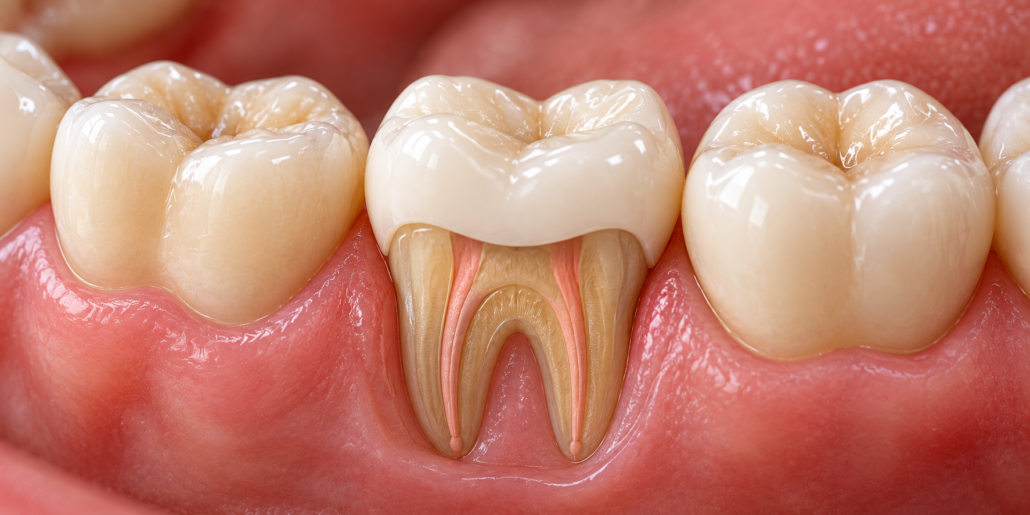
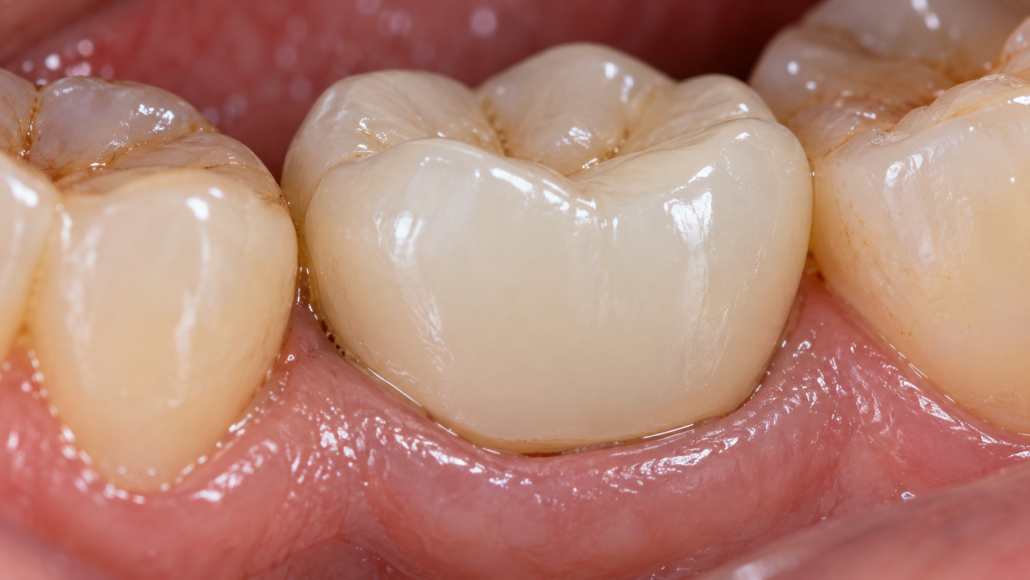
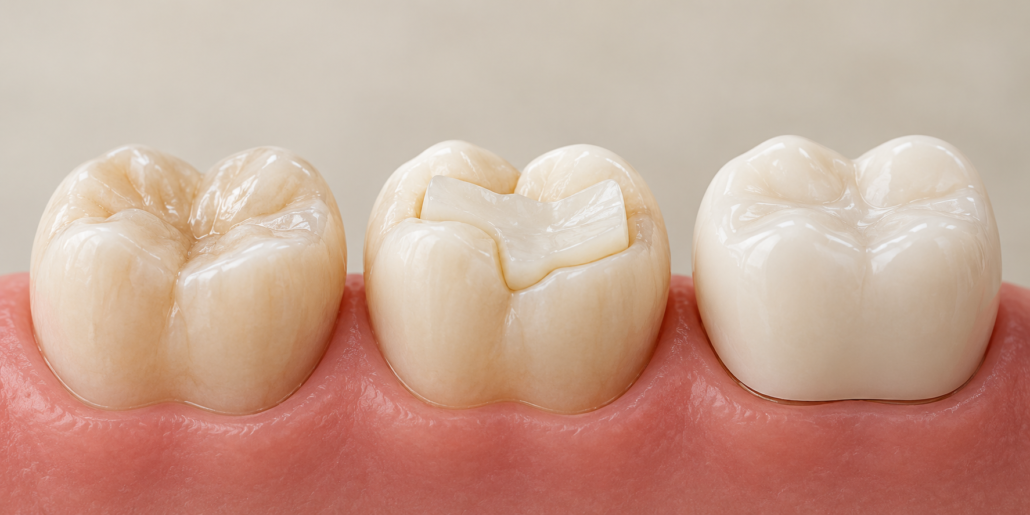
When a crown repeatedly comes off, the crown may not be the real problem. The answer is often underneath it.
It is tempting to think of a loose crown as a simple cement problem. Sometimes it is. If the crown still fits well and the tooth underneath is healthy, putting it back on may be entirely reasonable.
But when a crown has come off two, three, or four times, I become less interested in finding stronger cement and more interested in understanding the foundation. How much healthy tooth is actually left? Has decay developed underneath the restoration? Is the tooth cracked? Has the bite changed? Is the crown still shaped and fitted appropriately for the tooth it is supposed to protect?
Those questions matter because a crown can only be as predictable as the tooth supporting it.
Why do dental crowns come off?
A dental crown is designed to fit over a prepared natural tooth and restore its shape, strength, and function. Once the crown is seated, the shape of the prepared tooth and the dental cement work together to keep the restoration in place.
If something changes in that relationship, the crown can loosen. Sometimes the change is in the cement or the crown. Other times, the tooth underneath has changed since the crown was originally made.
Cement failure
The bond between the tooth and crown can eventually fail even when the crown and underlying tooth remain otherwise usable.
Loss of tooth structure
Decay, fracture, or previous treatment can leave less healthy tooth available to support and retain the crown.
Fit of the crown
An older or damaged crown may no longer have the fit we want, particularly if the tooth underneath has changed.
Repeated force
Heavy biting forces, clenching, or grinding can repeatedly load the restoration and contribute to loosening or other failures.
The first time a crown comes off, we may find a straightforward explanation. Repeated failure deserves a closer look.
The crown is only the top half of the equation.
When you look in the mirror, you see the crown. What I am evaluating is the crown and everything supporting it.
A crown needs a stable foundation of tooth structure underneath it. As more natural tooth is lost to a large filling, decay, fracture, or previous treatment, creating a durable restoration can become more challenging.
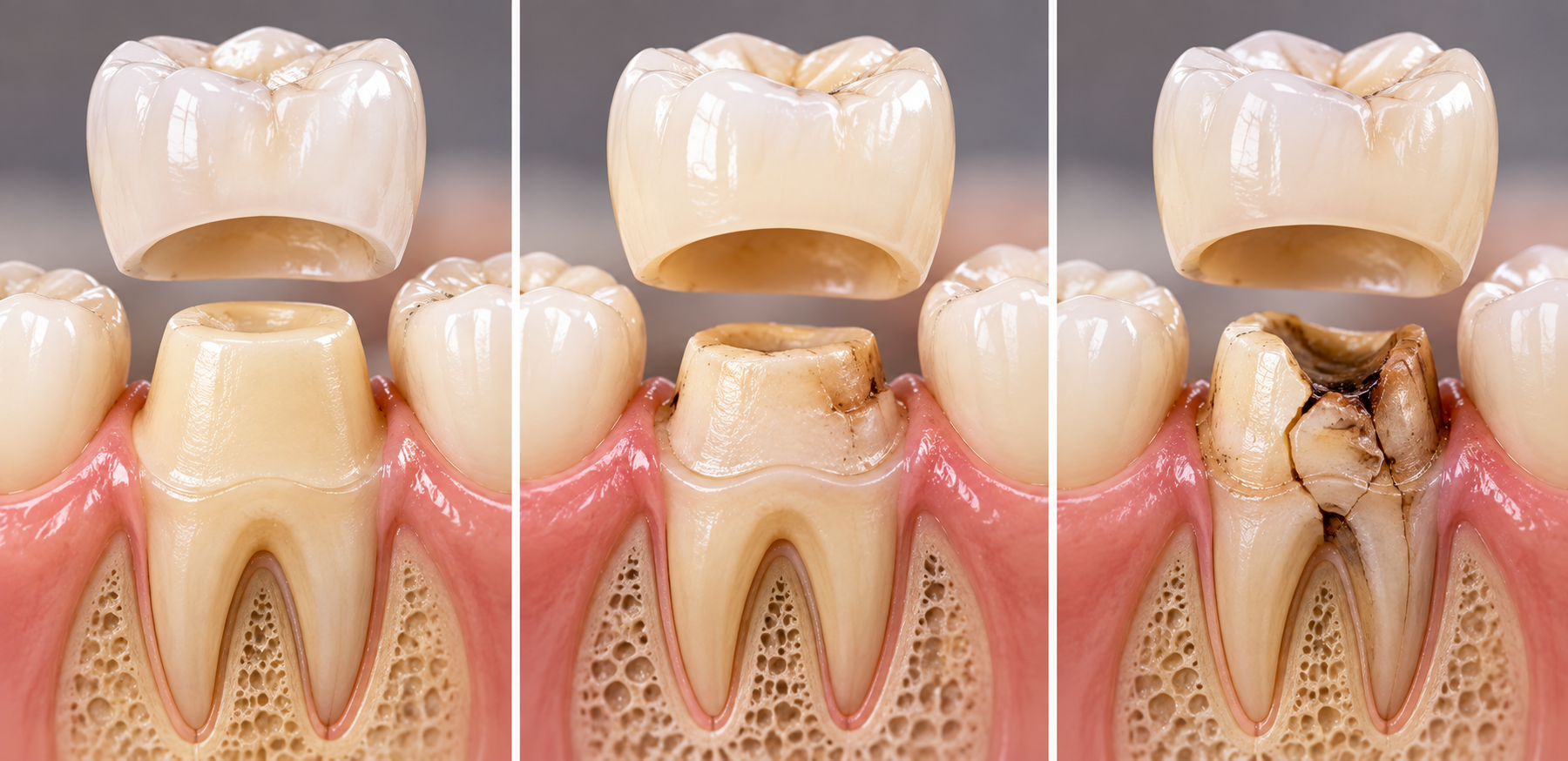
This is why replacing a crown is not simply a matter of making another ceramic tooth that looks the same. Before making the new crown, we have to decide whether the tooth underneath can provide a predictable foundation for it.
A crown can protect a compromised tooth. It cannot make an inadequate foundation disappear.
Our dental crowns page explains how crowns are used to protect and rebuild teeth when enough healthy structure remains to support the restoration.
Can a tooth get a cavity underneath a crown?
Yes. A crown covers the visible portion of a tooth, but the natural tooth still exists underneath it. The area where the crown meets the tooth remains particularly important.
If decay develops around that margin and extends underneath the restoration, the shape of the tooth can change. A crown that once fit securely may no longer have the same foundation.
Sometimes the extent of the problem is not obvious until the crown is removed and the underlying tooth can be evaluated directly. A small area may be treatable. More extensive decay can leave us with much less tooth than we expected.
This is one reason I do not like the idea of repeatedly recementing a crown without understanding why it came off. If the tooth underneath is changing, putting the same crown back on does not correct that problem.
What if part of the tooth broke off with the crown?
This changes the conversation. If a piece of natural tooth comes out inside the crown, we have lost part of the foundation that originally helped support the restoration.
The next question is how much tooth remains and where the fracture extends. A tooth with a small amount of lost structure may still be rebuildable. A fracture that extends much deeper can make the prognosis very different.
The important distinction is that putting the crown back on does not put the missing tooth structure back. We first have to determine whether the tooth can be predictably rebuilt.
Can your bite make a crown keep coming off?
It can. Teeth do not function independently. Every time you bite or chew, forces move through the crown and into the tooth underneath it.
If one crown is receiving more force than it should, or if you clench or grind your teeth, the restoration can be subjected to repeated stress. Depending on the situation, that can contribute to loosening, chipping, fracture, or wear.
The restoration
Look at the crown.
Is it intact? Does it fit the tooth appropriately? Is there evidence of wear, damage, or a problem at the margin?
The larger picture
Look at the bite.
Where does that tooth contact? Are there signs of clenching or grinding? Is something repeatedly placing excessive force on the restoration?
If the crown is replaced without considering the forces acting on it, the new restoration can inherit the same problem.
Can the crown just be cemented back on?
Sometimes, yes. If the crown is in good condition, still fits appropriately, and the underlying tooth is healthy and intact, recementing it may be a reasonable solution.
What I do not want to do is assume that recementing is always the answer simply because the crown can physically be placed back over the tooth.
- The crown still fits well If the restoration remains intact and seats properly, it may be possible to reuse it.
- The tooth underneath is healthy We want to make sure decay or fracture has not changed the foundation.
- There is enough structure for retention The remaining tooth still has to provide a reasonable foundation for the crown.
- The bite is manageable We also want to understand whether repeated force contributed to the failure.
If those conditions are not present, simply using new cement may give us another temporary fix rather than solving the underlying problem.
Can the tooth still be saved?
Often it can. A crown coming off does not automatically mean the tooth needs to be removed. The real decision is based on the condition of the tooth after the crown is off and we can evaluate what remains.
Good foundation
If the tooth remains healthy and the existing crown still fits appropriately, recementing may be all that is needed.
Restorable foundation
If the old crown is no longer appropriate but enough healthy tooth remains, the tooth may be rebuilt and restored with a new crown.
More complicated foundation
Deeper decay, fracture, or involvement of the nerve can mean that additional treatment is necessary before we know whether another crown makes sense.
Non-restorable foundation
If too little healthy tooth remains or the damage extends into an area that cannot be predictably restored, replacing the tooth may become the more reasonable option.
This is where conservative dentistry sometimes gets misunderstood. Saving a natural tooth is valuable when we can restore it predictably. Repeating treatment on a foundation that continues to fail is not automatically the more conservative choice.
If the tooth reaches that point, our article Is It Better to Save a Tooth or Get a Dental Implant? explains how I think about that larger decision. You can also learn more about replacement options on our dental implants page.
What should you do if your crown falls off?
Keep the crown if you can find it. Even if we ultimately decide not to reuse it, seeing the restoration can give us useful information about what happened.
Avoid chewing hard or sticky foods on that tooth until it has been evaluated. The tooth underneath may be more vulnerable without the crown protecting it, and it can also be sensitive.
I would not recommend trying to permanently glue the crown back on yourself. Household adhesives are not designed for use in the mouth, and getting the crown seated incorrectly can create additional problems.
Most importantly, have the tooth evaluated rather than waiting for the crown to come off again. The sooner we understand why it failed, the better chance we have of choosing the appropriate next step.
If it keeps happening, ask why.
A crown coming loose once does not necessarily mean there is a serious problem. Restorations occasionally need maintenance, and sometimes a crown simply needs to be recemented.
Repeated failure is different. If the same crown continues to come off, I want to know what has changed. The answer may be the crown, the tooth underneath it, the bite, or a combination of several things.
The goal is not to make the crown stay on at any cost. It is to understand whether we still have a healthy enough foundation to create a restoration that makes sense for the tooth.
Key takeaways
A loose crown may be telling you something about the tooth underneath.
- 01 A crown can come off because of cement failure, changes in the tooth, decay, fracture, fit, or repeated biting forces.
- 02 When the same crown repeatedly comes off, identifying the reason is more important than simply cementing it again.
- 03 The amount and condition of the natural tooth underneath the crown strongly influence whether another crown can be supported predictably.
- 04 Clenching, grinding, and the way the teeth come together can contribute to restoration failure and should be considered when problems repeat.
- 05 A failing crown does not automatically mean losing the tooth, but a severely compromised foundation may require a different treatment plan.
Frequently asked questions
A few questions I hear most.
Why does the same dental crown keep falling off?
Repeated loss of a crown can indicate that there is not enough healthy tooth structure providing retention, or that something else about the restoration or tooth has changed. The importance of the remaining tooth is well established, with greater preservation of remaining tooth structure associated with better restorative prognosis.
Can a crown be recemented more than once?
It may be possible if the crown still fits appropriately and the underlying tooth remains healthy. Repeated loss, however, is a reason to evaluate the foundation rather than assume cement alone is the problem. Clinical evidence shows that remaining dentin and the amount of tooth structure surrounding a restoration influence longevity.
Can there be decay underneath a dental crown?
Yes. The tooth underneath a crown is still natural tooth structure and can develop decay, particularly around the crown margin. Recurrent decay around crown margins can affect whether the crown can remain in place or needs to be removed so the tooth can be evaluated.
Can grinding your teeth make a crown come loose?
Bruxism can place repeated force on both teeth and restorations. It does not explain every loose crown, but it is an important factor to consider when restorations repeatedly fail. Bruxism has been identified as a risk factor for failure of direct and indirect dental restorations.
How much tooth needs to remain for a crown?
There is not one simple measurement that determines restorability in every tooth. The amount, height, thickness, and location of remaining healthy tooth all matter. In endodontically treated teeth, greater ferrule height and preserved dentin have been associated with improved fracture resistance and clinical outcomes.
Does a crown falling off mean the tooth needs to be extracted?
No. Many teeth can still be restored after a crown comes off. The decision depends on what remains underneath, including decay, fracture, root condition, and the amount of usable tooth structure. Across restorative research, restoration failure is closely related to the amount of remaining tooth structure, which is why the tooth needs to be evaluated before deciding whether it can be saved.
Should I glue a crown back on myself?
I would not use household glue or try to permanently cement it yourself. The crown and underlying tooth should first be evaluated for fit, decay, fracture, and remaining tooth structure. Those structural factors matter because loss of coronal tooth structure reduces the strength of a restored tooth.