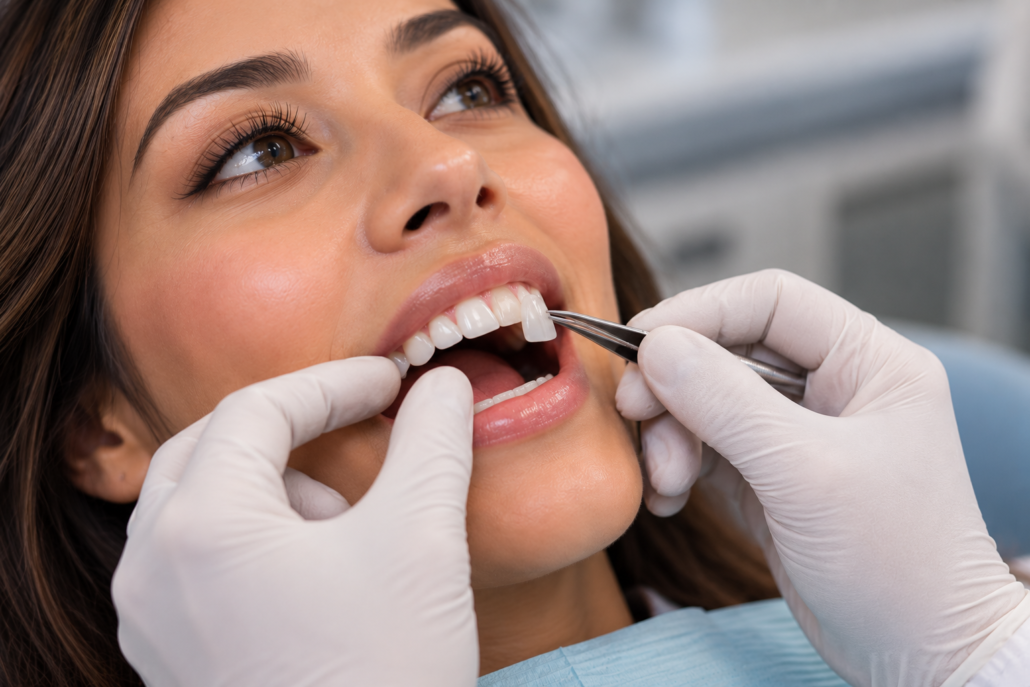
Most people who come in to talk about their smile do not begin with the name of a procedure. They point to something.
This tooth has always bothered me. My teeth have gotten darker. I don't like this space. That edge looks uneven. My smile just doesn't look the way I want it to.
Start with what you want to change. Then we can figure out the most thoughtful way to change it.
Sometimes whitening is enough. Sometimes a small amount of bonding can change the appearance of one tooth without doing anything to the others. Sometimes moving the teeth makes more sense than covering them. And sometimes porcelain veneers really are the right answer.
Cosmetic dentistry is not one treatment. It is a collection of treatments that can be used individually or together to improve the appearance of a smile while still respecting the health, function, and structure of the teeth underneath it.
What can cosmetic dentistry change?
Cosmetic dentistry can address many of the things patients notice when they look at their smile: discoloration, uneven edges, small chips, spaces between teeth, differences in tooth size, crowding, worn teeth, old restorations, and missing teeth.
But two people who dislike the same thing about their smiles may need completely different treatment.
A dark tooth may need whitening, internal bleaching, bonding, a veneer, or a crown depending on why it is dark. A space may be improved with bonding, orthodontics, or veneers. A tooth that looks too short may actually be worn, or its proportions may be influenced by the surrounding gum tissue.
That's why I don't like starting with a procedure. I want to understand what you see first, then determine why it looks that way.
Your cosmetic treatment options
These are some of the treatments we consider most often when someone wants to improve their smile. They overlap, but they are not interchangeable.
Professional teeth whitening
Whitening is often the simplest place to begin when the primary concern is tooth color and the teeth themselves are otherwise healthy and attractive.
It can brighten natural enamel without changing the shape or structure of the teeth. Existing crowns, veneers, and tooth-colored fillings may not respond to bleaching the same way natural enamel does, so their color has to be considered when we're planning treatment across the entire smile.
Cosmetic bonding
Bonding uses tooth-colored composite resin to make relatively small changes to a tooth. It can be especially useful for chipped edges, small spaces, minor shape differences, or a tooth that simply looks a little out of proportion.
One of the things I like about bonding is that it can often be quite conservative. The tradeoff is that composite does not behave exactly like porcelain over time. It can stain, wear, or chip and may eventually need maintenance.
Porcelain veneers
Veneers allow us to change several characteristics at once, including color, shape, proportion, symmetry, and the appearance of certain spaces or worn edges.
They make the most sense when the amount of change a patient wants is greater than whitening or conservative bonding can predictably provide.
Good veneer treatment is not about making every tooth identical. It is about designing a smile that belongs to the person wearing it. Tooth proportions, translucency, surface texture, facial features, lip position, and the neighboring teeth all matter.
Invisalign
Sometimes the problem is not the shape of the teeth at all. It is their position.
Invisalign can be used to address certain spacing, crowding, and alignment concerns without covering otherwise healthy teeth.
There are also cases where orthodontics is only one part of the plan. Moving the teeth into better positions first may allow us to be considerably more conservative with bonding or veneers afterward.
Dental implants
A missing tooth creates a different cosmetic problem because there is no longer a tooth to whiten, bond, straighten, or veneer.
A dental implant can replace the missing tooth while also restoring function. In the front of the mouth, planning involves much more than simply placing an implant. The position of the implant, gum contours, neighboring teeth, and final crown all contribute to whether the replacement looks natural.
The best cosmetic dentistry should make you notice the smile, not the dentistry.
Which treatment is right for you?
I usually think about cosmetic treatment in terms of the problem we are trying to solve and how much dentistry is actually necessary to solve it.
Mostly color
Whitening may be all that is needed if the teeth are healthy and their existing shape and position already work well.
A small shape change
Bonding may allow us to improve a chip, edge, space, or proportion without committing the tooth to porcelain.
Tooth position
Orthodontic treatment may make more sense than changing healthy enamel to disguise crowding or spacing.
Several things at once
Veneers may be appropriate when color, shape, proportion, wear, and symmetry all need to be considered together.
There are also plenty of situations where the best plan uses more than one treatment. We might straighten first and bond afterward. We might whiten the natural teeth before choosing the final shade of a veneer or crown.
The goal is not to use as many cosmetic procedures as possible. It is to use the right amount of dentistry to create a result that looks natural and makes sense long term.
Choosing a cosmetic dentist
Cosmetic dentistry involves technical dentistry, but it also involves judgment. That judgment is often what separates a result that simply looks new from one that looks like it has always belonged there.
Look at a dentist's actual work. Pay attention to whether the smiles all look the same or whether the treatment seems to change with the patient.
Look at tooth shape, texture, translucency, symmetry, and how the teeth relate to the lips and face. Natural teeth have character. Beautiful cosmetic dentistry should preserve some of that character rather than erase it.
I also think you should feel comfortable hearing that you don't need something.
If whitening will accomplish what you want, you should know that before discussing veneers. If moving a tooth could preserve healthy enamel, that option deserves a conversation. And if a tooth is already heavily restored and would benefit from more comprehensive treatment, you should understand why.
I go into this in more detail in what to look for when choosing a cosmetic dentist , including the questions I think patients should ask before committing to treatment.
You can also read our guide to cosmetic dentistry and smile transformation for another look at how different treatments can work together.
Key takeaways
What to remember about cosmetic dentistry.
- 01 Start with what you want to change, not with the name of a procedure.
- 02 Whitening, bonding, Invisalign, veneers, and implants solve different problems.
- 03 The most conservative treatment that predictably accomplishes your goal deserves consideration first.
- 04 A cosmetic plan should consider appearance, function, natural tooth structure, and how the result will age.
Frequently asked questions
A few questions patients ask most.
What does cosmetic dentistry include?
Cosmetic dentistry can include whitening, bonding, veneers, orthodontic treatment, and restorative procedures when improving the appearance of the smile is part of the treatment goal. There is no single mathematical formula for an attractive smile. A systematic review of esthetic tooth proportions found substantial variation in natural dentitions and did not support one universal proportion for predicting an esthetic result.
Do I need veneers to improve my smile?
No. Whitening, bonding, orthodontics, or a combination of treatments may accomplish the change you want without veneers. When veneers are appropriate, preserving enamel is important. A systematic review and meta-analysis of ceramic veneers found higher survival and success when veneers were bonded primarily to enamel rather than extensively exposed dentin.
How long do porcelain veneers last?
Porcelain veneers can remain successful for many years, although longevity depends on the material, bonding, bite, tooth preparation, oral habits, and maintenance. A systematic review of 6,500 porcelain laminate veneers estimated a 10-year cumulative survival rate of 95.5%, with fracture and debonding among the more common complications.
Do veneers require removing natural tooth structure?
Often some tooth preparation is required, but the amount varies considerably with the starting position of the tooth and the change being planned. Preserving enamel whenever clinically possible is valuable. Clinical evidence comparing veneer bonding substrates found better survival and success for veneers bonded to enamel than for veneers with substantial dentin exposure.
Can bonding fix a chipped tooth?
Yes. Composite bonding is commonly used to rebuild chipped or fractured front teeth and can often do so conservatively. A systematic review of anterior composite restorations found generally favorable clinical survival, with fracture of the tooth or restoration the most common reason for failure and esthetic changes also occurring over time.
Does professional teeth whitening cause sensitivity?
It can. Tooth sensitivity is a recognized side effect of bleaching, although its likelihood and intensity vary with the whitening protocol. An updated systematic review and meta-analysis compared at-home and in-office bleaching for whitening effectiveness as well as the risk and intensity of tooth sensitivity.
Will whitening change the color of crowns, veneers, or fillings?
Restorative materials do not necessarily respond to bleaching the way natural tooth structure does, so existing restorations have to be considered when planning a whitening treatment. A systematic review of bleaching and restorative materials found that peroxide bleaching can affect restorative materials in several ways, including their physical properties, bonding, surface characteristics, and color.
Can Invisalign improve the appearance of my smile?
Yes. Clear aligners can improve certain spacing, crowding, and alignment concerns without covering otherwise healthy teeth. A systematic review of clear aligner therapy found that aligners can produce clinically acceptable outcomes for some tooth movements, while also finding that predictability varies by the movement being attempted.
Is bonding better than porcelain veneers?
Neither is automatically better. Bonding can be a conservative choice for smaller changes, while porcelain may be appropriate when larger changes in color, shape, proportion, or symmetry are needed. A systematic review and meta-analysis of resin-composite veneers found moderately high survival rates, while surface roughness, color mismatch, and marginal discoloration were among the commonly reported complications.
Can cosmetic dentistry still look natural?
Yes. A natural result is not created by making every tooth the same size or following one ideal mathematical ratio. Tooth shape, proportion, texture, translucency, position, gum contours, lips, and facial features all contribute to the way a smile is perceived. A systematic review of mathematical tooth proportions found that natural tooth proportions vary substantially and that no single formula consistently predicts an esthetically pleasing result.
Should I straighten my teeth before getting veneers?
Sometimes. If tooth position would otherwise require more aggressive veneer preparation, moving the teeth first may allow for a more conservative restorative plan. That decision is individual. One reason enamel preservation matters is that a systematic review and meta-analysis of ceramic veneers found higher survival and success for veneers bonded to enamel than those bonded to teeth with substantial dentin exposure.
Can a dental implant replace a missing front tooth?
Yes. A single dental implant can replace a missing front tooth, but creating a natural result requires careful planning of the implant position, bone, surrounding gum tissue, neighboring teeth, and final crown. A systematic review of single-tooth implants in the esthetic zone evaluated implant survival together with bone levels, soft tissue, esthetics, and patient satisfaction.