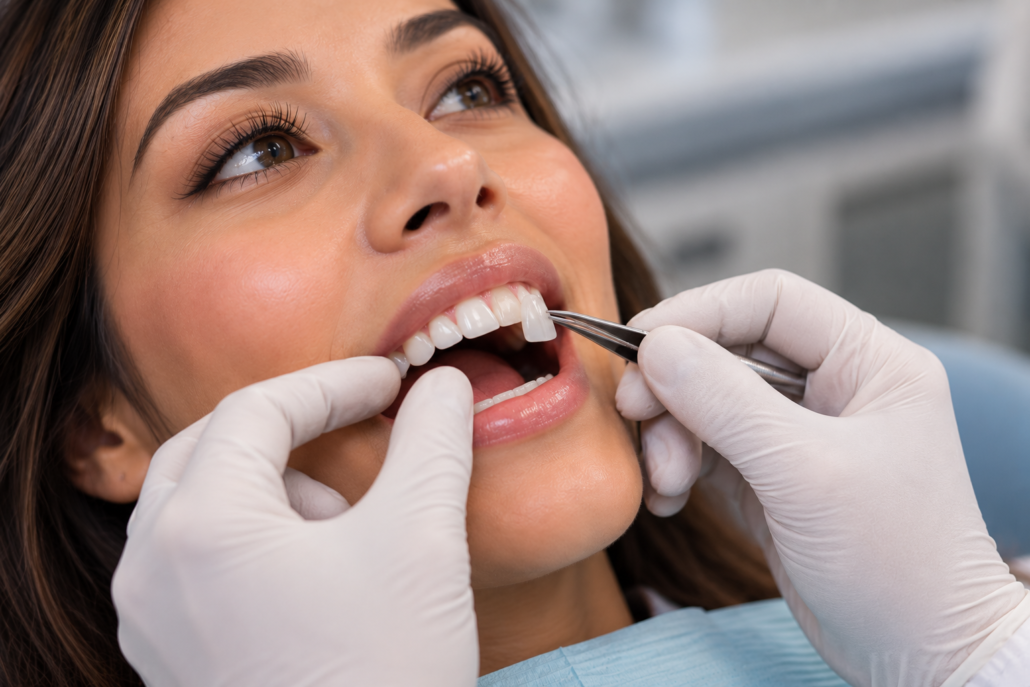
Patients sometimes come in convinced that they need veneers when what bothers them could be addressed with a small amount of bonding.
Other times, someone hopes bonding can accomplish a much larger change in tooth shape, color, proportion, or symmetry.
That's why I don't like beginning this conversation with the material. I want to begin with the smile.
I don't start by deciding between bonding and veneers. I start by looking at the teeth you have and what you actually want to change.
If a small addition of composite can solve the problem beautifully, there may be no reason to do more.
But being conservative also means recognizing when we're asking a material to make a change that is larger than it is well suited to make.
What's the difference between composite bonding and porcelain veneers?
The simplest difference is how the new tooth surface is created.
With composite bonding, tooth-colored resin is placed directly on the tooth. I can add material, shape it, refine the contour, and polish it while working directly with the tooth in the mouth.
A porcelain veneer is different. It is a thin ceramic restoration designed for the tooth and then bonded into place.
That distinction changes what each treatment is especially good at doing.

Composite bonding
Built directly on the tooth.
Tooth-colored composite is added and sculpted directly, which can make bonding especially useful for precise, localized changes.

Porcelain veneers
Designed before it reaches the tooth.
A ceramic restoration is created to control the visible surface of the tooth before it is bonded into place.
Think of bonding as the ability to add and refine. Think of a veneer as the ability to design the visible surface of the tooth more comprehensively.
Neither description tells us which one you need. It tells us why the size and type of change matter.
How much are you actually trying to change?
This is often where the decision becomes clearer.
Cosmetic concerns exist on a spectrum. Correcting one small edge is different from changing the appearance of several front teeth.
One detail
A small part of the tooth bothers you.
A chip, slightly uneven edge, small space, or subtle contour issue may only require a targeted addition.
Several details
Shape and proportion both need attention.
As the desired change becomes larger, we start looking more carefully at the relationship between the teeth rather than one isolated spot.
The visible surface
Color, shape, proportion, or several teeth need to change together.
This is where the additional design control of porcelain may become more useful.
Sometimes we're correcting one detail. Other times we're redesigning how several teeth belong in the smile.
When does composite bonding make sense?
I tend to think about bonding when the underlying tooth is healthy and attractive, but there is something specific we'd like to refine.
The beauty of bonding is that the treatment can sometimes remain very focused.
- Small chips. Composite can rebuild a chipped or worn edge without necessarily changing the entire visible surface of the tooth.
- Minor gaps. Carefully adding width to one or more teeth can sometimes close a small space while maintaining natural proportions.
- Uneven edges. A small amount of added length or contour can help neighboring teeth look more balanced.
- Subtle shape changes. A tooth that is slightly narrow, short, or asymmetrical may only need a localized addition.
- Localized repairs. Composite can also be useful when an existing bonded area needs reshaping, polishing, or repair.
When the problem is small, the treatment can be small too.
Bonding does have limits.
The larger the addition becomes, the more we have to think about the contour of the tooth, the bite, polish, color stability, and how that material will behave over time.
That's why I don't assume that doing a larger amount of bonding is automatically more conservative simply because we're using composite.
When might porcelain veneers make more sense?
Veneers become a different conversation when the concern is broader than one small defect.
Perhaps several teeth are undersized. Maybe their proportions don't work together. Perhaps color, shape, worn edges, spaces, and older dental work all need to be considered at the same time.
In those situations, porcelain allows us to think about the visible surface of the tooth as part of a larger design.
Several teeth need changing
Porcelain can help coordinate shape and proportion across multiple visible teeth.
Color is part of the concern
When the desired change involves more than contour, the optical properties and final shade of the restoration become part of the plan.
The shape change is larger
More substantial changes in width, length, symmetry, or overall tooth form may benefit from the design control of ceramic.
The smile needs to work as a whole
When several cosmetic concerns overlap, we can plan the relationship between the visible teeth before changing them.
If you're considering that kind of broader change, our porcelain veneers page explains how we plan treatment, what veneers can change, and what to expect from the process.
Composite bonding vs. porcelain veneers: side by side
The treatments overlap, but they don't behave exactly the same way.
Composite bonding
Direct
Porcelain veneers
Indirect
Which is more conservative: bonding or veneers?
Bonding can often be performed with very little alteration to the natural tooth. In some situations, we are simply adding material.
That can make composite an extremely conservative treatment.
But I don't think the word conservative should automatically decide the treatment.
If we're trying to dramatically change several teeth by adding larger and larger amounts of composite, the equation becomes different.
Veneers also don't all require the same amount of tooth preparation. The amount depends on the position and shape of the starting tooth, how much enamel is available, the desired color and contour, and the space needed for the ceramic.
Conservative dentistry isn't about choosing the treatment with the smallest name. It's about doing no more than the tooth and the goal actually require.
If you're wondering what actually happens to the natural tooth when veneers are prepared, I explain that in what happens to teeth under veneers .
That's also why a photograph online cannot reliably tell you whether you "need veneers." We have to evaluate the actual teeth.
Which looks more natural: composite bonding or porcelain veneers?
Either one can.
When you look at a natural smile, you aren't just seeing color.
You're seeing proportion, edge shape, translucency, surface texture, tiny asymmetries, the relationship between neighboring teeth, and how all of those things fit the person's face.
A beautifully executed piece of composite can disappear into a natural tooth. A carefully designed porcelain veneer can do the same.
Either can also look artificial when the result becomes too uniform, too opaque, too bright, too bulky, or simply too different from the person wearing it.
The goal isn't to make teeth look "done." It's to decide what needs changing and leave everything else alone whenever we can.
How do bonding and porcelain veneers age differently?
Neither treatment should be thought of as maintenance-free.
They simply tend to need different kinds of attention over time.
Composite bonding
More repairable. More likely to need maintenance.
Composite is shaped and polished at the time of treatment.
Over time, the surface may lose some polish or pick up stain.
An edge may chip or the contour may need refinement.
One advantage is that composite can often be polished, added to, reshaped, or repaired.
Porcelain veneers
More color stable. Still a restoration.
The ceramic surface is designed and bonded to the tooth.
Porcelain generally maintains its surface and color very well.
The veneer, margins, gums, bite, and supporting tooth still need to be monitored.
A veneer can eventually chip, debond, or require replacement if the restoration or tooth changes.
Porcelain generally maintains its color very well, while composite is more likely to pick up surface stain or lose some polish over time. There is more nuance to that distinction, which I cover in Do Porcelain Veneers Stain?
I would rather explain maintenance honestly than promise that either material lasts forever.
If you already have veneers and are wondering what happens when they get older, I explain that separately in Can Porcelain Veneers Be Replaced?
How do I decide between bonding and porcelain veneers?
Before I recommend either one, I want to understand the problem in the right order.
Start with what bothers you
A chipped edge is a different problem from wanting to change the color, shape, and proportion of six front teeth.
Look at the teeth you already have
Enamel, existing fillings, cracks, wear, tooth position, previous dentistry, and the bite can all influence which treatment makes sense.
Decide how much actually needs to change
If one small addition solves the problem, we don't need to create a larger treatment simply because another option exists.
Make sure the result belongs in the smile
Whatever we change still has to work beside the teeth we leave untouched and look appropriate for your face.
Sometimes that leads to bonding.
Sometimes it leads to porcelain.
Sometimes the better sequence is whitening or Invisalign before we consider either one.
And sometimes, after looking carefully, the right decision is to leave a healthy tooth alone.
The goal isn't to choose porcelain or composite. It's to change exactly what needs changing, and no more.
When several different cosmetic concerns need to be considered together, our smile makeover page explains how we approach the smile as a whole rather than choosing treatments one at a time.
Key takeaways
Choose the treatment for the change. Not the treatment name first.
- 01 Composite bonding is shaped directly on the tooth and can be especially useful for smaller, targeted cosmetic changes.
- 02 Porcelain veneers give us more control when shape, proportion, color, or several teeth need to change together.
- 03 Bonding may require little or no tooth preparation in selected cases, while veneer preparation depends on the starting tooth and treatment goal.
- 04 Composite is often easier to repair or modify, while porcelain generally offers greater long-term color stability.
- 05 Both bonding and porcelain veneers can look natural when the treatment is carefully planned and executed.
- 06 The most conservative treatment is the one that solves the actual problem without treating more tooth than necessary.
Frequently asked questions
A few questions patients ask most.
Do porcelain veneers last longer than composite bonding?
Generally, yes. Ceramic veneers have shown better long-term survival than direct composite veneers . Composite bonding can still perform well, but it is more likely to need repair or replacement over time.
Can composite bonding be used instead of porcelain veneers?
Sometimes. Composite is particularly useful for smaller, localized changes such as minor contour corrections, chips, or closing a small space. Composite resins are well suited to minor esthetic changes with minimal tooth preparation , while porcelain may offer more control when the planned change is larger.
Does composite bonding require shaving the tooth?
Not always. Depending on what we are correcting, composite may be added with very little preparation of the natural tooth. Conservative anterior composite techniques can preserve more natural tooth structure . The exact preparation depends on the tooth and what needs to change.
Do porcelain veneers always require shaving your teeth?
No. Preparation can range from very little to more substantial reshaping depending on the tooth's position, existing restorations, color, and the result we're trying to create. When possible, keeping porcelain veneer preparations within enamel is associated with better survival .
Can composite bonding be repaired if it chips?
Often, yes. One advantage of composite is that a chipped or worn area can frequently be repaired instead of replacing the entire restoration. Repairing anterior composite restorations can extend their service life while preserving healthy tooth structure .
Does composite bonding stain more than porcelain veneers?
It can. Composite is more likely to develop surface staining or lose some of its polish with time, especially with frequent exposure to staining foods and drinks. Dental ceramics generally provide greater color stability, while composite is more susceptible to discoloration and marginal staining .
Can bonding close a gap between front teeth?
Yes, in selected cases. Composite can be added to the sides of front teeth to close a gap while reshaping their proportions. Direct composite used for front-tooth gap closure has shown favorable clinical survival . The size of the space and the final width of the teeth still matter when deciding whether bonding makes sense.
Which is better for a chipped front tooth: bonding or a veneer?
For a small chip, bonding may allow us to replace only what is missing rather than covering the visible surface of the tooth. Composite is commonly used for localized anterior repairs, and long-term clinical data support repairing and maintaining composite restorations on front teeth . A veneer may make more sense when the chip is part of a larger problem with shape, color, or existing dental work.
Which looks more natural: bonding or porcelain veneers?
Both can look very natural. The result depends on much more than the material itself, including shape, proportion, translucency, surface texture, color, and how the restoration relates to the neighboring teeth. Composite can be shaped directly against the surrounding tooth structure, and direct composite can produce natural esthetic results . Porcelain gives us different control over color, translucency, and surface characteristics when a larger change is planned.