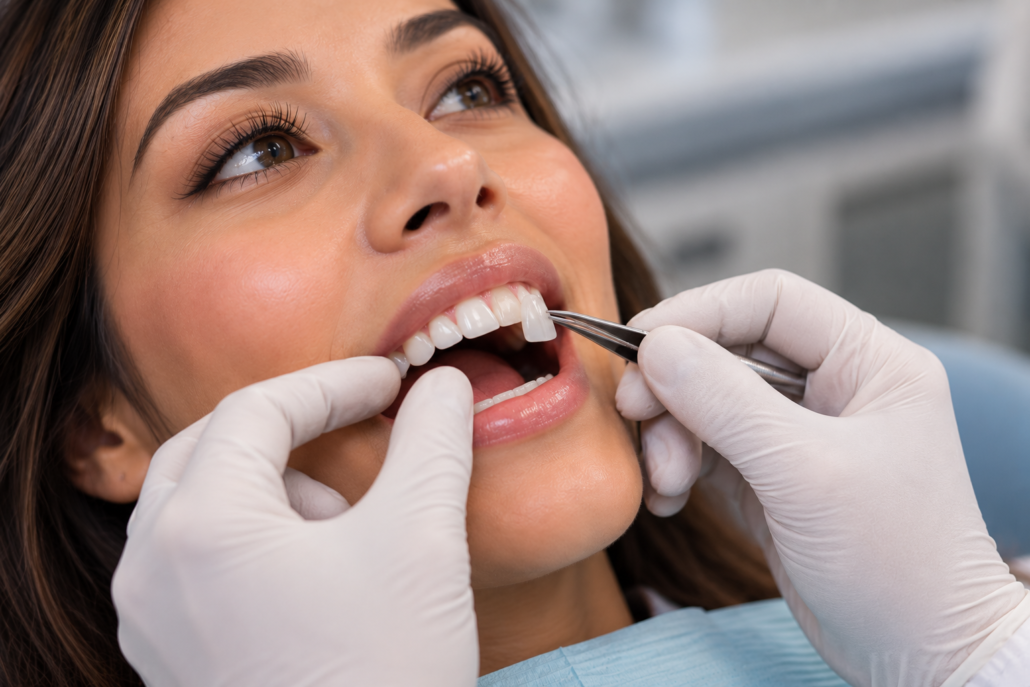
If you love coffee, tea, or a glass of red wine, it's completely reasonable to ask what those habits will do to porcelain veneers.
One of the reasons we use porcelain in cosmetic dentistry is its ability to maintain its appearance remarkably well.
Natural enamel is beautiful, but it's also porous enough to pick up discoloration over time. A glazed dental ceramic behaves differently.
Porcelain is remarkably color stable. But the veneer is only one part of the smile we're looking at.
The porcelain itself can remain quite stable while the natural teeth beside it change color. Plaque or stain can collect near a margin. The gums can recede. The bonding interface can age. And a veneer with a damaged or roughened surface won't necessarily behave exactly like one with its original polished finish.
So the simple answer is that porcelain veneers are very resistant to staining.
The more useful answer is understanding what can still change around them.
Do porcelain veneers stain?
Not in the same way natural teeth do.
A well-made porcelain veneer has a smooth ceramic surface that is much less susceptible to absorbing pigments than natural enamel or tooth-colored composite materials.
That's one of the reasons porcelain can be such a beautiful material for a long-term cosmetic restoration.
I would still use the phrase stain-resistant rather than stain-proof.
Dental restorations live in a difficult environment. They're exposed to foods, drinks, temperature changes, toothbrushing, grinding, plaque, and years of everyday use.
The condition of the surface matters too. Smooth, polished ceramic is different from a restoration that has become roughened, scratched, or damaged.
So yes, porcelain is exceptionally good at maintaining its color. I just wouldn't promise that anything placed in the mouth will look exactly the same forever.
Will coffee, red wine, or tea stain porcelain veneers?
These are some of the most common questions I hear because they're exactly the things patients know can stain natural teeth.
The good news is that you generally do not have to give up coffee, tea, or red wine because you have porcelain veneers.

Coffee
Coffee can gradually discolor natural enamel, particularly if you drink it frequently.
Porcelain is considerably more resistant. What I pay attention to over time is not just the veneer, but the natural teeth around it and the area where the veneer meets the tooth.
Red wine
Red wine contains strong pigments that can leave natural teeth looking darker over time.
Again, a smooth porcelain surface is much more resistant to that kind of discoloration. Good home care still matters because plaque and surface deposits can collect around restorations even when the porcelain itself hasn't changed color.
Tea
Tea can be surprisingly effective at staining natural teeth, especially when it's consumed frequently.
I wouldn't tell a veneer patient to stop drinking tea just to protect the color of the porcelain. I would tell them to maintain excellent oral hygiene and regular professional cleanings.
You shouldn't have to design your life around your veneers. Good dentistry should fit into your life.
If porcelain resists stains, why can veneers sometimes look discolored?
This is where the distinction becomes important.
When someone tells me an older veneer seems darker, I don't automatically assume the porcelain itself has stained.
There are several other possibilities.

- The natural teeth have changed color. Your veneers may be essentially the same shade they were when they were placed while the surrounding natural teeth have gradually become darker.
- There is discoloration at the margin. The edge where porcelain meets natural tooth structure is an important area to evaluate. Surface stain, plaque, changes in the bonding interface, or other issues can alter the way that margin looks.
- The gums have changed. Gum recession can expose an area of tooth or restoration that wasn't visible when the veneers were originally placed.
- The surface has become rough. Porcelain is at its best when its surface is smooth and highly polished. A roughened surface can collect deposits more easily and reflect light differently.
- Something underneath the veneer has changed. Porcelain veneers can be quite thin. Depending on the material and translucency, changes involving the underlying tooth or bonding materials may influence the final appearance.
Those are very different problems, and they don't all have the same solution.
That's why I want to see the veneer before deciding that it needs to be replaced.
Can stained veneers be polished?
Sometimes what looks like a stained veneer is actually surface buildup or discoloration around the restoration.
In those situations, professional cleaning or careful polishing may improve the appearance.
But porcelain needs to be treated like porcelain.
I don't want someone aggressively polishing a ceramic restoration with whatever happens to be available. The goal is to remove unwanted deposits while preserving a smooth surface.
If you notice a change, let your dentist determine whether we're dealing with something on the surface, something at the margin, or a change involving the restoration itself.
Can you whiten porcelain veneers?
This is one of the most important things to understand before you choose the shade of a veneer.
Traditional tooth whitening is designed to lighten natural tooth structure. It does not predictably change porcelain to a new, lighter shade.
That creates an interesting situation if you have veneers on some teeth but not others.
The natural teeth may become lighter with teeth whitening while the porcelain remains essentially the shade it was when we made it.
This is why I prefer to think about color before the veneers are finalized.
If someone wants noticeably lighter natural teeth, whitening first can give us a more stable reference point for choosing the final veneer shade.
With veneers, shade isn't something I want to choose in isolation. It has to belong to the entire smile.
Should you choose the whitest possible veneers?
Usually, that's not my goal.
When people say they want white teeth, what they're often really describing is a smile that looks fresh, healthy, and bright.
Those aren't necessarily the same thing as choosing the brightest porcelain shade available.
Natural teeth have variation. They reflect and transmit light. Their color relates to skin tone, lips, neighboring teeth, and the rest of the face.
Beautiful porcelain should respect those relationships.
A veneer can be bright without looking opaque. It can be uniform without looking artificial. And it can make a substantial cosmetic change without announcing itself as dental work.
That's part of the larger philosophy behind cosmetic dentistry . I'm not trying to make every patient's smile look the same.
How do you keep porcelain veneers looking bright?
You don't need an elaborate veneer-maintenance routine.
Most of what protects veneers is the same kind of care that protects natural teeth and gums.
- Brush consistently. Plaque doesn't care whether a tooth has a veneer on it. Keeping the margins clean helps protect both the restoration and the natural tooth supporting it.
- Floss around the veneers. The gums between veneered teeth still need regular cleaning.
- Keep up with professional cleanings. A hygienist can remove deposits you can't remove at home and monitor the areas around the veneers.
- Don't use your teeth as tools. Porcelain is strong, but opening packages or biting hard objects is an unnecessary way to test it.
- Protect the veneers if you grind. If you clench or grind your teeth, a nightguard may be recommended to reduce unnecessary stress on the restorations.
- Have changes evaluated rather than trying to fix them yourself. If something suddenly looks rough, dark, chipped, or different around a margin, let us determine why.
I don't generally ask patients to give up coffee or red wine because they have porcelain veneers.
I would much rather give you restorations that are designed for real life and then help you take good care of them.
When should a discolored veneer be checked?
A gradual cosmetic change isn't necessarily an emergency, but there are situations where I would want to take a closer look.
Make an appointment if you notice:
- A dark line developing around the edge of a veneer.
- One veneer changing appearance while the others remain the same.
- A surface that suddenly feels rough or catches your tongue.
- A chip, crack, or change in the shape of the porcelain.
- Gum recession that has exposed a new area around the veneer.
- New sensitivity or discomfort associated with the tooth.
Sometimes the answer is as simple as cleaning or polishing. Sometimes we're seeing a change in the natural tooth or the margin. And occasionally a veneer really does need to be repaired or replaced.
The important thing is figuring out which problem you actually have before deciding on the solution.
How long can porcelain veneers keep looking good?
There isn't a date when a veneer suddenly expires.
I look at veneers the same way I look at other high-quality dental restorations. Their longevity depends on the original diagnosis, how conservatively the teeth were prepared, the material and bonding, the bite, your habits, and how well everything is maintained.
Some veneers remain beautiful and functional for many years. Others eventually need attention because of a chip, a margin, gum changes, wear, or something happening to the underlying tooth.
Color stability is only one part of longevity.
A veneer should still fit well, function comfortably, protect the tooth beneath it, and look natural within the rest of your smile.
Key takeaways
What to remember about porcelain and stains.
- 01 Porcelain veneers are highly resistant to the kinds of stains that commonly discolor natural teeth.
- 02 Coffee, tea, and red wine do not mean you have to avoid porcelain veneers or give up the things you enjoy.
- 03 A veneer can appear discolored because of changes around it even when the porcelain itself has remained relatively color stable.
- 04 Natural teeth can continue to change color while porcelain remains essentially the same shade.
- 05 Whitening treatments can lighten natural teeth but do not predictably change the shade of porcelain veneers.
- 06 Good hygiene, professional maintenance, and protecting the porcelain from damage help veneers maintain their appearance over time.
Frequently asked questions
A few questions patients ask most.
Do porcelain veneers stain over time?
Porcelain and other dental ceramics are generally very color stable, but I would still describe them as stain-resistant rather than stain-proof. Laboratory aging studies have measured some color change in porcelain veneer systems over time, with the ceramic, cement, and restoration thickness all potentially influencing the final appearance. Research on the color stability of laminate veneers found measurable changes after artificial aging while also finding the average changes in that study to be within its stated clinically acceptable range.
Does coffee stain porcelain veneers?
Porcelain is generally more resistant to staining than natural tooth structure and resin-based restorative materials. Coffee can still contribute to surface deposits around restorations, so hygiene and professional maintenance remain important. Laboratory research continues to evaluate the color stability of ceramic materials exposed to coffee, tea, and red wine , with the amount of measured change varying by ceramic material and staining solution.
Does red wine stain porcelain veneers?
Red wine contains strong pigments, but a smooth dental ceramic surface is relatively resistant to external staining. That doesn't mean the entire smile will remain unchanged forever. Natural teeth, margins, and other restorative materials may behave differently. Studies testing dental ceramics in common staining solutions have included red wine specifically when evaluating ceramic color stability.
Can the edges of porcelain veneers become discolored?
Yes. The margin is different from the glazed porcelain surface itself. Plaque, surface stain, gum changes, and changes involving the cement or tooth-restoration interface can affect its appearance. In a randomized clinical trial evaluating ceramic laminate veneers , marginal discoloration increased during the two-year follow-up in both resin-cement groups studied.
Can the cement underneath a veneer change color?
It can contribute to the final appearance, particularly with thin and translucent restorations. The veneer, underlying tooth, and bonding materials function optically as a system. Research evaluating resin cement beneath ceramic veneers found that aging-related cement color changes could be visible through ceramic in some of the materials studied.
Does veneer thickness affect the final color?
Yes. Porcelain isn't simply an opaque white shell. Thickness, translucency, ceramic shade, the underlying tooth, and the resin cement can all influence what you ultimately see. An in-vitro study of ceramic thickness and resin cement found that ceramic thickness, ceramic shade, and the type and shade of resin cement influenced the final color of laminate restorations.
Can teeth whitening make porcelain veneers whiter?
Whitening is intended to change the color of natural tooth structure. It should not be relied upon to change an existing porcelain veneer to a lighter porcelain shade. This is one reason shade planning matters before veneers are fabricated. Research also demonstrates that the final appearance of a veneer depends on several optical factors, including ceramic thickness, ceramic shade, and resin cement , rather than the ceramic shade alone.
Is marginal discoloration a sign that my veneer is failing?
Not automatically. It needs to be examined so we can determine whether we're seeing removable surface stain, a cosmetic change at the margin, gum recession, or a problem that affects the restoration or underlying tooth. A systematic review and meta-analysis of porcelain and glass-ceramic veneers reported severe marginal discoloration as one of the evaluated complications, with an estimated rate of 2% across the included studies.
How long do porcelain veneers last?
There isn't one expiration date for every veneer. Longevity depends on the tooth, preparation, bonding, ceramic, bite, habits, and maintenance. A systematic review of 6,500 porcelain laminate veneers estimated cumulative survival at 95.5% after ten years. Survival doesn't mean every veneer remained completely unchanged cosmetically, but it gives us useful long-term clinical context.
What problems are most likely to affect porcelain veneers over time?
Color is only one thing we monitor. Fracture, chipping, debonding, the condition of the margins, the health of the underlying tooth, and gum changes also matter. In a systematic review and meta-analysis of clinical veneer studies , fracture and chipping were more common complications than severe marginal discoloration.
Do porcelain veneers stay the exact same color forever?
I wouldn't promise that. Porcelain is highly color stable, but a veneer is a combination of ceramic, bonding material, and natural tooth structure living in the mouth for years. A recent nine-year randomized clinical follow-up found color changes beyond the study's clinical acceptability thresholds and marginal discoloration in the evaluated ceramic veneers. That is a useful reminder that stain resistance and permanent color immutability are not the same thing.
Are porcelain veneers a durable cosmetic treatment?
They can be. Appropriate case selection and careful treatment planning matter. A systematic review and meta-analysis of ceramic laminate veneers reported high long-term survival for feldspathic, leucite-reinforced, and lithium-disilicate veneer systems. That doesn't make veneers permanent, but it supports ceramic veneers as a well-established restorative option when they're appropriately used.