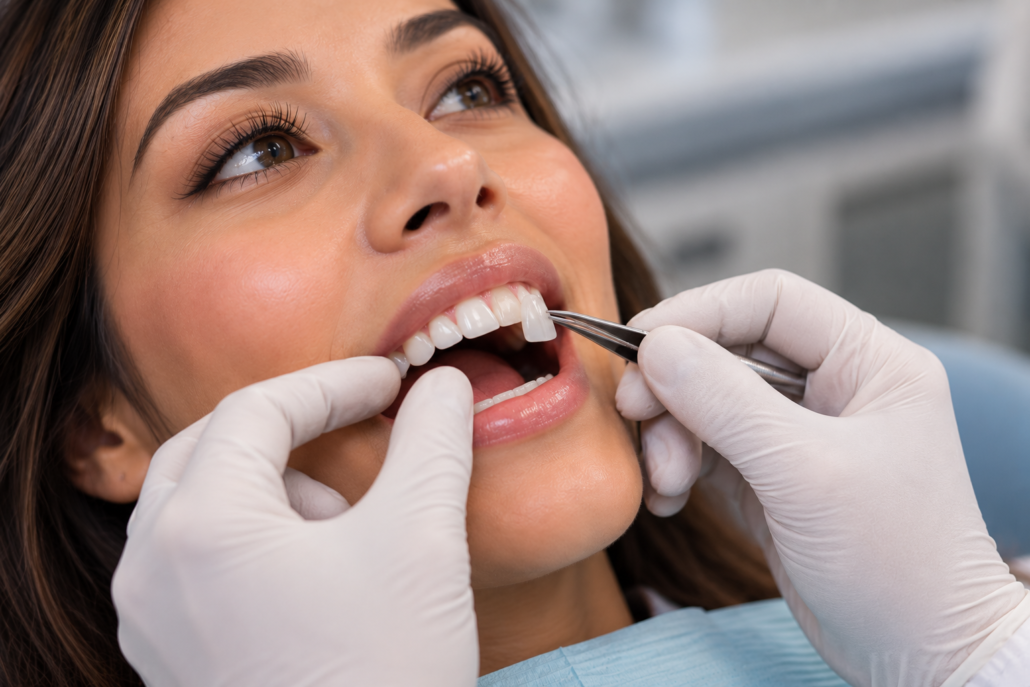
When someone tells me they want veneers but they don't want them to look like veneers, I know exactly what they mean.
They don't want a row of identical white rectangles.
They don't want teeth that enter the room before they do.
They want a better smile without losing the things that make the smile feel like their own.
A natural-looking veneer shouldn't announce itself. It should simply look like a beautiful tooth.
That's why I don't think about natural-looking porcelain veneers as a shade-selection exercise.
Color matters, of course. But so do proportion, translucency, texture, tooth position, gumline, the surrounding teeth, and the face around the smile.
All of those details have to make sense together.
Can porcelain veneers really look natural?
Absolutely.
But “natural” doesn't mean making porcelain an exact copy of every irregularity that was there before.
We're still trying to improve something.
Maybe a tooth is too short. Maybe several teeth have worn unevenly. Maybe there are spaces, discoloration, old bonding, or proportions that don't feel right in the smile.
The challenge is deciding what to change and what to leave alone.
If every characteristic is corrected toward some theoretical idea of perfection, the result can begin to look artificial.
Natural teeth aren't manufactured objects. They have subtle differences in contour, texture, brightness, translucency and the way they reflect light.
I don't want every tooth to be perfect in isolation. I want the smile to make sense as a whole.
What makes some veneers look fake?
Usually it isn't one thing.
It's a collection of little decisions that don't quite belong together.
They're too uniform
When every tooth has exactly the same length, contour, surface and character, the smile can begin to look manufactured.
They're too opaque
Natural teeth interact with light. Porcelain that looks completely flat or solid can lose some of that visual depth.
They're too bulky
If the existing position of the tooth isn't considered, simply adding material to the outside can create excessive volume.
They're too bright for the smile
A beautiful shade still has to make sense beside the surrounding teeth, gums, lips and face.
None of those decisions exists independently.
A very bright veneer can still look natural in the right smile. A beautifully translucent veneer can still look wrong if its shape doesn't belong.

Natural-looking veneers aren't simply about choosing the right white
Shade is one of the first things patients notice, so naturally it becomes one of the first things they ask about.
But teeth aren't one flat color.
Even within a single natural tooth, your eye may see differences from the gumline to the biting edge. Some areas appear warmer. Others allow more light through. There may be subtle variations that you would never consciously identify but would notice if they suddenly disappeared.
That's part of why simply making a veneer “white” isn't enough.
I want to know how that brightness behaves beside the surrounding teeth.
If we're treating only one or two teeth, that relationship becomes especially important because the porcelain has to live immediately beside natural enamel.
If we're treating several teeth, we have more control over the overall color relationship, but the result still has to belong in the face.
The question isn't simply, “How white can we make it?” It's “What brightness belongs here?”
Shape may matter even more than color
You can choose a beautiful porcelain shade and still end up with a smile that doesn't look right.
That's because your eye is also reading shape.
How long are the front teeth? How wide do they appear? Where are the corners? How does one tooth transition into the next? How much tooth shows when you smile? How does the smile relate to the lips?
Those relationships create proportion.
And proportion doesn't mean giving everyone the same tooth shape.
A shape that looks wonderful in one face may look completely wrong in another.
That's why I don't want to design the teeth as isolated objects on a model. I want to see them in the smile.
Natural teeth do something porcelain has to imitate: they play with light
This is one of those details that's difficult to appreciate until you see it.
Natural enamel isn't visually flat.
Light reflects from the surface, but it also interacts with the layers of the tooth. The surface itself has subtle texture rather than behaving like perfectly polished glass.
Those characteristics contribute to the depth we associate with a natural tooth.
Porcelain gives us the ability to create some of that same visual complexity.
The goal isn't to add obvious grooves or dramatic color effects. It's much quieter than that.
It's giving the restoration enough character that light doesn't expose it as a flat artificial surface.
Natural doesn't mean imperfect for the sake of imperfection. It means giving the eye the details it expects to see.
The tooth underneath the veneer matters too
We're not designing porcelain in empty space.
There's a tooth underneath it.
Its position, color, existing restorations and amount of healthy enamel all influence what we can do with the veneer.
A tooth that's already positioned farther forward may require a different approach than one that sits farther back.
A very dark tooth creates a different color challenge than a tooth that's already close to the desired shade.
And the amount of change we're trying to make affects how we think about preparation.
That's why I don't separate the cosmetic design from the tooth supporting it.
If you're wondering what actually remains beneath the porcelain, I've explained that in more detail in what happens to teeth under veneers .

The gums, lips and neighboring teeth are part of the design
A veneer doesn't stop at the edge of the porcelain.
Visually, your eye keeps going.
It sees the gumline above it, the teeth beside it, the lips around it and eventually the entire face.
That surrounding anatomy is the frame.
If one front tooth is being restored, I may be paying very close attention to how its edge, width, brightness and surface compare with the natural tooth beside it.
If several teeth are being changed, I'm thinking about the relationship of the group.
Either way, the veneer has to belong to something larger than itself.
Do you need veneers on every tooth that shows when you smile?
No.
I don't think the goal should be to veneer as many teeth as possible.
The question is which teeth actually need to change.
Sometimes we're correcting one tooth that stands out from the others.
Sometimes several front teeth need to be considered together because changing only one or two would create a mismatch in color, shape or proportion.
And sometimes a tooth doesn't need porcelain at all.
Whitening, orthodontic movement, composite bonding , or simply leaving a healthy tooth alone may make more sense.
More dentistry isn't automatically better dentistry. The treatment should stop where the reason for treatment stops.
Four questions I want the result to answer quietly.
Does the color belong?
Not simply “Is it white?” but does the brightness and character make sense beside the surrounding teeth and in the face?
Does the shape belong?
The length, width and contours should feel intentional without making the teeth look manufactured.
Does the surface behave like a tooth?
Texture and translucency affect the way light moves across and through the restoration.
Does the smile still look like you?
Cosmetic dentistry should improve what bothers you without automatically erasing everything that made your smile yours.
Natural-looking doesn't mean nothing changes
There's another side to this conversation.
Sometimes patients become so worried about veneers looking artificial that they become afraid to make a meaningful change.
Natural doesn't mean the new smile has to look exactly like the old one.
We may be changing tooth length. Closing spaces. Improving proportion. Correcting wear. Changing color. Replacing old restorations. Or redesigning several teeth so they work better together.
Those changes can be noticeable.
What I don't want is for the dentistry to be the thing people notice.
A beautiful veneer shouldn't call attention to itself. It has to work with your face, your smile, your gums and the teeth around it.
Sometimes the real question is bigger than veneers
If you're considering changes across several teeth, the conversation may become less about choosing individual veneers and more about planning the smile as a whole.
That's where a smile makeover approach can be useful.
We can look at which teeth actually need treatment, whether the teeth should be moved first, whether whitening changes the plan, where bonding may be appropriate, and where porcelain gives us better control.
The point isn't to make every visible tooth identical.
It's to make the changes work together.
I want the final result to look less like dentistry and more like it was always supposed to be there.
Key takeaways
What matters most about natural-looking veneers.
- 01 Porcelain veneers can look very natural. The result depends on much more than simply choosing a shade.
- 02 Natural teeth contain variation. Translucency, texture and subtle differences in color help create visual depth.
- 03 Proportion matters. A tooth has to fit the neighboring teeth, gums, lips and face.
- 04 Whiter isn't automatically more natural. Brightness has to make sense within the entire smile.
- 05 The starting tooth matters. Its color, position and condition influence how the restoration can be planned.
- 06 You don't necessarily need veneers on every visible tooth. Treatment should be based on what actually needs to change.
Frequently asked questions
A few questions patients ask most.
Can porcelain veneers look like natural teeth?
Yes. Dental ceramics can reproduce characteristics such as color, translucency and surface appearance that contribute to a natural result. The final appearance also depends on the restoration's shape, thickness, underlying tooth and surrounding teeth. Long-term clinical evaluations of ceramic veneers have reported favorable esthetic outcomes when treatment is appropriately planned and bonded.
Why do some veneers look too white?
Perceived tooth color is influenced by more than a single shade designation. Ceramic thickness, translucency, the color of the underlying tooth and the luting material can all influence the final appearance. Ceramic systems and restorative variables can affect final color and color stability .
Do veneers have to be perfectly uniform to look good?
No. Natural teeth contain differences in contour, texture, translucency and light reflection. Esthetic ceramic restorations are designed with those optical characteristics in mind rather than simply producing a flat, uniform surface. Ceramic optical properties play an important role in reproducing natural dental appearance .
Does the natural tooth color show through a porcelain veneer?
It can influence the final result, particularly with thinner or more translucent ceramics. The veneer, underlying tooth and cement function optically as a system, which is why a significantly discolored tooth may require different planning than a lighter tooth. Substrate and restorative factors can influence veneer treatment planning .
Do veneers look more natural after a few days?
The porcelain itself does not need to “settle” into a different shape, but the way you perceive a new smile can change as you become accustomed to it and as the surrounding soft tissues recover from treatment. Healthy gum tissue is an important part of the final esthetic frame, and periodontal response around ceramic veneers is an important consideration in long-term outcomes .
Can one veneer match the tooth beside it?
It can, although matching a single restoration directly beside natural enamel can be one of the more demanding cosmetic situations. Shade, translucency, surface texture and contour all contribute to the match. Understanding the optical behavior of dental ceramics is important when reproducing natural tooth appearance .
Will porcelain veneers stay the same color?
Dental ceramics are generally quite color stable, but the appearance of a veneered smile can still change as natural teeth, gums and surrounding restorations change over time. I explain the distinction in more detail in Do Porcelain Veneers Stain?
How many veneers look the most natural?
There isn't one number that produces the most natural result. The number depends on which teeth need to change, which teeth show in the smile, and whether untreated neighboring teeth can harmonize with the planned restorations. Preserving enamel is an important consideration in adhesive veneer treatment , which is one reason healthy teeth should not be included without a reason.
Can veneers look natural if my teeth are very dark?
They can, but darker underlying tooth structure changes the restorative challenge. The dentist and laboratory have to balance masking the underlying color with maintaining enough translucency and depth for the restoration to remain lifelike. Ceramic material and restorative conditions can influence the final perceived color .