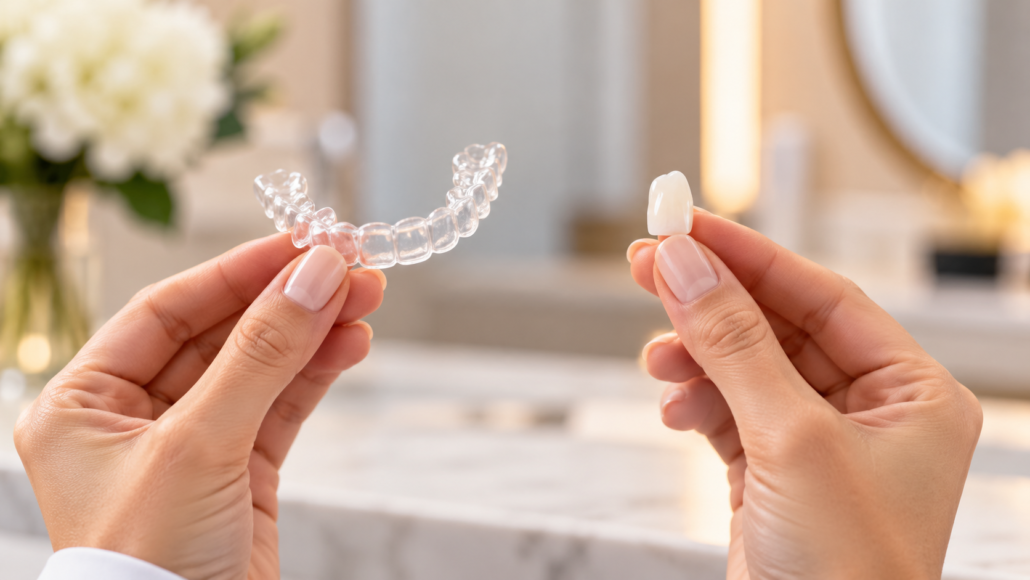
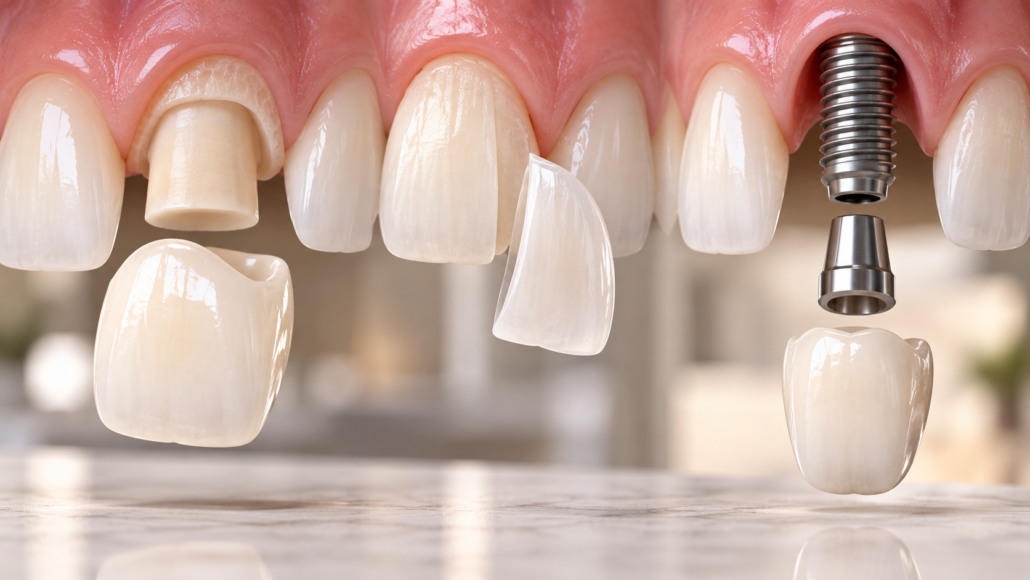
One of the things patients like most about Invisalign is how little it asks them to change their everyday appearance.
There are no brackets across the front of the teeth. You can remove the aligners to eat and brush. And for many adults who have thought about straightening their teeth for years, that makes orthodontic treatment feel much more approachable.
But I think the most important thing to understand about Invisalign happens before you ever put in the first tray.
The goal isn't a mathematically perfect smile. It's a smile that looks balanced, functions well, and belongs to you.
Teeth don't all move equally well in every direction. Your bite matters. The shape and position of your teeth matter. The amount of crowding or spacing matters.
And sometimes the small tooth-colored attachments you weren't expecting are exactly what allow an aligner to create the movement we're asking for.
That's why I think of Invisalign as a treatment system rather than a product. The clear trays are the part you see. The planning behind them is what creates the result.
What can Invisalign actually fix?
Invisalign and other clear aligner systems move teeth by applying carefully planned forces through a sequence of removable trays.
Depending on the individual case, aligners can be used to address concerns such as:
- Crowded teeth. Teeth that overlap or don't have enough room to sit in a more ideal position.
- Spaces between teeth. Aligners can gradually close selected gaps and redistribute space.
- Rotated teeth. Certain rotations can be corrected, although some are more challenging than others.
- Some bite problems. Depending on their cause and severity, selected overbite, open-bite, crossbite, and other bite relationships may be treated with aligners.
- Teeth that have shifted after previous orthodontics. Invisalign can often be useful when teeth have moved after braces or earlier aligner treatment.
What matters is that "Invisalign can move teeth" doesn't mean every tooth movement is equally predictable.
A systematic review of clear aligner effectiveness found that aligners can successfully produce orthodontic tooth movement, but predictability varies depending on the type of movement being attempted.
That distinction is important. A straightforward alignment case and a complex bite correction aren't the same treatment simply because both patients are wearing clear trays.
How does Invisalign straighten your teeth?
We begin by creating a digital representation of your teeth and bite. From there, the desired tooth movements can be planned as a sequence rather than trying to move everything at once.
Each aligner is slightly different from the one before it.
As you progress through the series, those small differences apply forces to selected teeth and gradually guide them toward their planned positions.
That sounds simple. Biologically, it isn't.
Teeth move because controlled orthodontic forces create changes in the tissues and bone surrounding their roots. The crown you see in the mirror is only part of the tooth we're moving.
That's one reason digital treatment simulations should be viewed as a plan rather than a guarantee of exactly how every tooth will respond.
The computer can show us where we'd like the teeth to go. The biology determines how they actually get there.
How your smile changes during Invisalign treatment
Orthodontic treatment is a progression. You usually won't see one dramatic change from one tray to the next. Instead, a series of small movements gradually changes the alignment of the teeth.

Starting position
Crowding, rotation, spacing, and the bite are evaluated before movement is planned.
Early alignment
Initial trays begin creating space and guiding selected teeth toward better positions.
Fine-tuning
As alignment improves, smaller rotations, contacts, and bite relationships can become the focus.
Final alignment
The goal is a balanced result that looks good and works comfortably within your bite.
This is also why I don't judge Invisalign treatment only by whether the front teeth look straight. We need to look at how the teeth fit together and whether the movements we planned were actually achieved.
What are Invisalign attachments?
If you've looked closely at someone wearing Invisalign, you may have noticed tiny tooth-colored shapes bonded to some of their teeth.
Those are attachments.
They give the aligner additional surfaces to push against so we can create movements that would be difficult for a smooth plastic tray to accomplish on its own.
The number, shape, and location of attachments depend on the movements being planned. Some patients need very few. Others need more.
Does needing attachments mean my case is complicated?
Not necessarily.
I think of attachments as tools. If adding a small tooth-colored attachment gives us better control over a tooth, I'd rather use the tool than ask the aligner to do something less predictably without it.
What is an Invisalign refinement?
A refinement is an additional series of aligners used after we've evaluated how your teeth responded to the original series.
Maybe one tooth didn't rotate as completely as planned. Maybe the bite needs additional adjustment. Maybe we're very close, but there are a few details I don't want to leave unfinished.
That doesn't automatically mean treatment failed.
It means we're responding to what your teeth actually did rather than pretending they followed a digital plan perfectly.
The part of Invisalign treatment only you can control
Clear aligners have one enormous advantage and one corresponding responsibility: you can take them out.
That's wonderful when you're eating, brushing, flossing, or have a special occasion.
But teeth only experience the planned orthodontic force while the aligners are being worn.
Removable orthodontic appliances depend on patient cooperation, and research evaluating removable-appliance wear has found that actual wear can differ meaningfully from prescribed wear.
A systematic review of compliance with removable orthodontic appliances found discrepancies between prescribed and objectively measured wear, reinforcing why consistent wear matters in removable orthodontic treatment.
Invisalign works best when wearing the trays becomes part of your routine rather than something you have to remember occasionally.
Removable is one of Invisalign's greatest conveniences. It also makes you part of the treatment team.
Does Invisalign hurt?
You should expect some pressure and tenderness.
That's particularly common when you begin treatment or change to a new aligner. The sensation usually feels more like tightness or soreness than a sharp pain.
A systematic review comparing pain with Invisalign and fixed braces found moderate-certainty evidence suggesting Invisalign patients experienced less pain during the first few days of treatment than patients with conventional fixed appliances. After that early period, the differences were not apparent.
A later systematic review and meta-analysis similarly found lower pain with clear aligners on days three and four, but not consistently at the other time points studied.
So I wouldn't describe Invisalign as painless. We're intentionally moving teeth. Some soreness is normal.
Eating, brushing, and living with Invisalign
This is where clear aligners can fit very naturally into adult life.
You remove them to eat, which means you aren't navigating food around brackets and wires. You can also brush and floss your teeth without fixed orthodontic hardware in the way.
That doesn't mean oral hygiene becomes optional. If anything, you become more aware of it because you're putting the aligners back over your teeth.
Brush and floss carefully, keep the trays clean, and don't let wearing aligners become a reason to trap food or plaque against the teeth for long periods.
From a quality-of-life perspective, research has found some advantages during treatment. A systematic review and meta-analysis comparing clear aligners with fixed appliances found better oral-health-related quality-of-life scores with clear aligners at several points during treatment, although the groups were similar by the end of treatment.
Can everyone get Invisalign?
No, and I think that's an important thing to say clearly.
Clear aligners have become much more capable, but they're not automatically the best tool for every orthodontic problem.
Some complex movements and bite corrections can be more difficult to accomplish predictably with aligners alone. In certain cases, additional orthodontic techniques or fixed appliances may offer better control.
Recent systematic-review evidence comparing clear aligners with fixed appliances continues to find that effectiveness varies by the movement being attempted, with some aspects of rotation and torque control favoring fixed appliances in the limited available evidence.
That's why I don't think the first question should be, "Can I have Invisalign?"
The better question is, "What does my smile need, and is Invisalign a good way to accomplish it?"
Is Invisalign right for you?
I start with the same things I would evaluate before any orthodontic treatment.
- Your teeth and gums. We want a healthy foundation before intentionally moving teeth.
- Your bite. Straight front teeth aren't enough if the teeth don't function well together.
- The movements required. Some are very well suited to aligners. Others require more planning, auxiliaries, or a different approach.
- Your expectations. We should agree on what we're trying to change and what Invisalign realistically can and cannot accomplish.
- Your willingness to wear the trays. A beautifully planned treatment can't work while the aligners are sitting on the bathroom counter.
- The entire smile. Alignment is only one part of what makes a smile look balanced. Tooth shape, color, proportions, gum levels, and facial relationships matter too.
For the right patient, Invisalign can be a remarkably discreet way to make a meaningful change.
I just don't want the fact that the appliance is simple to wear to make the treatment itself seem simple.
Key takeaways
What to know before starting Invisalign.
- 01 Invisalign can treat many common alignment and spacing concerns, but not every orthodontic problem is equally suited to clear aligners.
- 02 Tooth movement happens gradually through a planned sequence of aligners rather than one dramatic change.
- 03 Tooth-colored attachments can give the aligners additional control and are a normal part of many treatments.
- 04 Refinement aligners allow treatment to respond to how your teeth actually moved rather than relying only on the original digital plan.
- 05 Consistent wear matters because removable aligners can only work while they're actually on your teeth.
- 06 The goal is more than straight front teeth. A successful result should also respect your bite, oral health, and the proportions of your individual smile.
Frequently asked questions
A few questions patients ask most.
Does Invisalign really straighten teeth?
Yes. Clear aligners can produce orthodontic tooth movement and can be very effective in appropriately selected cases. However, systematic-review evidence shows that the predictability of treatment varies according to the type of tooth movement being attempted.
What problems can Invisalign fix?
Invisalign may be used for crowding, spacing, rotations, and selected bite problems. The severity and cause of the problem matter. Research evaluating clear aligner effectiveness has found that different tooth movements have different levels of predictability, which is why case selection and treatment planning are so important.
Does Invisalign hurt?
Some pressure and soreness are normal, especially after beginning treatment or changing aligners. A systematic review found that Invisalign patients tended to report less pain than patients with conventional fixed appliances during the first few days, with no clear difference thereafter.
Are clear aligners more comfortable than braces?
They may be more comfortable during some portions of treatment, but neither option should be described as painless. A systematic review and meta-analysis found lower pain with clear aligners on the third and fourth days after treatment began, but not consistently at other measured times.
What are the little bumps on my teeth with Invisalign?
They're usually attachments: small tooth-colored composite shapes bonded to selected teeth. They provide additional surfaces for the aligner to engage so we can create better control over certain tooth movements. Their number and position depend on your individual treatment plan.
Do I have to wear Invisalign all day?
Invisalign is intended to be worn consistently according to your prescribed treatment plan, with the aligners removed for activities such as eating and oral hygiene. A systematic review of removable orthodontic appliance compliance found that actual wear can differ from prescribed wear, which is an important consideration whenever orthodontic treatment depends on a removable appliance.
Can I eat normally with Invisalign?
One of the practical advantages of Invisalign is that the aligners are removable. You normally remove them when eating, then clean your teeth as appropriate before putting them back in. This means there aren't brackets and wires restricting the foods you can chew in the same way as fixed braces.
Will I need Invisalign refinements?
You may. Teeth don't always express every planned movement exactly as predicted. Systematic-review evidence shows that clear-aligner predictability varies by the movement being attempted. Refinement aligners give us a way to reassess and fine-tune the result when additional movement is needed.
Is Invisalign faster than braces?
Not necessarily. Treatment time depends on what needs to move, the complexity of the bite, how the teeth respond, and how consistently removable aligners are worn. I wouldn't choose Invisalign on the assumption that it will automatically finish faster than fixed orthodontic treatment.
Is Invisalign as effective as braces?
That depends on the orthodontic problem being treated. Both can be effective, but they don't provide identical control for every movement. A systematic review comparing clear aligners and fixed appliances found that the available evidence varies by treatment outcome and that some movements remain less predictable with aligners.
Will my teeth stay straight after Invisalign?
Orthodontic treatment doesn't end the day the last aligner comes out. Teeth can move throughout life, so retention is an important part of protecting the alignment you've achieved. Your retention plan should be discussed as part of treatment rather than as an afterthought at the final appointment.
How do I know if I'm a good candidate for Invisalign?
We need to evaluate your teeth, gums, bite, amount of crowding or spacing, the movements required, and your ability to wear removable aligners consistently. Evidence on clear aligner effectiveness supports the importance of matching the appliance to the type and complexity of tooth movement rather than assuming aligners are equally predictable for every patient.