A patient will sometimes come in frustrated because it feels as though there is always another tooth to fix.
First a filling breaks. A few months later, part of another tooth chips. Then an older crown develops a problem. Each event may have been treated appropriately on its own, but eventually the patient starts asking the more important question:
Why do my teeth keep breaking?
That is when I want to widen the view. Instead of looking only at the latest broken tooth, I want to understand what the teeth have been through, how much natural structure remains, how the bite is functioning, whether there are signs of grinding or clenching, and whether older dental work is beginning to fail.
The broken tooth is important. But when breakage keeps happening, it may be the latest symptom of a larger problem.
One broken tooth is different from teeth that keep breaking.
Teeth can break for many reasons. You might bite unexpectedly on something hard. A tooth may have a crack that finally gives way. A large filling may weaken the remaining walls. Decay can undermine part of a tooth. Sometimes an accident explains everything.
An isolated event does not necessarily mean there is a problem throughout your mouth.
Repetition gets my attention.
If several teeth have fractured over a period of time, or if fillings, crowns, and natural teeth are all beginning to fail, I want to understand what those problems have in common.
Fix the tooth that broke. Then ask why it broke.
That second question can change the treatment plan considerably.
Years of dental work can leave less natural tooth behind.
A tooth that has never had a cavity is structurally very different from a tooth that has been repaired several times.
Imagine a molar that received a small filling years ago. Later, decay developed around that filling and it was replaced with a larger one. Eventually, much of the center of the tooth may be restoration rather than natural tooth.
The tooth can still look quite substantial from the outside, but the remaining walls and cusps may be thinner than they once were.
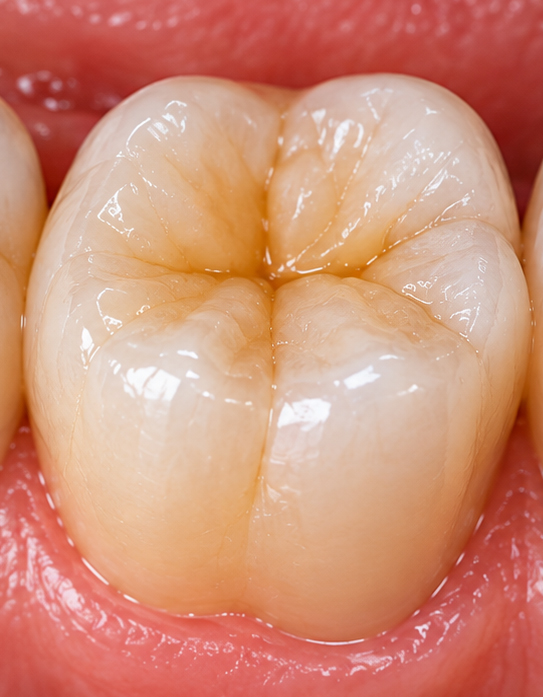
Healthy tooth
An intact tooth has its natural structure available to absorb and distribute the forces of everyday biting and chewing.
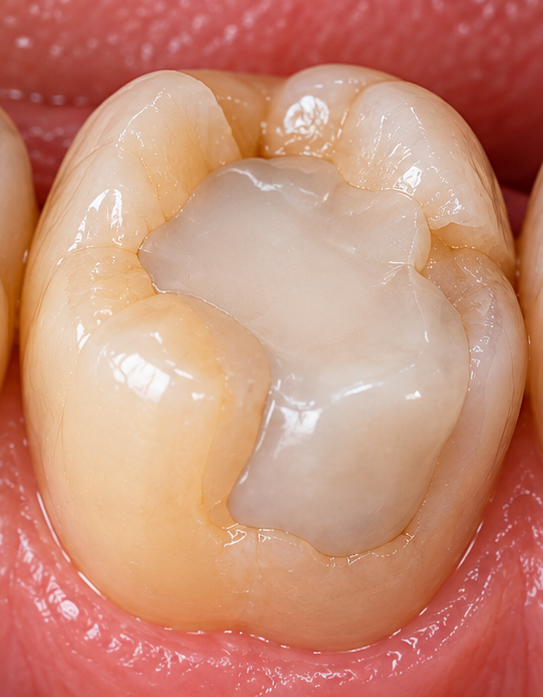
Large restoration
As a restoration becomes larger, less natural tooth remains. The walls and cusps surrounding the filling may become more vulnerable to force.
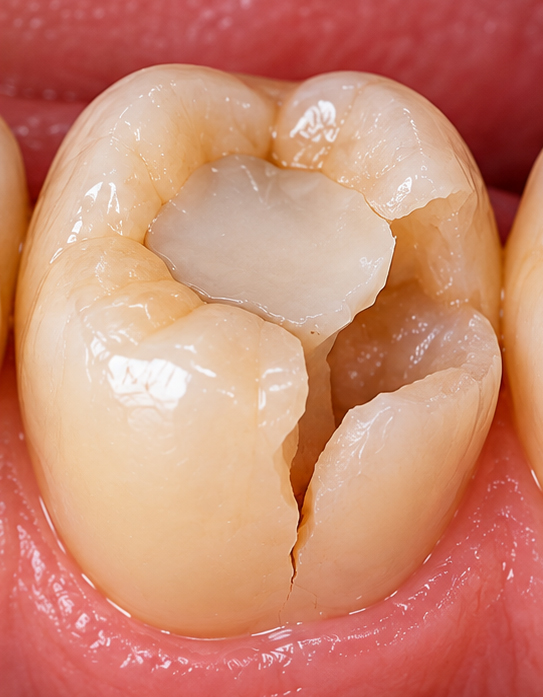
Fractured tooth
If a remaining cusp or wall can no longer tolerate the forces placed on it, part of the natural tooth may eventually break.
This does not mean that large fillings are bad dentistry or that every heavily restored tooth will fracture. It means the history of the tooth matters when we are trying to understand why something broke.
Sometimes a new filling is still appropriate. When more structure has been lost, protecting the remaining tooth with a dental crown may make more sense.
The decision depends on what is actually left, not simply on the size of the piece that broke off.
Grinding and clenching can add up over time.
Teeth are designed to tolerate considerable force. The problem is not simply that your teeth touch each other. It is how often, how hard, and in what direction those forces are being applied.
Someone who clenches or grinds may repeatedly load the same teeth and restorations far beyond ordinary chewing. You may not even be aware that it is happening, particularly if much of the activity occurs during sleep.
I look for the pattern it leaves behind. Flattened chewing surfaces, chipped edges, cracks, worn restorations, muscle symptoms, and repeated restorative failures can all contribute to the overall picture.
Grinding is not the explanation for every broken tooth, and I would not assume it is the cause simply because a tooth fractured. But when teeth keep breaking, it is one of the factors worth evaluating.
Your bite determines where the forces go.
I do not look at a broken tooth as though it functions by itself. Every tooth is part of a larger system.
When you close your mouth and chew, the upper and lower teeth meet in a particular pattern. Ideally, those forces are distributed in a way the teeth and restorations can tolerate.
If certain teeth are carrying more of the load, or if the bite has changed because of wear, tooth movement, missing teeth, or previous dentistry, some areas may be placed under greater stress.
The individual tooth
What happened here?
I look at the fracture, existing fillings or crowns, decay, cracks, and how much healthy tooth structure remains.
The whole mouth
Why did it happen here?
I also look at wear patterns, opposing teeth, missing teeth, previous dentistry, and how forces move through the bite.
Both views matter. Repairing the individual tooth without considering the larger pattern can sometimes leave the reason for the failure untouched.
Missing teeth can change the larger picture.
Losing a tooth does not automatically mean another tooth will break. But teeth function together, and a missing tooth can change how the remaining teeth contact, move, and share chewing forces.
The effect depends on which tooth is missing, how long it has been missing, what the opposing teeth are doing, and the condition of the rest of the mouth.
That is why I include missing teeth in the evaluation when someone has experienced repeated fractures. Sometimes they are unrelated. Sometimes they are one part of a much larger restorative picture.
A tooth can be weakened before you know it is damaged.
Not every fractured tooth gives you much warning.
Decay can develop around an existing filling or underneath the edge of older dental work. As healthy tooth structure is lost, the remaining portion of the tooth may become less capable of handling normal chewing forces.
Eventually, a cusp or wall can fracture.
From the patient's perspective, the tooth seemed fine until the day it broke. From my perspective, the fracture may be the final event in a process that had already weakened the tooth.
This is another reason the examination matters. I do not want to assume that every broken tooth is simply a mechanical problem. We need to know whether there is disease underneath the damage too.
Why repairing one tooth at a time may not solve the problem.
If one tooth breaks and everything else is healthy, treating that tooth individually makes perfect sense.
The situation changes when there is a history of repeated fractures, large old restorations, significant wear, several crowns, missing teeth, or other signs that multiple parts of the mouth are beginning to need attention.
We can keep responding to whichever tooth becomes the emergency that month. Sometimes that is all a patient wants or can reasonably do at that time.
But I still want the patient to understand the larger picture.
If we only repair the tooth that broke, we may only be treating the latest symptom.
Looking at the mouth comprehensively does not mean every tooth needs treatment. In fact, it can help us avoid unnecessary dentistry by identifying which teeth are healthy, which should simply be watched, which need attention now, and which problems may be connected.
What am I looking for when teeth keep breaking?
I want enough information to understand both the individual failures and the pattern connecting them.
- How much natural tooth structure remains? A tooth with a small restoration presents a very different structural situation from one that has been rebuilt several times.
- Are there cracks or fractures? Where a crack extends can influence whether a tooth can be restored predictably.
- Is there active decay? Decay around older restorations may weaken teeth before a visible fracture occurs.
- What condition is the existing dental work in? Older fillings and crowns may still be functioning beautifully, or they may be approaching the point where replacement should be considered.
- Is there a pattern of wear? Worn, flattened, or chipped teeth can give us information about what has been happening over time.
- How is the bite functioning? I want to understand where the teeth contact and whether certain areas appear to be carrying excessive force.
- Are any teeth missing? Missing teeth may affect the way the remaining teeth function and can influence the larger restorative plan.
No single finding automatically determines treatment. I am putting the pieces together.
Can broken teeth still be saved?
Very often, yes.
A broken tooth does not automatically need a crown, and it certainly does not automatically need to be removed. Treatment depends on the amount and location of the damage, the condition of the remaining tooth, and what caused the problem.
Small, localized damage
A relatively small chip or damaged area may sometimes be repaired conservatively with bonding or a filling.
Larger structural loss
When a substantial portion of a tooth has been lost, a crown or another restoration that protects more of the remaining structure may be appropriate.
Several compromised teeth
When multiple teeth are breaking or heavily restored, I may step back and plan how those teeth should function together rather than making isolated decisions.
A tooth that cannot be predictably restored
If damage extends too far or there is not enough healthy structure to create a dependable restoration, replacing the tooth may eventually become part of the discussion.
The goal is not to move through those steps automatically. It is to use the least treatment that gives the tooth a reasonable long-term prognosis.
If a tooth reaches the point where saving it is uncertain, our article Is It Better to Save a Tooth or Get a Dental Implant? goes deeper into that decision.
What if several teeth are already damaged?
This is where planning becomes particularly important.
A patient may have a mixture of healthy teeth, large fillings, older crowns, worn teeth, missing teeth, and one or two teeth that are actively breaking. That does not necessarily mean everything needs to be replaced.
It means we need priorities.
Which teeth are healthy and should be left alone? Which restorations are still functioning well? Which teeth are vulnerable but stable? Which problems need attention now? And if several teeth do need treatment, how should they work together when we are finished?
For some patients, the answer may still be a few individual restorations. For others with extensive wear, failing dentistry, or problems involving many teeth, a more comprehensive full-mouth reconstruction may be worth discussing.
Comprehensive planning does not mean treating everything. It means understanding everything before deciding what actually needs treatment.
What if it is your crowns that keep failing?
A crown is designed to protect and restore a compromised tooth, but the restoration still depends on the tooth underneath it and the forces acting on it.
If a crown repeatedly loosens or comes off, I would not assume that the answer is simply stronger cement. The fit of the crown, the remaining tooth structure, decay, fracture, and the bite all deserve a closer look.
We cover that specific situation in Why Does My Crown Keep Falling Off?
Do not just count the broken teeth. Look for the pattern.
If you have broken one tooth, there may be a straightforward explanation and a straightforward repair.
If your teeth seem to keep breaking, I think you deserve a better answer than being told that you simply have bad teeth.
There may be a structural problem, older dentistry that is beginning to reach the end of its useful life, decay, grinding, changes in the bite, missing teeth, or several factors working together.
Once we understand the pattern, we can decide what actually needs to be repaired, what can be preserved, and whether anything needs to change so that we are not simply waiting for the next tooth to break.
Key takeaways
Repeated breakage deserves a wider look.
- 01 One broken tooth can be an isolated event. Several broken teeth may indicate a larger pattern.
- 02 Large fillings and previous dental work can leave less natural tooth structure available to tolerate biting forces.
- 03 Grinding, clenching, decay, the bite, and missing teeth can all be relevant when repeated fractures occur.
- 04 Repairing the latest broken tooth may not address the reason failures keep happening.
- 05 Many broken teeth can still be saved. The right treatment depends on how much healthy structure remains and the condition of the tooth.
- 06 When several teeth are involved, comprehensive planning can help determine what needs treatment and what should be left alone.
Frequently asked questions
A few questions patients ask most.
Why do my teeth keep breaking even though I take care of them?
Oral hygiene is important, but it is not the only factor affecting whether a tooth fractures. The amount of healthy tooth structure remaining also matters. In heavily restored teeth, preservation of remaining coronal tooth structure is strongly associated with fracture resistance and long-term prognosis .
Do large fillings make teeth more likely to break?
A large restoration means some of the original tooth structure has already been lost. How much remains and where it remains can affect the strength of the tooth. Biomechanical research has found that tooth strength decreases as coronal tooth structure is lost , whether that loss results from decay, previous restorative treatment, or a combination of both.
Can grinding or clenching cause teeth and dental work to break?
It can contribute. Bruxism repeatedly loads natural teeth and restorations, although the effect varies with the tooth, restoration, material, and individual bite. A review of direct and indirect restoration failure identified bruxism as a risk factor for restorative failure .
Does a broken tooth always need a crown?
No. The appropriate restoration depends on the location and extent of the fracture and how much healthy tooth remains. Evidence from structurally compromised teeth shows that teeth with more preserved structure may perform well with more conservative restorations, while greater structural loss can favor cuspal coverage .
Can a tooth with a very large filling still be saved?
Often it can, but the size of the filling alone does not answer the question. I also need to know how much healthy tooth surrounds it, whether there are cracks or decay, and whether the remaining structure can support another restoration. The amount and configuration of remaining tooth structure are important predictors of restorative prognosis .
Why does another tooth seem to break every few months?
Repeated fractures can have more than one cause. Different teeth may have different amounts of remaining structure, while forces from clenching, grinding, or the bite can also affect restorations. Current evidence supports looking at both the structural condition of the tooth and functional risk factors such as bruxism rather than assuming every failure has the same cause.
Does a broken tooth mean I am going to lose it?
No. Many fractured teeth remain restorable. Prognosis depends on where the fracture extends, whether decay is present, the condition of the root, and how much usable tooth remains. Preserving remaining tooth structure is an important biomechanical principle when restoring compromised teeth .
If several teeth are breaking, do I need full-mouth reconstruction?
Not necessarily. Several broken teeth are a reason to evaluate the mouth comprehensively, not a reason to assume every tooth needs treatment. Restorative decisions should be based on the condition and remaining structure of each tooth as well as the way the teeth function together. Available evidence supports tailoring the restoration to the amount and configuration of structure that remains .