I understand why whitening toothpaste is appealing. You already brush your teeth every day, so choosing a toothpaste that promises a brighter smile feels like one of the easiest things you can do.
And whitening toothpaste really can make teeth look brighter. Research has found that whitening dentifrices can reduce extrinsic staining, meaning discoloration that accumulates on the outside of the teeth.
But there is another side of the conversation that I think deserves more attention. Some whitening toothpastes accomplish part of that stain removal through abrasion. Depending on the formulation and the condition of your teeth, more aggressive polishing is not necessarily better.
A toothpaste can make a tooth look brighter by removing surface stain without actually changing the tooth's underlying color. That distinction matters.
What does whitening toothpaste actually do?
Most whitening toothpastes are very good at one particular job: helping remove discoloration that has accumulated on the surface of your teeth.
Coffee, tea, tobacco, red wine, and other strongly pigmented foods and drinks can contribute to extrinsic staining over time. A whitening toothpaste may use abrasives, chemical stain-removing ingredients, or a combination of approaches to help reduce that discoloration.
That is real whitening in the sense that your teeth may look cleaner and brighter afterward. But it is different from bleaching the tooth itself. I explain that distinction further in my guide to whitening strips and how peroxide whitening works .
Surface stain removal
Whitening toothpaste
Primarily helps remove or reduce discoloration sitting on the surface of the tooth. The result can be a visibly brighter smile because more of your natural tooth color is showing again.
Tooth bleaching
Peroxide whitening
Whitening gels containing peroxide work differently. Rather than simply polishing away surface stain, bleaching agents can change the appearance of color within natural tooth structure.
This is why I sometimes describe the effect of whitening toothpaste as giving a little bit of an illusion of whitening. If you remove coffee or other staining that has collected on a tooth, of course the tooth can look whiter. What the toothpaste has not necessarily done is change the natural underlying shade of that tooth.
Why can some whitening toothpastes be abrasive?
Toothpaste needs some cleaning ability. Abrasive particles help remove plaque, deposits, and surface stains during brushing. The issue is not that a toothpaste contains an abrasive ingredient. The issue is how abrasive the finished formulation is and how it interacts with your teeth over time.
Different toothpastes can behave very differently. Research comparing commercial dentifrices has found wide variation in both stain-removing ability and dentin abrasion. Importantly, a toothpaste that is more abrasive is not automatically proportionally better at removing stains.
The formulation matters
"Whitening" is a broad category. Different products use different abrasive systems and additional ingredients, so two whitening toothpastes may behave very differently.
Your tooth surface matters
Healthy enamel, acid-softened enamel, exposed root dentin, and areas already affected by tooth wear do not necessarily respond to brushing in the same way.
How you brush matters
Toothpaste is only part of the equation. Brushing pressure, toothbrush stiffness, frequency, and the condition of the tooth surface all contribute to the amount of wear that can occur.
More polishing is not always better
Once superficial stain has been removed, scrubbing harder does not give you an unlimited supply of whiter enamel. There is still tooth structure underneath the stain that we want to protect.
Can trying to make your teeth whiter eventually work against you?
This is the part I wish more people understood.
The color you see when you look at a tooth is influenced by more than its outer surface. Enamel is somewhat translucent, and the dentin underneath it naturally has a warmer, more yellow appearance. The relationship between those layers contributes to the overall color of the tooth.
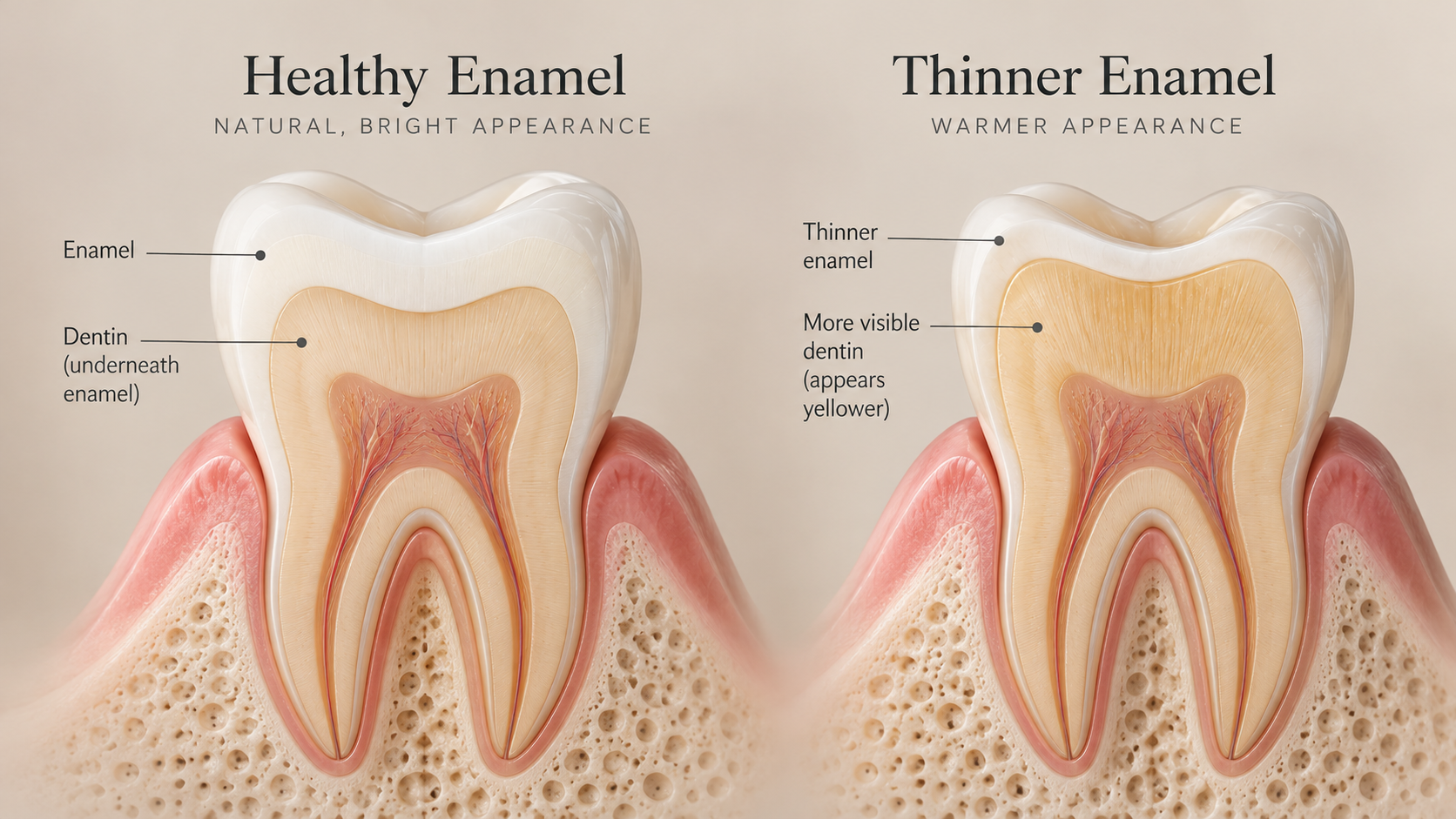
That is why aggressively polishing a tooth in pursuit of a whiter appearance can become counterproductive. If tooth structure is already thin or worn, I am much more interested in protecting what remains than repeatedly trying to polish the tooth brighter.
More abrasive does not necessarily mean more white. The goal is a brighter smile without sacrificing healthy tooth structure.
I also want to be careful with the word "damage." Normal brushing with an appropriately formulated toothpaste is not the same thing as grinding away your enamel every morning. Studies have found whitening toothpastes that produced little clinically relevant enamel wear, while other formulations produced greater wear under experimental conditions.
That variability is exactly why I do not think every product with the word whitening on the tube should be treated as if it were interchangeable.
Is it safe to use whitening toothpaste every day?
For many people with healthy teeth, an appropriately formulated whitening toothpaste used with good brushing technique may be perfectly reasonable. I would not tell every patient to throw away a whitening toothpaste simply because it says whitening on the label.
I become more cautious when someone already has signs of tooth wear, exposed root surfaces, gum recession, significant sensitivity, an acidic diet, or a habit of brushing very aggressively.
- Your teeth are becoming increasingly sensitive. Sensitivity has many possible causes, but a change is worth paying attention to rather than simply brushing through it. If the sensitivity appeared suddenly, my guide to sudden tooth sensitivity explains some of the reasons I would want to look more closely.
- You have exposed root surfaces. Root dentin is not protected by the same enamel covering as the crown of the tooth and deserves a different level of caution.
- You already have visible tooth wear. Notches near the gumline, thinning edges, or other changes should be evaluated before assuming that stronger polishing is the answer.
- You brush very hard. More pressure does not equal cleaner teeth. Technique matters just as much as the toothpaste you put on the brush.
- You keep changing to more aggressive products because your teeth are not getting lighter. At that point, the problem may simply be that surface stain is no longer what is determining your tooth color.
What if whitening toothpaste isn't making my teeth any whiter?
There is a point where removing more surface stain cannot make a tooth substantially lighter because you are already looking at the natural color of the tooth.
That is when I want to know what you are actually trying to change. Are we dealing with coffee stain on otherwise light teeth? A naturally warmer tooth shade? Thin enamel? Gray or deeper discoloration? Existing crowns or bonding that will not respond to bleaching?
Those are different problems, and they should not all be treated with a more aggressive toothpaste.
If the problem is surface stain
Cleaning and stain removal may be enough
A suitable toothpaste and routine professional cleanings may help maintain a cleaner, brighter surface without trying to bleach the underlying tooth.
If you want a lighter tooth shade
Whitening is a different conversation
Peroxide-based whitening is designed to change tooth color rather than relying primarily on polishing away external stain. If you are considering it, I also explain how long teeth whitening can last and why maintenance varies from person to person.
In our office, I use KöR teeth whitening when professional whitening is appropriate. The point is not that everyone using whitening toothpaste needs professional treatment. Most do not. It is simply important to use the right tool for the change you are actually trying to make.
So, should you stop using whitening toothpaste?
Not necessarily.
I would rather have you understand what is in your routine and why you are using it. If a whitening toothpaste keeps superficial staining under control, your teeth and gums are healthy, and you are not developing sensitivity or wear, there may be no reason to change something that is working well for you.
But if you are continually reaching for stronger whitening products because your teeth are not becoming lighter, I would stop chasing the label for a moment.
Sometimes the color you are seeing is not stain anymore. It is the tooth itself. And sometimes what looks like a whitening problem is actually something I would rather identify during a dental exam before you spend more money trying to scrub it away.
And if color is only one part of what you would like to change, that becomes a broader cosmetic dentistry conversation rather than simply a question of finding a stronger whitening product.
I am much more interested in keeping your enamel healthy than making you win a battle with a toothpaste tube. Healthy teeth come first. Then we can decide how bright you want them.
Key takeaways
Whitening toothpaste can help. It just isn't harmless by definition.
- 01 Whitening toothpastes can reduce surface staining and make teeth look visibly brighter.
- 02 Many whitening formulas use abrasives as part of their stain-removing action, and abrasivity varies by product.
- 03 Some whitening toothpastes have caused greater enamel or dentin wear than comparison toothpastes in experimental studies, while others have not.
- 04 Whitening toothpaste primarily addresses external stain. Peroxide whitening works through a different mechanism when the goal is to change the shade of natural teeth.
- 05 If your teeth are sensitive, worn, or have exposed root surfaces, it is worth asking your dentist whether your current toothpaste is a good fit.
Frequently asked questions
A few questions I hear most.
Can whitening toothpaste damage enamel?
It depends on the formulation and the conditions in which it is used. An in vitro study comparing several commercial whitening toothpastes found that some produced greater wear on eroded enamel than others. Importantly, the results were not uniform across every whitening product, which is why the label alone does not tell us how abrasive a toothpaste will be. The study is available on PubMed.
Does whitening toothpaste actually whiten teeth?
It can make teeth look whiter, particularly by reducing external staining. A 2025 systematic review and meta-analysis of randomized controlled trials found that whitening dentifrices significantly reduced the area and intensity of tooth surface stains compared with regular dentifrices. That is different from saying every whitening toothpaste substantially bleaches the intrinsic color of a tooth. Read the systematic review on PubMed.
Is whitening toothpaste more abrasive than regular toothpaste?
Some are, but not all whitening toothpastes behave the same way. Laboratory testing of commercial dentifrices has found a wide range of dentin abrasion values. Products marketed as whitening were generally more abrasive in that study, particularly many silica-based formulations, but stain-removing ability did not increase in a simple one-to-one relationship with abrasivity. See the study on PubMed.
Are all whitening toothpastes bad for your teeth?
No. That would be much too broad a conclusion. Research on a calcium carbonate and perlite whitening toothpaste, for example, found effective extrinsic stain removal without a clinically relevant level of enamel wear or a significant increase in dentin wear compared with the non-whitening formulations evaluated. The better conclusion is that formulations differ and should be evaluated individually. Read the review on PubMed.
Can whitening toothpaste wear down exposed dentin?
This is one reason I am more cautious when root surfaces are exposed. In an in situ study, a whitening dentifrice produced greater wear of both sound and eroded dentin than the regular dentifrice used for comparison. Another laboratory study found that some commercial whitening toothpastes increased wear of eroded dentin, while others did not. The formulation matters. One study can be reviewed on PubMed , along with the later comparison of commercial whitening toothpastes.
Is charcoal whitening toothpaste more abrasive?
It can be. A laboratory study comparing several whitening toothpastes found the charcoal-containing product in that particular experiment produced the greatest dentin surface loss. That does not establish that every charcoal toothpaste is more abrasive than every conventional toothpaste, but it is a good reason not to assume that "natural" or charcoal-based automatically means gentler. Read the study on PubMed.
Can whitening toothpaste change my natural tooth color?
Whitening toothpastes use several different mechanisms, including abrasives, anti-stain ingredients, optical agents, and in some formulations peroxide. A review of modern whitening methods describes abrasives primarily as a way to mechanically remove stains, while peroxide works by oxidizing colored compounds. This is why polishing away external stain should not be confused with the bleaching effect expected from a dedicated peroxide whitening treatment. Read the review on PubMed.
Why can thinner enamel make teeth look more yellow?
Tooth color is produced by the interaction of enamel and the dentin underneath it. Enamel is translucent rather than completely opaque, so the underlying dentin contributes to the color we perceive. This is one reason tooth color cannot be understood simply as "white enamel" sitting on the outside of a tooth. A review of the optical properties involved in tooth whitening discusses the different mechanisms used to alter or influence perceived tooth color. Review the paper on PubMed.
What should I do if whitening toothpaste isn't making my teeth whiter?
I would first figure out whether the color you are trying to change is actually surface staining. Research supports whitening dentifrices for reducing extrinsic tooth discoloration, but whitening products do not all work through the same mechanism or address every type of discoloration. If surface stain has already been removed, moving to a more abrasive toothpaste may not address the reason your teeth look the way they do. A systematic review of whitening dentifrices and extrinsic stain is available on PubMed.