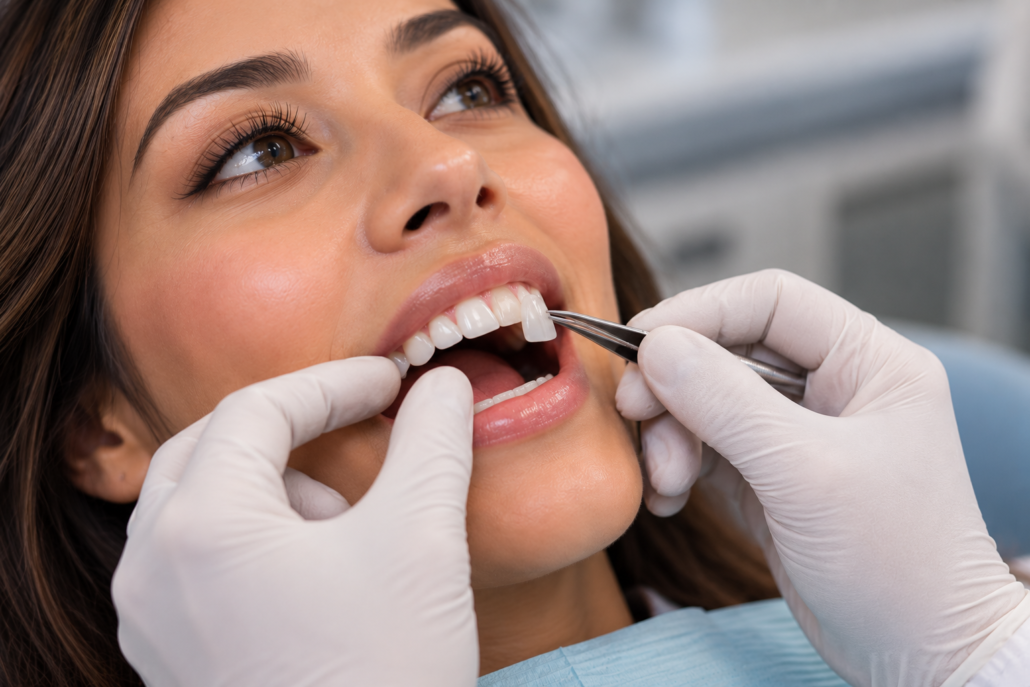
Patients often come in knowing they want a better smile but not knowing what treatment they need.
That's completely reasonable.
You shouldn't have to diagnose your own smile before seeing a dentist.
Instead of beginning with, "Do I need veneers?" or "Should I get Invisalign?" I usually start with a much simpler question:
What is it about your smile that you would actually like to change?
Maybe the teeth look darker than they used to. Maybe one edge is chipped. Maybe the front teeth overlap. Maybe they're straight but their proportions have never looked quite right to you.
Those are different problems, and they don't all need the same solution.
Good cosmetic dentistry begins by separating those concerns before deciding how to treat them.
What can cosmetic dentistry actually change?
When I evaluate a smile, I'm not looking for one definition of "perfect teeth."
I'm looking at several characteristics and how they work together: color, alignment, shape, proportion, spacing, tooth position, and the relationship between the teeth, lips, and gums.

Color
Teeth can become darker, yellower, or more uneven in color with age, diet, medications, previous dental treatment, and changes within the teeth themselves.
Alignment and spacing
Teeth may overlap, rotate, lean, or have spaces between them. Sometimes moving the teeth is the best solution. Other times, a small spacing issue can be addressed by changing tooth shape.
Shape
Chips, worn edges, naturally narrow teeth, uneven contours, or asymmetry can change the overall appearance of a smile even when the teeth are otherwise healthy.
Proportion
A tooth can be perfectly healthy and still look too short, too narrow, or out of proportion with the teeth beside it. Small changes in proportion can sometimes change the entire balance of a smile.
The design serves your face. Your face doesn't have to conform to a template.
That's an important distinction because cosmetic dentistry should not be about making everyone's teeth look the same.
The goal is to understand what is drawing your eye and decide whether changing it would make the smile feel more balanced while still looking like you.
If the problem is color, start with the simplest solution
If you like the size, position, and shape of your teeth and simply wish they were brighter, I don't want to change healthy tooth structure unnecessarily.
That's where professional teeth whitening can be such a useful treatment.
Whitening changes color while leaving the shape and position of the teeth alone.
But not every discoloration responds the same way.
When whitening may be enough
You like your teeth. You just want them brighter.
- General yellowing or darkening
- Age-related color change
- Surface staining
- Uneven brightness that responds to bleaching
When we may discuss something else
Color isn't the only thing you want to change.
- Deep intrinsic discoloration
- A single tooth that is substantially darker
- Existing restorations that no longer match
- Color combined with shape or proportion concerns
Existing crowns, veneers, and fillings don't whiten the way natural enamel does. That matters when we're planning a brighter smile because sometimes the sequence of treatment is just as important as the treatment itself.
If we're planning new porcelain restorations and you also want whiter natural teeth, I generally want to establish the natural tooth shade first and then design the porcelain to match.
What if you want to change the shape of your teeth?
Shape is where cosmetic dentistry becomes much more interesting, because even a very small change can alter how the entire smile reads.
Maybe one front tooth has a chipped corner. Maybe the lateral incisors have always looked small. Maybe years of grinding have flattened edges that used to be more youthful.
We don't necessarily need the same treatment for all of those situations.
Cosmetic bonding
For smaller, additive changes.
Tooth-colored composite can sometimes repair a chip, add a little length, reshape an edge, or close a small space without requiring porcelain.
It can be an especially conservative option when the change we're making is relatively small.
Porcelain veneers
When we're redesigning more than one characteristic.
Porcelain veneers can change color, shape, length, width, proportion, and symmetry at the same time.
They make more sense when the design change is substantial enough that bonding alone isn't the most predictable solution.
More treatment isn't automatically better treatment. The right amount is the amount your smile actually needs.
What if your teeth are crooked or have spaces?
This is where I want to distinguish changing the appearance of alignment from actually moving the teeth.
Veneers can alter the visible shape of selected teeth, and bonding can sometimes close a small gap. But neither one physically moves the roots into new positions.
Invisalign does.
Move the teeth
When position is the real problem.
If teeth are crowded, rotated, noticeably out of position, or the bite needs correction, orthodontic movement may be the more conservative solution because we're changing position rather than covering the teeth.
Change the tooth
When shape is creating the appearance of a space.
A small gap between narrow teeth, a chipped edge, or a minor proportion issue may sometimes be improved with bonding or veneers without orthodontic treatment.
And sometimes the best answer is both.
We can use Invisalign to put the teeth in better positions first, then make smaller cosmetic changes afterward. That can allow us to be more conservative with the final restorations.
Sometimes moving the tooth first means changing less of the tooth later.
What if the problem isn't purely cosmetic?
A smile concern can look cosmetic from the outside while actually being structural underneath.
A heavily broken tooth, a tooth with extensive decay, or a missing tooth needs a different conversation than a healthy tooth that is simply the wrong color or shape.
That's where restorative dentistry and cosmetic dentistry begin working together.
- A damaged but savable tooth may need a crown. A dental crown surrounds and protects more of the tooth than a veneer.
- A missing tooth may need to be replaced. Depending on the situation, a dental implant or another restorative option may be appropriate.
- Several worn or damaged teeth may require a broader plan. In those cases, we're no longer simply choosing a cosmetic procedure. We're thinking about function, structure, bite, longevity, and appearance together.
This is why I don't separate "cosmetic" from "restorative" as sharply as patients sometimes expect.
A front crown still has to look beautiful. An implant crown still has to belong in the smile. A veneer still has to function as a tooth.
The categories help us describe treatment. Your mouth doesn't know which category the insurance form puts it in.
How do we decide which cosmetic treatment you actually need?
This is the part I don't want patients trying to solve from a list of procedures online.
We start with the change you want, then work backward.

Tell me what catches your eye
I want to know what you notice when you look at your smile before I tell you what I notice.
Those aren't always the same thing.
Make sure the teeth are healthy
Cosmetic work needs a healthy foundation. Decay, gum disease, fractures, failing restorations, and bite problems may need to be addressed before we start changing the appearance.
Separate color, position, and shape
Once we know which part of the smile is bothering you, the treatment choices become much clearer.
Choose the least invasive predictable solution
If whitening solves the problem, we don't need veneers. If moving the teeth solves it, I don't want to remove healthy enamel simply to make crooked teeth look straight.
Design the treatments together when there is more than one
When a smile needs a combination of whitening, orthodontics, bonding, veneers, crowns, or implants, sequence matters.
I want to know where we're going before we begin the first step.
What if you want to change several things at once?
That's when the conversation becomes less about an individual procedure and more about a smile plan.
One patient might need whitening and a little bonding. Another might benefit from Invisalign followed by two veneers. Someone else may have old crowns, worn teeth, and a missing tooth that all need to be considered together.
A smile makeover isn't a specific procedure. It's the planning process that allows several procedures to work toward the same result.
And sometimes the best plan is surprisingly small.
The goal isn't to make your smile look "done." It's to make the things bothering you stop drawing your attention.
I like a result that makes someone look refreshed, healthy, and confident without making everyone around them wonder what dental work they had.
Key takeaways
Start with what you want to change, not with the procedure.
- 01 Cosmetic dentistry can change tooth color, shape, proportion, spacing, and the appearance of alignment.
- 02 Whitening is often the most conservative choice when color is the only concern.
- 03 Bonding and veneers change tooth shape, while Invisalign actually moves teeth into different positions.
- 04 A tooth that is damaged or missing may need restorative treatment rather than a purely cosmetic procedure.
- 05 Combining treatments can sometimes allow each individual treatment to be more conservative.
- 06 The best treatment plan solves the concerns that matter to you without changing healthy tooth structure unnecessarily.
Frequently asked questions
A few questions patients ask most.
What is considered cosmetic dentistry?
Cosmetic dentistry refers broadly to dental treatment intended to improve the appearance of the teeth and smile. Depending on what we're changing, that can include whitening, bonding, veneers, orthodontic treatment, and restorations that have both functional and cosmetic goals. The important distinction is that these treatments don't all accomplish the same thing, so the diagnosis still comes before the procedure.
Does professional teeth whitening damage enamel?
When appropriately used, tooth bleaching is considered a conservative approach to changing tooth color. The most common side effects are temporary tooth sensitivity and gingival irritation rather than permanent destruction of enamel. A systematic review and meta-analysis of bleaching-related tooth sensitivity evaluated sensitivity associated with different concentrations of hydrogen peroxide used for in-office bleaching.
Is bonding more conservative than porcelain veneers?
It can be, particularly when we're making a small additive change. Direct composite can often be added to a tooth with little or no preparation, whereas traditional porcelain veneers may require some enamel preparation. The tradeoff is that composite and porcelain have different optical properties, wear characteristics, and long-term maintenance needs, so "more conservative" doesn't automatically mean "better" for every case.
How long do porcelain veneers last?
Porcelain veneers can provide long-term service when appropriately planned, bonded, and maintained. A systematic review and meta-analysis of porcelain veneers found high estimated long-term survival, although outcomes varied among the included studies and clinical situations.
Is Invisalign better than veneers for crooked teeth?
They solve different problems. Invisalign moves teeth. Veneers change the visible surfaces and proportions of teeth. If tooth position is the main issue, orthodontic treatment may allow us to correct that position without preparing healthy teeth simply to create the appearance of alignment. A systematic review of clear aligner treatment evaluated the predictability of tooth movements with clear aligners and found that predictability varies by the type of movement being attempted.
Can Invisalign and veneers be used together?
Yes. In selected cases, moving teeth into better positions first can allow the final veneers or bonding to be more conservative. Clear aligners are capable of producing several types of orthodontic tooth movement, although their predictability varies depending on the movement. A systematic review of Invisalign treatment accuracy discusses those differences in predictability.
Can cosmetic dentistry fix a chipped front tooth?
Often, yes, but the treatment depends on how much tooth was lost and whether the remaining tooth is healthy. Small chips may be restored with direct composite bonding. Larger structural damage can require a different restoration. The important first step is determining whether we're treating a cosmetic edge defect or a more significant fracture.
Can veneers close gaps between teeth?
Sometimes. Porcelain veneers can change tooth width and proportion, which can close selected spaces. But a gap may also be related to tooth position, tooth size, or other anatomical factors. That's why I don't automatically treat every space with porcelain. Sometimes orthodontic movement, bonding, veneers, or a combination produces a more balanced result.
Will veneers make my teeth look too big or too white?
They shouldn't if the case is designed appropriately. Veneer treatment involves decisions about width, length, edge position, translucency, surface texture, and shade. I don't think the goal should be the whitest or largest teeth we can make. The goal is a proportion and color that make sense for your smile and face.
Can cosmetic dentistry replace a missing tooth?
Replacing a missing tooth is fundamentally restorative, although the final result has an important cosmetic component. Dental implants are one option for replacing missing teeth. A systematic review of contemporary dental implants reported high estimated long-term implant survival, while also showing why maintenance and follow-up remain important over time.
Do I need healthy gums before cosmetic dental work?
Healthy periodontal tissues are an important foundation for cosmetic and restorative dentistry. Gum inflammation, recession, or periodontal disease can affect both the appearance and long-term stability of dental treatment. I want those conditions understood and appropriately managed before we finalize a cosmetic plan.
How do I know which cosmetic dental treatment I need?
Start with the problem rather than the procedure. If the concern is color, whitening may be enough. If it's tooth position, orthodontics may make more sense. If it's shape or proportion, bonding or veneers may be appropriate. And if a tooth is structurally damaged or missing, the conversation becomes restorative as well as cosmetic. The examination tells us which of those situations we're actually treating.