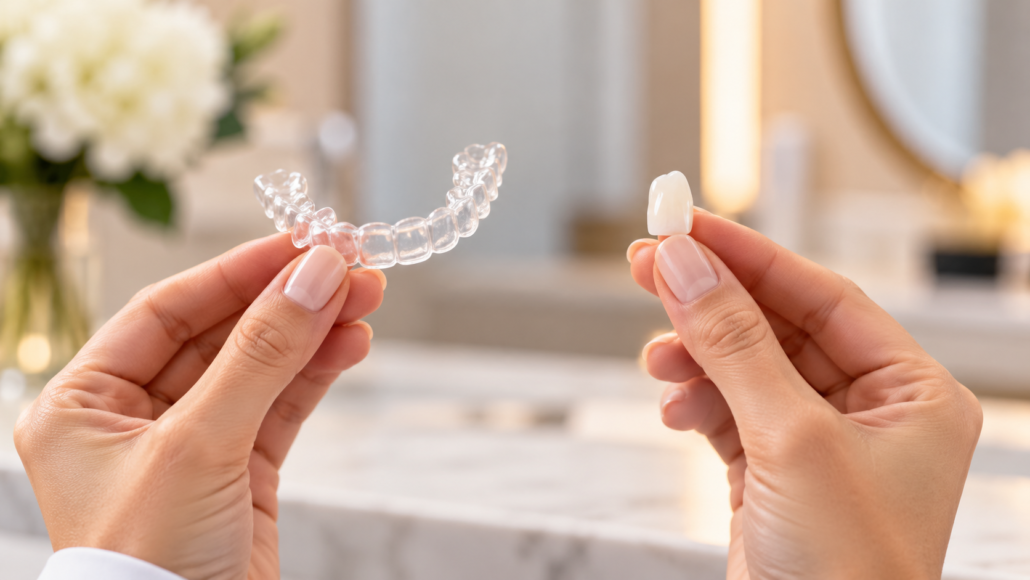
When I hand a patient their first set of Invisalign aligners, there's something almost deceptively simple about them.
They're thin. They're clear. And at first glance, each one looks remarkably similar to the next.
But those trays didn't begin as pieces of plastic.
They began with a digital model of that patient's teeth and a plan for where we want those teeth to go.
An Invisalign aligner isn't simply made to fit your teeth. It's made to fit the next position we want your teeth to move toward.
That's the part of Invisalign treatment I think is easiest to overlook.
You're not wearing the same appliance throughout treatment. You're moving through a series of individually manufactured aligners, with each one representing another small step in the treatment plan.
Here's how we get from your teeth to that series of clear trays.
How are Invisalign aligners made?
The process is almost entirely digital until the physical aligners are manufactured.
We first capture the shape and position of your teeth. That information becomes a three-dimensional model. From there, we plan how the teeth should move and divide that movement into a sequence of smaller stages.
Invisalign then manufactures a series of custom aligners based on that plan.

That means your aligners aren't selected from standard sizes. They're created specifically for the anatomy of your mouth and the tooth movements we've planned.
Step one: It starts with a digital scan
Before we can plan where the teeth are going, we need an accurate record of where they are now.
An intraoral scanner captures the surfaces of the teeth from many different angles and combines that information into a three-dimensional digital model.
We can rotate that model, examine individual teeth, look at the relationship between the upper and lower arches, and evaluate the bite in ways that aren't possible from a single photograph.
This digital model becomes the starting point for the aligner treatment plan.
But it's important to understand what the scan does and what it doesn't do.
The scanner records your teeth. It doesn't decide where they should end up.
Step two: We plan where the teeth should move
Once we have the digital model, treatment planning begins.
This is where Invisalign becomes much more than a manufacturing process.
The software allows us to visualize proposed tooth movements, but software isn't the same thing as diagnosis.
I still have to decide what I'm trying to accomplish.
Which teeth need to move? How much space do we need? How should the bite come together? Does a tooth need to rotate, tip, move bodily, intrude, or extrude? Is the proposed final position actually appropriate for this patient?
And perhaps most importantly, does the digital plan make sense when I compare it with the person sitting in front of me?
The computer can show me a proposed result. My job is deciding whether it's the right result.
This is one reason two patients with seemingly similar crooked teeth may have very different Invisalign treatment plans.
We're not simply straightening individual teeth. We're planning how an entire system should function together.
Step three: One treatment plan becomes many smaller movements
Imagine trying to move every tooth from its starting position to its final position with one aligner.
It wouldn't work.
Instead, the planned movement is divided into a sequence of much smaller stages.
Each aligner corresponds to one of those stages.
That's why aligner number 12 is subtly different from aligner number 11. The differences may be difficult to see when you hold the trays next to each other, but they're intentional.

When you wear one aligner, it applies forces that encourage the teeth toward the positions represented by that tray.
Then you move to the next.
And the next.
The result is a progression rather than one large movement.
Step four: The physical aligners are manufactured
Once the treatment stages have been planned, those digital stages have to become physical appliances.
Invisalign manufactures the aligners from a proprietary clear thermoplastic material designed for orthodontic use.
Each tray is formed to correspond to a particular stage of the digital treatment plan and is finished so that it follows the patient's gumline and tooth anatomy.
What arrives at the dental office is therefore not one aligner reproduced many times.
It's a sequence.
If you put several of your aligners next to one another and look carefully, you may actually be able to see the planned progression in the shape and position of individual teeth.
Why does a new Invisalign aligner feel tighter?
Because it isn't made for exactly where your teeth are today.
It's made around the next planned stage.
When you first insert a new aligner, there may be a small discrepancy between the current position of a tooth and the position represented inside the new tray.
That's what allows the aligner to deliver force to the tooth.
As the teeth respond, the tray generally begins to feel less tight. Then, according to the prescribed wear schedule, you progress to the next stage.
This also explains why wearing the aligners consistently matters. The next tray assumes that the teeth have made enough progress through the previous stage.
What do Invisalign attachments have to do with the aligners?
Sometimes a smooth tooth doesn't give an aligner enough control for the movement we're asking it to make.
That's where attachments can help.
Invisalign attachments are small shapes made from tooth-colored dental composite and bonded temporarily to selected teeth.
The aligner is manufactured with corresponding areas that fit around those attachments.
Together, the attachment and the shape of the aligner can give us additional control over how force is applied to a tooth.
Not every tooth needs one, and not every patient needs the same arrangement.
Their number, position, and shape depend on what the treatment plan is asking individual teeth to do.
Why do some Invisalign aligners have bumps, cutouts, or other shapes?
Once you know that an aligner is manufactured around a treatment plan, these little details start making more sense.
The tray isn't designed simply to cover the teeth.
Its geometry can include features related to attachments, particular tooth movements, or other parts of treatment.
Some patients may also have cutouts or features that work with orthodontic elastics.
So if your aligners look more complicated than the perfectly smooth clear trays you see in an advertisement, that doesn't mean something went wrong.
Often, those details are there because we're asking the appliance to do more.
Is the digital Invisalign preview exactly what my teeth will do?
I wouldn't think of it that way.
A digital treatment plan is extraordinarily useful because it lets us plan and visualize movement before treatment begins.
But teeth are attached to bone through living tissues. Biology doesn't behave exactly like an animation.
Some movements are easier to accomplish with clear aligners than others. Individual teeth may also respond differently than expected.
That's why I don't view the initial digital plan as a promise that every tooth will arrive at every digitally predicted position without adjustment.
It's the plan we begin with.
Then we monitor what actually happens.
Why would I need another scan and more aligners?
This is usually what patients are referring to when they hear the word refinement.
Let's say you've completed the initial series of aligners.
Most of the teeth have moved beautifully, but a few haven't quite reached the positions we planned.
I don't want to pretend the original digital plan matters more than what I can actually see in your mouth.
We may scan the teeth again.
That new scan records where they really are now. We can then plan the remaining movements from that updated position and have additional aligners manufactured.
Refinement isn't starting over. It's adjusting the plan to what your teeth actually did.
To me, that's one of the strengths of a digital system. We can compare the plan with the clinical result and adapt when the two aren't identical.
Custom-made doesn't mean automatically planned
This distinction matters.
Invisalign uses sophisticated digital technology to manufacture extremely customized appliances.
But manufacturing a custom aligner and planning good orthodontic treatment are not the same job.
The aligner can only express the treatment we're asking it to deliver.
That's why I care about the bite, the position of the roots, the amount and direction of movement, the periodontal health, the patient's goals, and what we're ultimately trying to accomplish with the smile.
The technology gives us a remarkable tool.
The treatment still needs judgment.
From a digital plan to something you wear every day
I think understanding how aligners are made changes the way you look at that little clear tray.
It isn't just a retainer-shaped piece of plastic.
It's a physical representation of one small stage in a much larger treatment plan.
Your first aligner represents the beginning. Your last planned aligner represents where we hoped that sequence would take us. And everything between those two trays is a series of controlled, incremental changes.
That's what makes clear aligner treatment so interesting to me.
The technology can be very sophisticated, but what the patient experiences is wonderfully simple:
Wear this aligner. Let it do its work. Then move to the next one.
Key takeaways
What to remember about how Invisalign aligners are made.
- 01 Invisalign treatment begins with a digital model of your own teeth and bite.
- 02 The treatment plan determines where the teeth should move before the physical aligners are manufactured.
- 03 The planned movement is divided into smaller stages, with a different custom aligner representing each stage.
- 04 Attachments and other aligner features can help deliver particular types of tooth movement.
- 05 Digital predictions and actual biological tooth movement are not always identical.
- 06 Refinement aligners allow the treatment plan to be updated when additional movement is needed.
Frequently asked questions
A few questions patients ask most.
How does Invisalign get a model of my teeth?
Digital intraoral scanners can capture the surfaces of the teeth and create a three-dimensional model for orthodontic planning. A systematic review of intraoral scanning in orthodontics found digital scanning to have satisfactory to excellent reproducibility in the included studies, while also reporting shorter scanning time and improved patient comfort compared with conventional impressions.
Does the computer decide how my teeth should move?
No. Digital software is a planning and visualization tool. The clinician still has to diagnose the problem, evaluate the bite, and decide whether the proposed movements and final positions make clinical sense. Research comparing predicted with achieved clear-aligner movement shows why that clinical oversight matters. A systematic review of digital aligner treatment planning found that the predictability of tooth movement varies substantially by the type of movement being attempted.
Are all of my Invisalign trays exactly the same?
No. Each aligner corresponds to another planned stage of treatment. The differences between consecutive trays can be quite subtle, but those changes are what create the sequence of forces used to move teeth. A systematic review of Invisalign tooth movement evaluated the system specifically as a method of producing planned orthodontic movements through a sequence of plastic aligners.
What material are Invisalign aligners made from?
Invisalign uses a proprietary thermoplastic aligner material commonly referred to as SmartTrack. Material properties matter because an aligner has to remain flexible enough to be inserted and removed while still delivering orthodontic force. A systematic review and meta-analysis of SmartTrack aligners after intraoral use found measurable changes in surface morphology and mechanical properties after the aligners had been worn.
Why does each new aligner feel tight?
A new aligner represents the next planned stage rather than exactly duplicating the current position of your teeth. That difference allows the appliance to deliver orthodontic force. The timing of aligner changes is therefore part of treatment planning. A systematic review of clear-aligner wear protocols found that 7-, 10-, and 14-day schedules produced broadly similar movement efficacy in most comparisons, although some movements performed better with longer wear in individual studies.
What do Invisalign attachments actually do?
Attachments create additional surfaces for an aligner to engage and can help control the direction of force applied to a tooth. Their effectiveness depends on the movement being attempted, and one attachment design is not necessarily superior for every situation. A systematic review and meta-analysis comparing optimized and conventional Invisalign attachments found no significant overall difference for several movements and concluded that superiority remains inconclusive.
Will my teeth move exactly as the Invisalign simulation predicts?
Not necessarily. The simulation represents the planned movement, while the mouth is a biological system. Different movements have different levels of predictability. A systematic review examining Invisalign movement of upper incisors found substantial variation in accuracy depending on the type of movement and noted that refinements were often required in the included studies.
Are some tooth movements harder for clear aligners than others?
Yes. Predictability depends on the tooth, direction of movement, amount of movement, attachments, and other biomechanical factors. A systematic review of clear-aligner tooth movement found meaningful differences in the control of intrusion, extrusion, rotation, inclination, and molar movement, although the authors cautioned that the evidence was heterogeneous.
Why might I need Invisalign refinement aligners?
Refinements are used when the teeth don't completely match the planned positions after an initial series. Rather than relying on an outdated model, we can capture the new positions and plan the remaining movement from there. A systematic review of refinement after an initial clear-aligner series identified multiple clinical, biomechanical, and digital factors associated with the need for additional aligners.
Does needing refinements mean Invisalign didn't work?
No. A refinement means we're responding to the actual tooth positions rather than assuming every digitally planned movement occurred exactly as predicted. Clinical studies repeatedly show differences between planned and achieved movement. A systematic review of Invisalign accuracy reported that refinements were often necessary in the studies it evaluated.
Does it matter how many hours a day I wear the aligners?
Yes. Clear aligners can only deliver their intended forces while they're seated on the teeth. Your wear schedule and the interval between trays should follow the instructions given for your treatment rather than a schedule you choose yourself. A systematic review evaluating aligner wear protocols found that the optimal change interval may vary with the movement being attempted and emphasized the role of clinical judgment in more complex situations.
Are Invisalign aligners custom-made for each patient?
Yes. Clear-aligner treatment uses a patient's digital dental anatomy and planned tooth positions to create a customized sequence rather than choosing trays from a set of standard tooth arrangements. Digital scanning has become an important part of that workflow. A critical review of intraoral scanners in orthodontics describes their use for digital impressions and computer-aided orthodontic workflows while also noting that operator experience remains important.