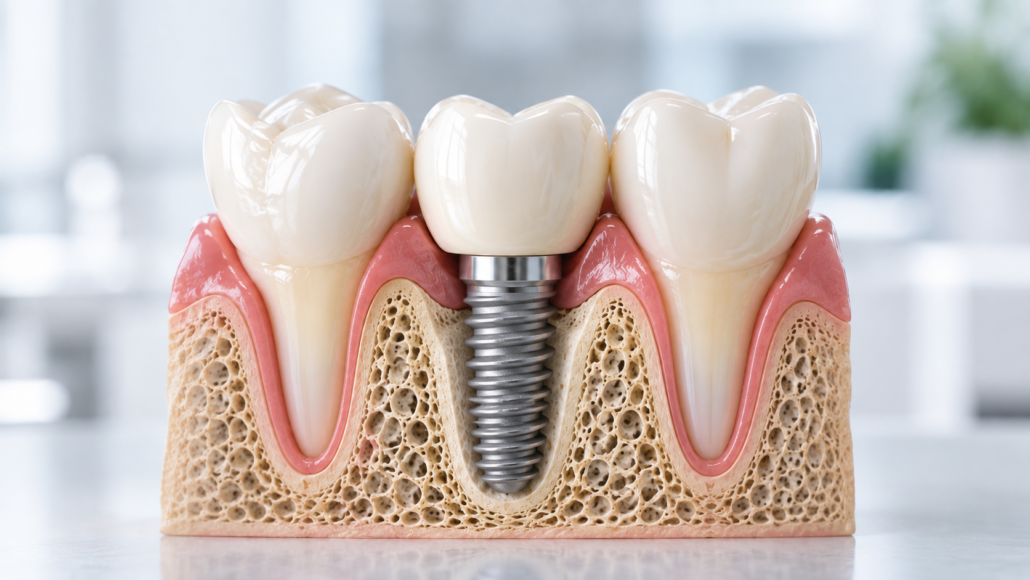
If you're replacing all of your teeth, there are more choices than there used to be. A well-made traditional denture can restore a complete smile without surgery. Dental implants can also be used to help retain a removable denture so it feels more secure.
On a treatment plan, those can sound like two versions of the same thing. In everyday life, the difference can be much more noticeable. It comes down to how the denture is supported, how much it moves, what is involved in treatment, and how you want to live with it.
Our dentures page explains the different ways we can replace missing teeth. Here, I want to focus on one specific decision: whether adding implants to retain a removable denture is worth it for you.
You don't need implants simply because you're getting dentures. You need to understand what the implants would actually change for you.
Traditional dentures vs. implant-supported dentures
Both can replace a full arch of missing teeth. Both can be removed from the mouth, depending on the implant design being discussed. The major difference is what helps keep the denture in position.
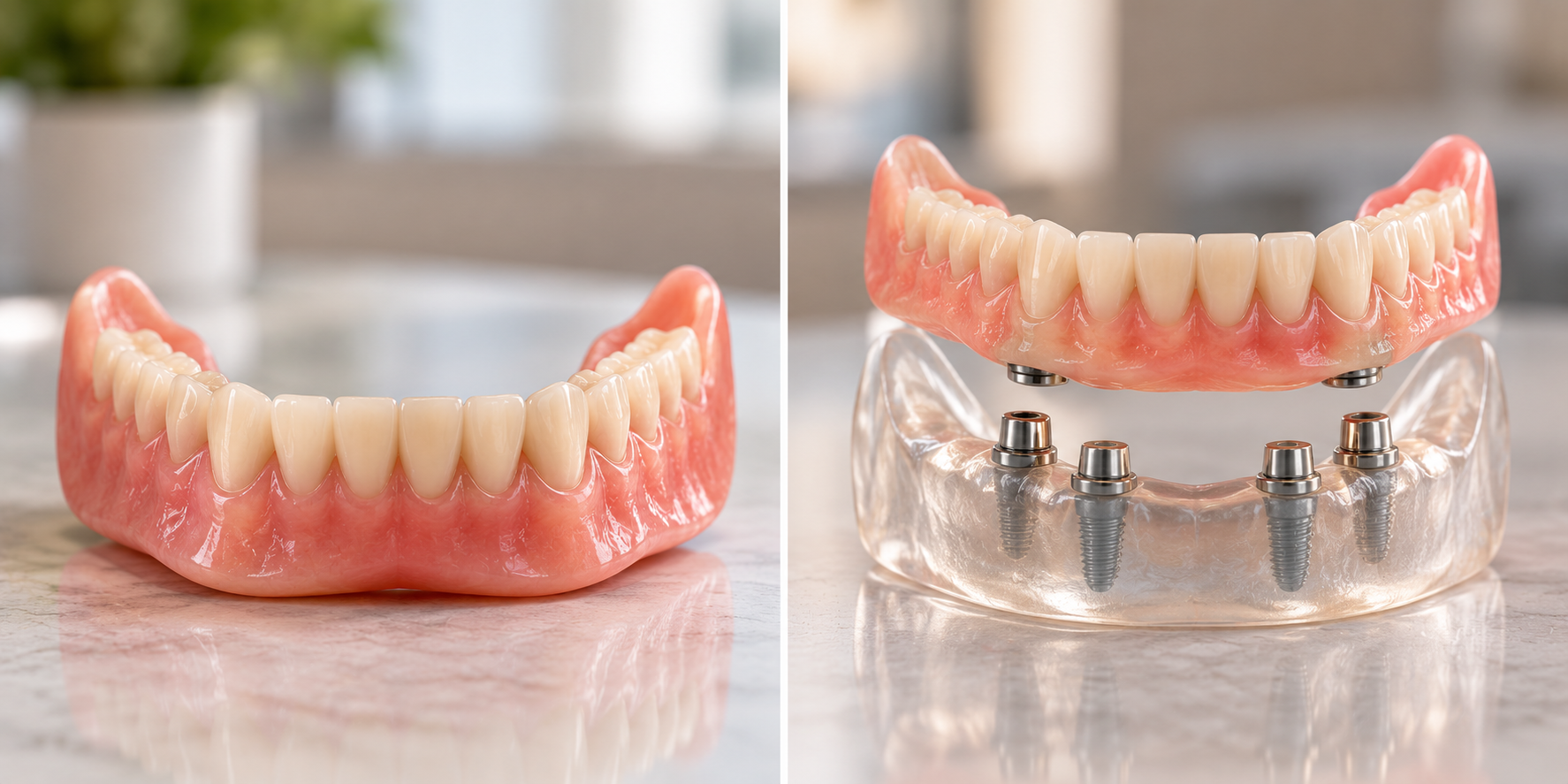
Traditional Dentures
Supported by the mouth
A conventional complete denture is shaped to fit over the gums and underlying tissues. Its fit, the anatomy of your mouth, saliva, muscle control, and sometimes denture adhesive all contribute to how secure it feels.
Implant-Supported Dentures
Retained by implants
Dental implants are placed in the jaw and fitted with attachments that connect to the denture. The denture is still removable in an overdenture design, but the implants give it mechanical retention that a conventional denture does not have.
A traditional denture can work very well
I don't think traditional dentures should be described as the inferior option. For many patients, they are an appropriate and practical way to replace missing teeth. They don't require implant surgery, treatment is generally less involved, and they can restore appearance and function very effectively.
The limitation is that the denture does not physically attach to the jaw. It relies on its relationship with the tissues underneath it. That can work beautifully when the anatomy is favorable and the denture fits well.
It can be more challenging when there is less ridge available to support the denture, particularly in the lower jaw. The tongue, cheeks, and movement of the floor of the mouth all share a fairly small space with a lower denture. Some people adapt very well. Others continue to feel movement even with a carefully made prosthesis.
What do the implants actually change?
They give the denture something to attach to. Instead of relying entirely on the shape of the gums and jaw for retention, the denture connects to attachments associated with implants placed in the bone.
For a patient who is comfortable with a conventional denture, that additional retention may not solve an important problem. For someone whose lower denture moves when they chew, speak, laugh, or yawn, it can be a meaningful change.
More retention
The denture connects to attachments instead of relying entirely on the tissues underneath it to remain in place.
Less movement
Added retention can reduce the rocking or lifting that some patients experience with conventional dentures.
More confidence in function
When the denture feels more stable, eating and speaking may feel less like something you have to think about.
More treatment
Implants also mean surgery, healing, additional components, additional cost, and another part of the restoration that needs ongoing care.
The difference is often most noticeable with a lower denture
Upper and lower dentures don't behave exactly the same way. A traditional upper denture has a broad area of the palate available for support. A lower denture has much less surface area and has to coexist with a very active tongue.
That's why a patient can be perfectly comfortable with an upper traditional denture but frustrated by the lower one. It may lift when eating, move during conversation, or simply never feel as secure as the patient would like.
In that situation, implants are not necessarily about replacing the denture. They're about giving the lower denture a more secure connection to the jaw.
Can you eat better with implant-supported dentures?
Often, stability is what changes the experience. A denture that moves while you're chewing can make certain foods frustrating even when the teeth themselves are perfectly capable of breaking the food down.
When implants help stabilize the denture, patients may feel more confident using it. That doesn't mean implant-supported dentures suddenly function exactly like natural teeth. They are still prosthetic teeth, and there is still an adjustment period.
The practical difference is that you're asking the denture to do its job while giving it a more secure foundation.
What about speaking and comfort?
Any new denture can feel unfamiliar at first. Your tongue has to learn the shape of it, your muscles adapt, and speech can temporarily feel different while you get used to the new contours.
Stability can make that adaptation easier for some patients because the denture is less likely to move unexpectedly. But implants don't make fit irrelevant. The denture still has to be designed carefully for your mouth, bite, facial proportions, and the way you speak.
A poorly designed denture doesn't become a good denture just because implants are underneath it.
Implant-supported doesn't always mean fixed
This is one of the most important distinctions to understand. Patients sometimes hear "implant-supported dentures" and picture a set of teeth that never comes out.
An implant-retained overdenture is typically designed to be removable. It connects securely to the implants while you're wearing it, then you remove it for cleaning. There are also fixed full-arch implant restorations, but that is a different treatment concept with different requirements, maintenance, and cost.
When comparing options, make sure you know whether the proposed restoration is removable or fixed. "Implant teeth" can mean very different things.
Implants add stability, but they also add maintenance
Traditional dentures need to be cleaned, evaluated for fit, and adjusted or relined as the mouth changes. Implant-retained dentures need all of that plus care around the implants and attachment components.
The small parts that help the denture snap or connect into place can wear. Retention can change. Inserts or other components may eventually need replacement. The denture itself can also need adjustments over time.
That isn't a reason not to choose implants. It's simply part of the decision. If we're adding mechanical components to make the denture more stable, those components become part of what we maintain.
Which one is easier to clean?
A traditional removable denture is straightforward in the sense that it can be removed and cleaned outside the mouth. The gums and oral tissues also need daily care.
A removable implant-supported denture can also be taken out for cleaning, but the implants and attachments in the mouth need careful attention too. Plaque doesn't stop mattering because natural teeth are gone.
For some patients, the removability of an overdenture is actually an advantage because both the prosthesis and the implant areas are accessible for cleaning. The important thing is being willing and able to maintain whichever design we choose.
Why do implant-supported dentures cost more?
You're adding an entirely separate phase of treatment. The plan may involve imaging, surgical placement of the implants, healing, implant components, restorative attachments, and the denture itself.
A conventional denture does not require that implant phase. That makes it the simpler treatment financially and surgically.
I wouldn't look at the additional cost of implants as paying for a more expensive version of the same denture. What you're paying for is the implant foundation and the retention it can provide. Whether that benefit is worth adding depends on what you need from the restoration.
Who may benefit most from implant-supported dentures?
I pay particular attention to what is bothering the patient now. If someone is comfortable, eats reasonably well, and feels confident with a traditional denture, I don't need to manufacture a problem for implants to solve.
The conversation becomes different when the denture itself is interfering with everyday life.
- Your lower denture moves frequently. You may notice it lifting or rocking while eating or speaking.
- You avoid foods because the denture feels unstable. Added retention may make function feel more predictable.
- You rely heavily on adhesive but still aren't comfortable. The underlying issue may be something worth evaluating rather than simply adding more adhesive.
- You feel self-conscious about the denture moving. Stability can matter socially as much as it does mechanically.
- You want more retention but still like a removable restoration. An overdenture can provide an implant connection while remaining removable for cleaning.
And when might traditional dentures make more sense?
Sometimes simplicity is valuable. A patient may not want surgery, may have medical or anatomical considerations that affect implant treatment, or may simply be comfortable with the function a conventional denture can provide.
Cost matters too. It is completely reasonable for that to be part of the treatment decision. The goal is not to push every patient toward the most involved option. It's to understand the tradeoffs clearly enough to choose intentionally.
More treatment isn't automatically better treatment. The right treatment is the one whose benefits matter enough to you to justify what it asks of you.
Start with what you want to change
If you don't have dentures yet, the decision starts with your anatomy, health, priorities, and the different ways we can replace your missing teeth. If you already wear dentures, I want to know what is working and what isn't.
"I hate my dentures" can mean many things. They move. They hurt. They look wrong. Eating is difficult. They're old. The bite has changed. Or sometimes the patient simply never had enough time and guidance to adapt to them.
Implants can solve some of those problems very well. They don't solve every denture problem, and that's why figuring out the problem comes before choosing the solution.
If you're still at the beginning of that decision, our dentures treatment page walks through full, partial, and implant-supported options and what the treatment process looks like.
Key takeaways
Implants change how a denture is retained. Whether you need that change is personal.
- 01 Traditional dentures rest on the oral tissues without attaching to dental implants.
- 02 Implant-retained dentures connect to implants for additional retention and stability.
- 03 The stability difference can be especially meaningful for patients who struggle with a conventional lower denture.
- 04 Implant treatment adds surgery, cost, hygiene requirements, and components that need ongoing maintenance.
- 05 A well-made traditional denture remains a reasonable option when it provides the comfort and function a patient needs.
Frequently asked questions
A few questions patients ask most.
Are implant-supported dentures more comfortable than regular dentures?
Many patients report greater comfort and satisfaction, particularly with lower implant-retained dentures. A systematic review and meta-analysis found better overall satisfaction, comfort, speech, chewing, and stability with mandibular implant-retained overdentures compared with conventional complete dentures.
Can you eat better with implant-supported dentures?
Improved stability can make chewing easier for many patients. A systematic review comparing conventional dentures with implant-retained overdentures found better masticatory performance and higher ratings for the ability to chew among patients with mandibular implant overdentures.
Do implant-supported dentures come out at night?
Implant-retained overdentures are removable even though they connect to implants while being worn. This differs from a fixed full-arch implant prosthesis. Published research on implant overdentures and fixed complete implant restorations treats them as distinct prosthetic designs with different characteristics and patient experiences.
Are implant-supported dentures better than traditional dentures?
They can provide important advantages when stability is a problem, but that doesn't make conventional dentures inappropriate for everyone. An umbrella review found greater satisfaction and oral health-related quality of life with implant-retained overdentures, with the benefit particularly noticeable among patients who wanted implant treatment or had difficulty adapting to conventional dentures.
Do implant dentures still need maintenance?
Yes. The denture, implants, and attachment components all require ongoing care. A systematic review of overdenture maintenance documented wear, loosening, and replacement of attachment components among the maintenance needs associated with implant overdentures.
Why are lower dentures harder to keep in place?
Lower dentures generally have less surface area available for support and must function alongside the tongue and other moving tissues. A systematic review noted lower retention with mandibular conventional complete dentures and substantial improvements in retention, stability, comfort, speech, and chewing after implant retention was added.
Can implants help if my current lower denture is loose?
They may. Implant retention is specifically useful when a conventional lower denture lacks adequate stability. Evidence comparing conventional mandibular dentures with implant-retained overdentures has shown meaningful improvements in patient-reported satisfaction and quality of life after implant retention was introduced.
How many implants do implant-supported dentures need?
There isn't one number for every patient or every prosthetic design. The jaw being treated, available bone, attachment system, and whether the restoration is removable or fixed all affect planning. Research on mandibular implant overdentures includes both single- and two-implant designs, which is why the appropriate number should come from the individual treatment plan rather than a universal rule.